By Casey First
The Red Crossbill (Loxia curvirostra) has long puzzled scientists due to variations in both the bird’s size and behavior. Red Crossbills in North America range in size from the smallest, no bigger than a Black-capped Chickadee, to the largest, about the size of a Red-winged Blackbird. One thing they have in common is a stocky body, a notched tail and, of course, a twisted bill that crosses in an X, giving them their name.
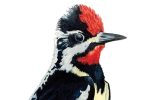
The male Crossbill’s body is a beautiful brick red color with a hint of light orange on its throat and much darker red wings. The female has a brownish and olive-green body with accents of dark yellow under her belly. The crossed bill that these birds have is designed to meticulously pry into the tightly closed scales of cones in the mature coniferous woodlands to which they flock. Once pried open, their treat is nutritious seeds from conifer cones like Douglas fir, hemlock, pine, spruce and larch.

David Ballard, artist
Red Crossbills’ variations in size are largely due to the conifer species they favor as a food source. They also don’t conform to typical species or even subspecies due to their nomadic and sporadic behavior, often following food sources out of their normal range (although not migratory) and co-mingling with other crossbills. These movements out of their normal range involve tens of thousands of birds traveling long distances in search of food (sometimes migrating to unfamiliar/new environments). Other species that “irrupt” like this are Snowy Owls and Evening Grosbeaks.
Red Crossbills are found year-round in most of the Rocky Mountain region of the US, the Pacific Northwest, much of Canada, in parts of Mexico and in small pockets in the Southern Appalachians mountain range. Lucky for us here in Western North Carolina, we get to see them year-round—if the conditions are right and we know where to look. The Red Crossbill we see is typically about the size of a Purple Finch and can be seen in parts of WNC that have higher elevation, like the Blue Ridge Parkway.
Their vocalizations—sharp kip-kip or jip-jip calls—are often the first sign of their presence as flocks fly high overhead through the trees. If you are lucky enough to have them make their way down into your yard, try offering black oil sunflower seeds or sunflower hearts to entice them to come to your bird feeder. Occasionally, they will show up to finch feeders, using their bills to carefully pry thistle from the feeder’s delicate openings.
Speaking of food, Crossbill nesting season is sometimes untraditional compared to other species of birds as they have been known to “follow the food.” Nesting is typically in late summer to early fall and/or late winter to early spring, but can also be in the middle of winter if crops are particularly abundant in the current year. They will even feed seeds from cones to their nestlings in the nests they build high above the ground situated in open woodlands. Mom and Dad Crossbill are both very active in the nest survey and building process and due to their social nature, they often build nests close to other nesting pairs.
Red Crossbill populations are not considered to be threatened the way other species of birds are. This is great news for a bird that displays so much evolutionary adaptation and remains a subject of so much interest for the scientific community.
Casey First is owner of North Asheville Wild Birds Unlimited, located at 946 Merrimon Avenue, Suite 120. Monthly bird events are free and open to the public, with no registration required. To learn more, visit NorthAsheville.wbu.com. Artist David Ballard lives in Candler. Find his work on Instagram at d.ballard.art.