Story by Jim Murphy
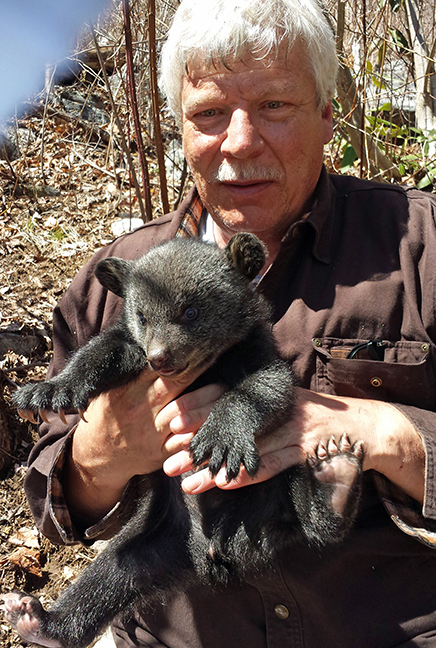 Tom Noblett spreads out two aerial photos showing a stretch of woods below the Blue Ridge Parkway. “These are GPS tracking maps,” he explains. “This one covers the movements of Bear 15277.”
The map is covered with dozens of tiny yellow circles, marking the bear’s hourly movements as indicated by its GPS tracking collar. The circles are clustered in a random pattern connected by lines to form a tangled maze. It appears 15277 was quite content to amble around this small patch of woods. The data is part of a five-year state study to learn more about the bear population in and around Asheville.
Tom is one of the volunteers helping the professionals at NC State University and the NC Wildlife Resources Commission trap the bears, tranquilize them, and then attach the tracking collars.
“I’m fascinated with all wildlife, particularly with bears,” says Tom. “I’m a little more interested in bears because I’ve had a lot of personal dealings with them.” He is standing in his log cabin at the top of a long and steep dirt road in East Asheville. A waterfall twists its way down the mountain behind him as he explains that his 50-acre property includes two or three bear dens. On a tree at a remote edge of his front lawn, he has mounted a motion-activated camera. He explains that it is focused on a hub of three trails that the bears frequently use in their travels. “In the spring, bears tend to funnel through here, mainly out of the Mount Mitchell area. They use this as a thoroughfare to get to the city of Asheville. Last year, we trapped three big males right here on three consecutive nights.” It is as if the trails form a bears’ lane in the Blue Ridge Parkway, which runs directly above.
Tom guesses that the bears are heading into town for the bird feeders and garbage pickings left by residents who don’t usually have to deal with foraging wildlife in urban neighborhoods. To the bears, an unprotected garbage bin amounts to a convenient fast-food outlet. “That’s one of things they’re trying to determine in the study,” Tom says.
This is actually Tom’s second bear project. He volunteered in the 1980s for a tagging project at Mount Pisgah. “I spent every weekend and all my summer vacations up there,” he says. “And back then, there were never bears around here. In the late 1990s or so, we started seeing an occasional bear. Now they’re just everywhere this year. In the summer, I see a bear almost every day.”
Between his experience in two bear-tagging projects and the ursine neighbors around his cabin, Tom has had a number of close—too close—encounters with bears. “Every time I’ve had a close encounter it was my fault,” he says. “Either I got too close or I came between a mother and her cubs. Those are cardinal sins.”
He recalls one incident that took place on his front lawn when he got too close to a bear. “What this bear did, it ran at me and it stopped about five or six feet from me and pawed the ground and popped its jaws, real aggressive. And I went ‘Oh, oh, oh, okay,’ and I backed off, and it stood there, and I backed into the house.” He sums up the experience: “You’ve really got to keep your distance from them.”
Now if a bear wanders too close to him or his house he claps his hands and yells at it. “That usually runs them off,” he says. “But people have begun feeding them, and the bears are evolving. They’re becoming more people friendly. They’re dependent on humans for food. They’re not as afraid of human contact as they once were.”
He shakes his head in disbelief as he relates a recent incident. “There was one bear that had been hanging out here. And when I’d yell at him and clap my hands he wouldn’t run off, but he’d come right at me. I mentioned this to a friend who lives down the way. He told me, ‘My neighbor’s feeding that bear a loaf of bread about every day, and that’s how he calls the bear. He claps.’ I couldn’t believe it,” he says, with another shake of his head.
Tom says it is not illegal to feed bears in North Carolina “as long as you don’t feed them processed food. It’s not a good idea, but it’s not illegal.” He hopes the tagging project can lead to a public education program that will teach people to keep a safe distance from these wild, powerful animals.
As for his own involvement with the two bear projects, he sums it up by saying, “I’ve always enjoyed the outdoors and this was just something that naturally worked for me. I have great respect for bears.”
Jim Murphy, of East Asheville, is a retired television news reporter and former copy editor for the Los Angeles Times. He can be reached at jimurph41@gmail.com. (Photo by Nick Gould)