By Carol Howard
A cottage sits alone on the rocky islet of Klovharu in the Pellinki Archipelago of Finland. A one-room summer home, it is at once cosy and austere, with a window in each of the four walls allowing a view of the sea in all directions. Tove Jansson, a cartoonist known around the world for her Moomintroll comics, and her partner, the graphic artist Tuulikki Pietilä, spent summers at this cottage for more than two decades, beginning in the 1960s.
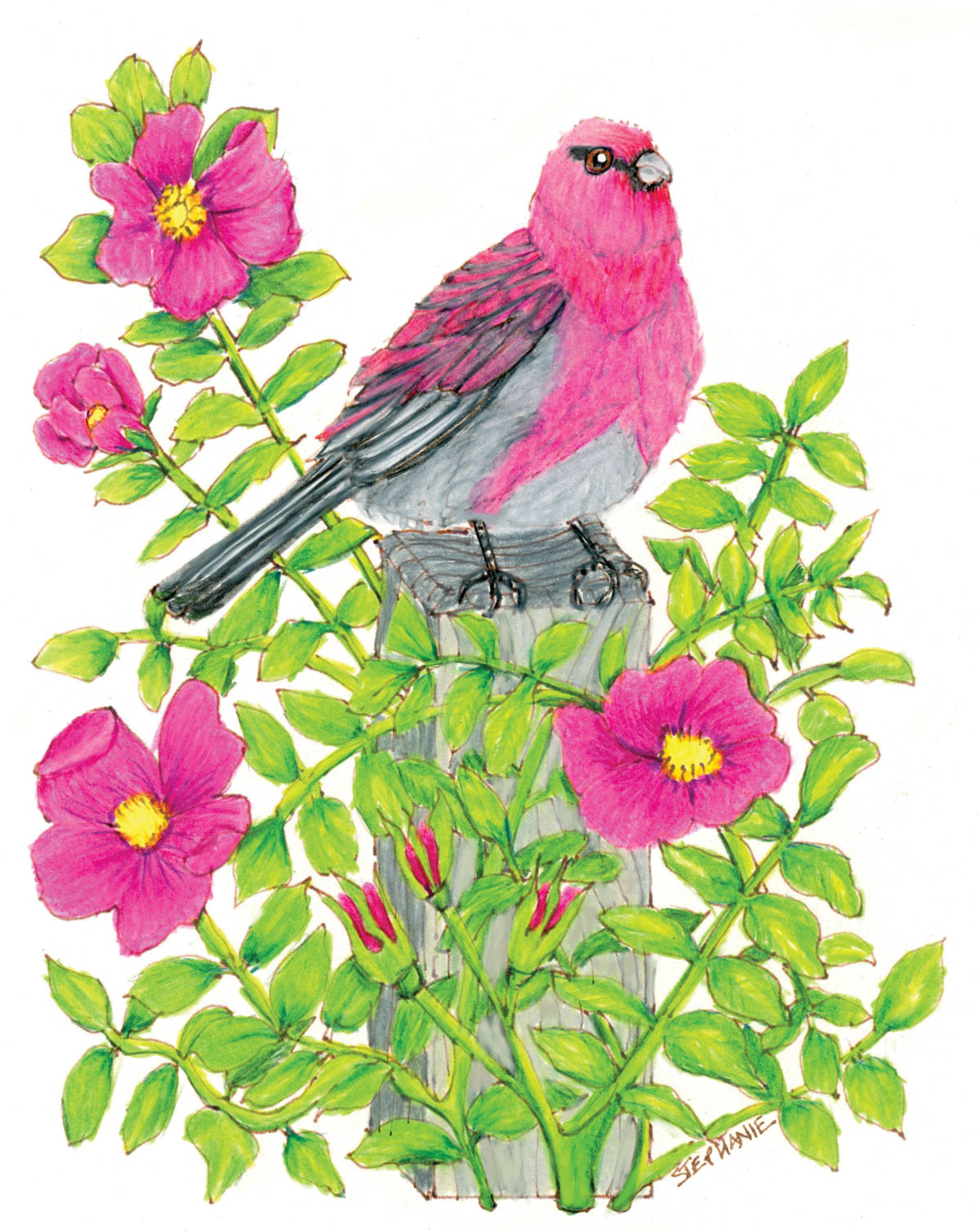
Stephanie Sipp, illustrator
Tove Jansson (Tu-veh Yahn-son) was part of a Swedish-speaking minority community in Finland. At the end of World War II, when she was thirty, she began publishing children’s books and comics about fairytale trolls called Moomins, who look something like hippopotamuses. The books have since been translated into thirty-five languages and are the basis for theme parks in Finland and Japan. In her fifties, she and Pietilä built the summer house, and she turned to writing books for adults. These include The Summer Book, a novel that offers exquisite observations of the natural world and of people who thrive on being intimately connected with nature.
Told in a series of elegant vignettes about the everyday lives of a grandmother and her little granddaughter on a remote Finnish island, Jansson draws from her many years of summer retreat to probe her fictional characters’ experience of the landscape and seascape. In one chapter, for instance, the granddaughter climbs a small, four-windowed tower that recalls the architecture of Jansson’s own cottage. The windows facing each direction become a compass enabling the girl to locate her place in the world as well as offering a panoramic view of the vast sea itself. As she turns her attention to the near distance, the girl surveys an island resembling the author’s own Klovharu, a strangely lovable skerry of “nothing but rocks and juniper and smooth round stones and sand and tufts of dry grass.”
The Summer Book teaches us that simplicity in a natural landscape—and in how humans undertake a minimalist cultivation of that landscape—is a matter of degree and perspective. We learn, for instance, that “Grandmother had had to be frugal all her life, and so she had a weakness for extravagance.” Her prodigality as a gardener, however, is decidedly limited: “she filled a coffee cup with precious drinking water and poured it over a daisy.”
At one point in the story, the grandmother and the girl row to a nearby island to visit a big new house that has intruded upon their view. For an island dweller, as for the artist-author herself, such an unforeseen change to one’s view of the horizon is not merely a cause for annoyance. It is, rather, a traumatic rupture that alters one’s sense of the world. When they meet their new neighbor, a businessman from the mainland whom they approach with suspicion, he tells them that he does not go fishing because he prefers “primitive, undisturbed nature.” The grandmother observes that his idea of wilderness is actually a luxury that people who have spent their whole lives on islands cannot afford.
As they row back home, the grandmother consoles herself with the knowledge that, with time, the neighbor will come to understand the shortsightedness that stems from his own privilege. “Every human being,” she tells her granddaughter, “has to make his own mistakes.”
Carol Howard is dean of academics at Warren Wilson College. Thomas Teal’s excellent English translation of The Summer Book is published by New York Review Books.