Story & Photo by Simon Thompson
It’s a beautiful early spring morning. The first flowers have broken the brown surface of the winter soil and the birds are singing. It’s a great time of the year. You look out of your window at the feeder where you see an unfamiliar face mixed in with the Chickadees and Titmice. This dramatically-colored interloper looks quite tropical. You’ve definitely never seen one of these in your garden.
Just who is this newcomer? Look at it closely and examine the features. The conical bill signifies that it’s definitely a seed-eating bird, but its body is a lot larger than most of your regular feeder birds. It has a black head, black-and-white wings, and a large yellow bill. The most dramatic color is the bright pink cravat that the bird seems to be wearing. Wow, this bird is really distinctive.
You turn to your bird book and flip through the color plates to discover that it’s a male Rose-breasted Grosbeak, a spring visitor to our area of Western North Carolina. You’ve solved the mystery. Welcome to the exciting world of birdwatching!
Birdwatching (or simply birding as it is most frequently called these days) is one of the fastest growing hobbies in North America. Birds are often easy to see and hear whenever we walk outside. Plenty of books encourage bird watching, but no photographs can match what we’ll find in the nature around us.
Now, back to that Rose-breasted Grosbeak. Many people can remember the bird that got them started, the catalyst that encouraged them to explore further the world right outside the front door. For me, it was the African Fish Eagle I saw when I was a young boy growing up in the highlands of Kenya. I remember it to this day as it flew past us and caught a fish near our boat.
Birdwatching can be an inexpensive hobby with an initial expense of binoculars and a bird book.
Let’s start with optics. When it comes to binoculars, a magnification of 7x or 8x is preferred by even the most experienced birder. The best way to test out binoculars is to attend a local bird walk. Ask folks if you can look through their optics, or visit a nature store where you can browse through their selection of binoculars.
The next step is a good, up-to-date field guide. Rather than rush out and buy a book that covers all North American species, it is better to find one that has a good selection of species you are likely to see in the area where you live.
There is also truth in the expression, the early bird gets the worm, and it’s true that birding does involve some early mornings. Most birds get up early and feed at first light and by midmorning have retreated to thicker cover. Try to learn a few bird songs so you can identify certain species by sound, especially during the summer months when the leaves are on the trees. Most importantly, take your time and walk as silently as possible. The quieter you are, the more birds you are likely to see.
If you find the activity of birding in your own backyard to be exciting, consider taking a walk with a local bird group. The Elisha Mitchell Audubon Society (emasnc.org) represents both Buncombe and Henderson Counties in Western North Carolina and there are several organized walks each month to some excellent local birding sites. The leaders know where to see them.
Give it a try. You never know. Birdwatching could be your new spring addiction.
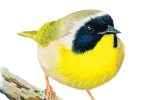
Simon Thompson has lived in WNC for the past 20 years. He owns and operates his own birding and nature tour company, Ventures Birding Tours (birdventures.com). Pictured: Male Rose-breasted Grosbeak.