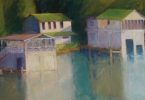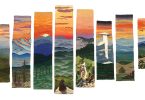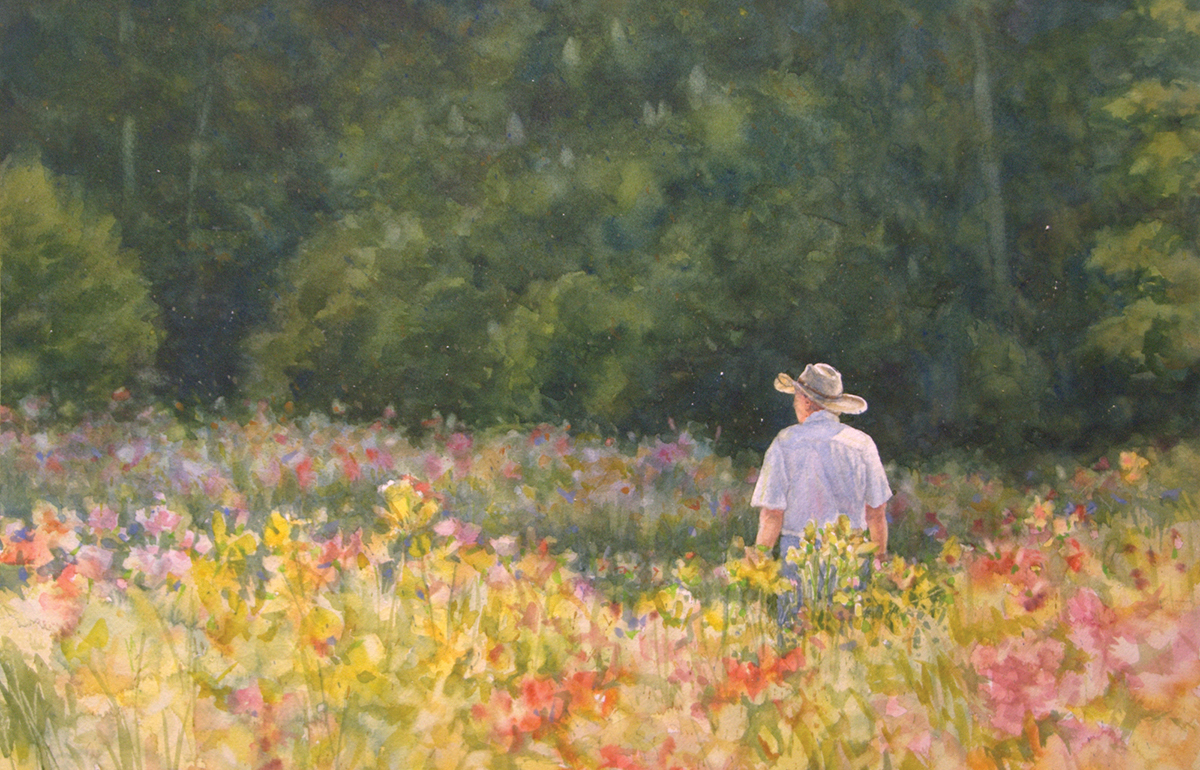
Place of Peace. Sandra Brugh Moore, artist
By Gina Malone
Sandra Brugh Moore’s favorite studio is the great outdoors. “Nature is the key to my inspiration as an artist,” she says. “I have always loved being outside in fresh mountain air. My parents both grew up on farms and had an appreciation for the land. They had a farm in West Virginia where they rebuilt an old log cabin. I would go there to paint, and it’s where I began painting plein air.”
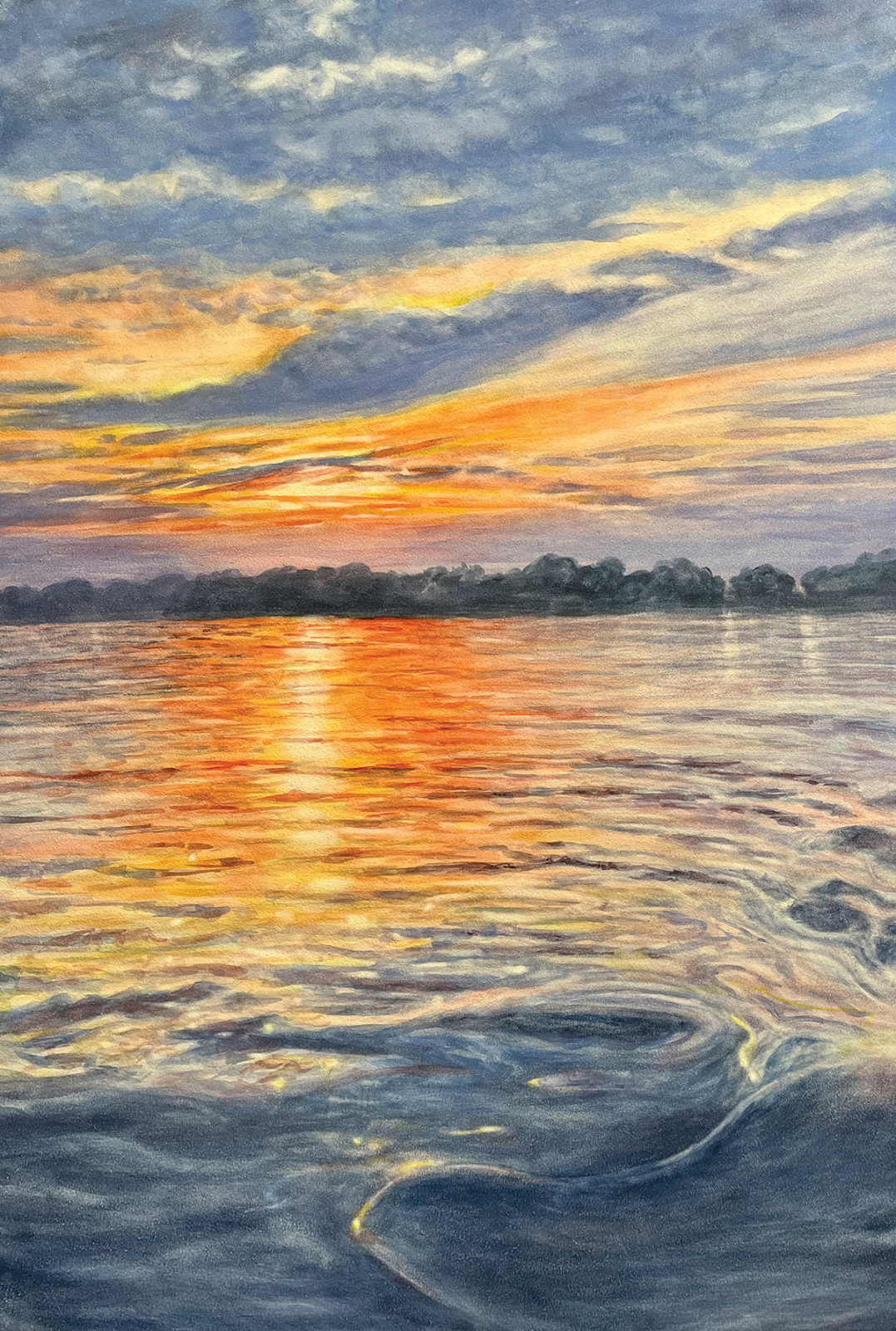
Buckley’s Wave. Sandra Brugh Moore, artist
Sandra grew up in LaVale, MD, not far from Cumberland. “Being a free-range child, I spent my days outside in the woods playing with my brothers and sisters in the mountains of western Maryland,” she says. “The memories of my childhood have influenced how I see and feel this world.”
As a child, Sandra found self-confidence as she drew and practiced art. Her family was always supportive, and when it was time for college she chose to attend West Virginia University for a degree in Elementary Art Education. She taught for a year, then married and moved to Western North Carolina. “I wanted to learn how to paint mountains,” she says. “Watercolor books were my companions trying to figure out how I wanted to paint, not just using someone else’s style or technique. I painted a lot and learned to let the magic of watercolor teach me. Now I have a color recipe for our smoky blue mountains that works for how I see them.” She has always admired Impressionism and the watercolors of Thomas Eakins and John Singer Sargent.
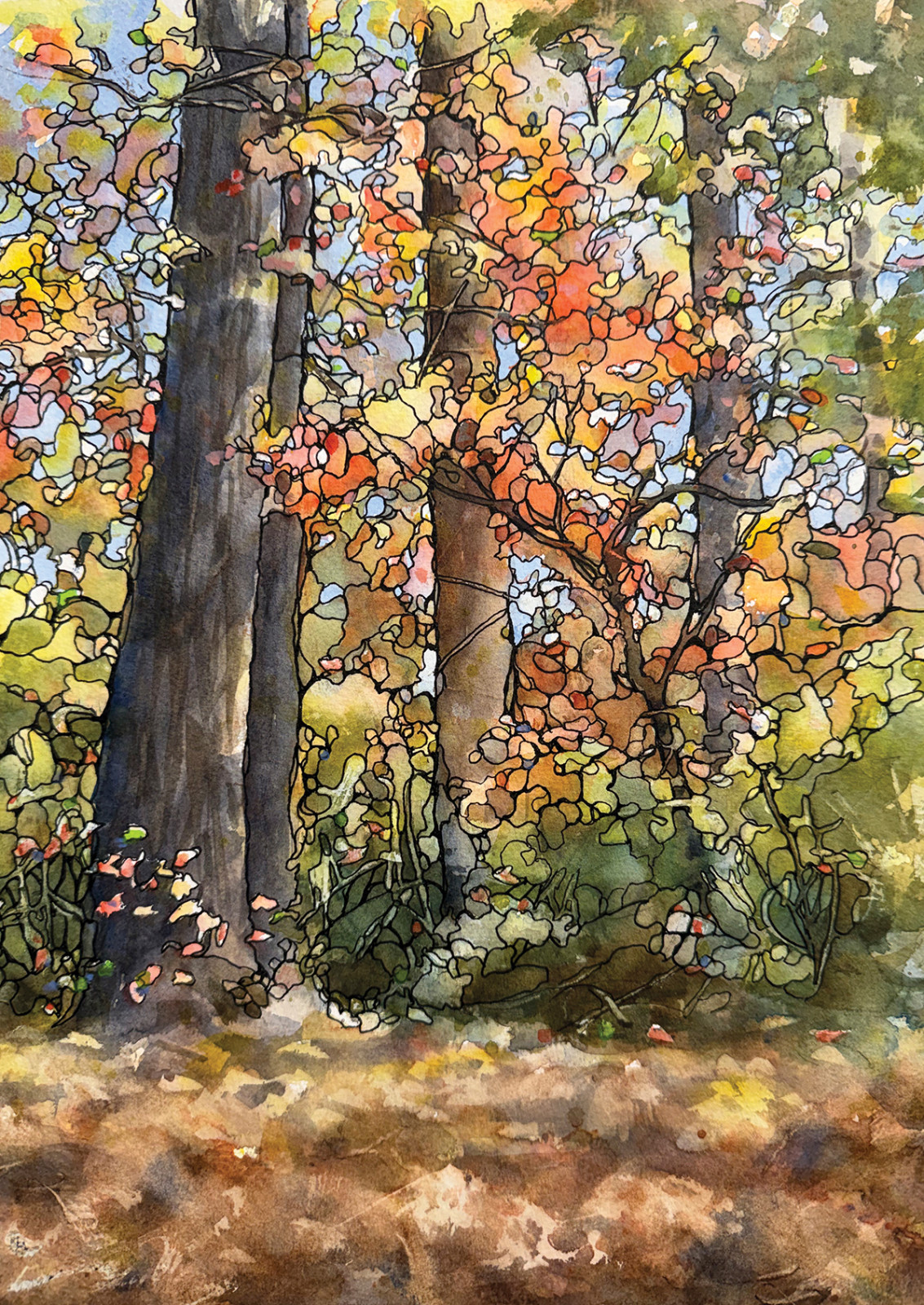
Autumn Joy. Sandra Brugh Moore, artist
As Sandra raised her children, it became necessary for her to stop painting for a while, but when they were old enough to go to school, she taught watercolor classes at Blue Ridge Community College in Hendersonville, and she still enjoys sharing what she has learned over the years. In spring and fall, she teaches four-week Landscape Watercolor Technique classes at AB-Tech in Asheville. Through the years she has also taught herself many techniques and challenged herself by revisiting older work that she did not think worked at the time. And she continues to broaden her horizons with plein air painting.
“When I am on location trying to decide where I want to paint, I like to walk around and get the feel of the place,” she says. She looks for colors and shapes in the landscape and gets a feeling for what she wants to try to capture. “I do not strive for a painting, but I like to experiment with techniques and colors. I stopped playing it safe a while ago. I continue to explore this medium of watercolor.”
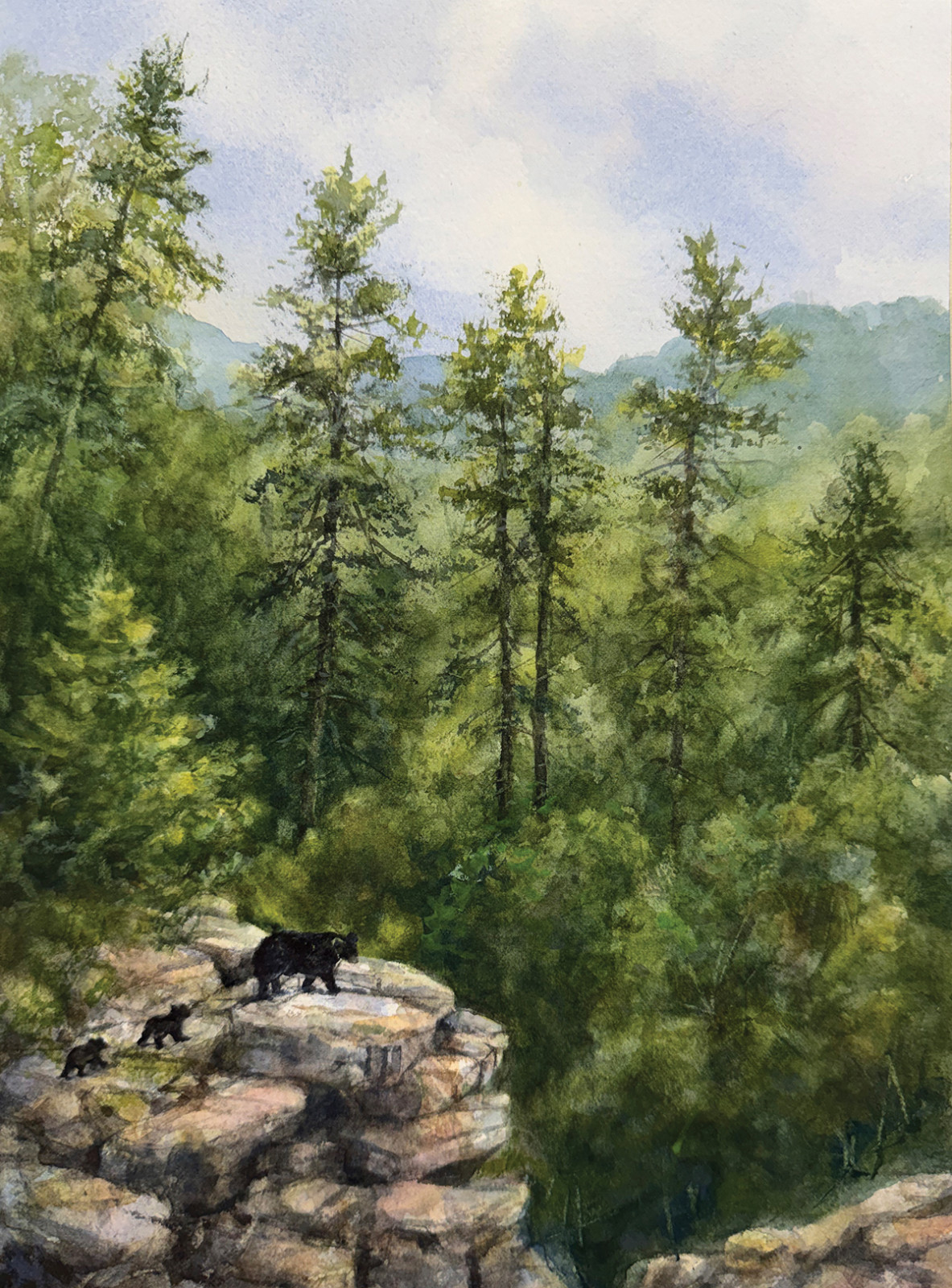
Woodland Family. Sandra Brugh Moore, artist
Recently, at Blue Ridge Daylilies in Alexander, shadows in the background and falling across the fields of flowers captivated Sandra. “I have taught myself a watercolor technique that helps me lock in the shadows by using a cobalt blue underpainting,” she says. “Then I can concentrate on exploring the local color. This does not always work with every subject, but it helps me stop chasing the shadows as the morning passes. The light changes quickly so I have to choose what appeals to me and start painting. I do take reference photos and finish the painting in my home studio.”
Sandra says that she feels happy and immersed in her work as she paints. “I am willing to push the paintings in different directions and explore what is possible by getting out of my comfort zone,” she says. “Playing with watercolor is fascinating. Using gravity to blend colors and soften shapes is where some of the magic begins.”
Sahar Fakhoury, a fellow artist at both Asheville Gallery of Art and Trackside Studios, admires Sandra’s work for the quality and beauty it adds to the region’s art scene. “The luminosity in her paintings is captivating,” she says. “Her style of layering the paints, adding so much detail, yet the painting is so soft, and light comes through the layers.”
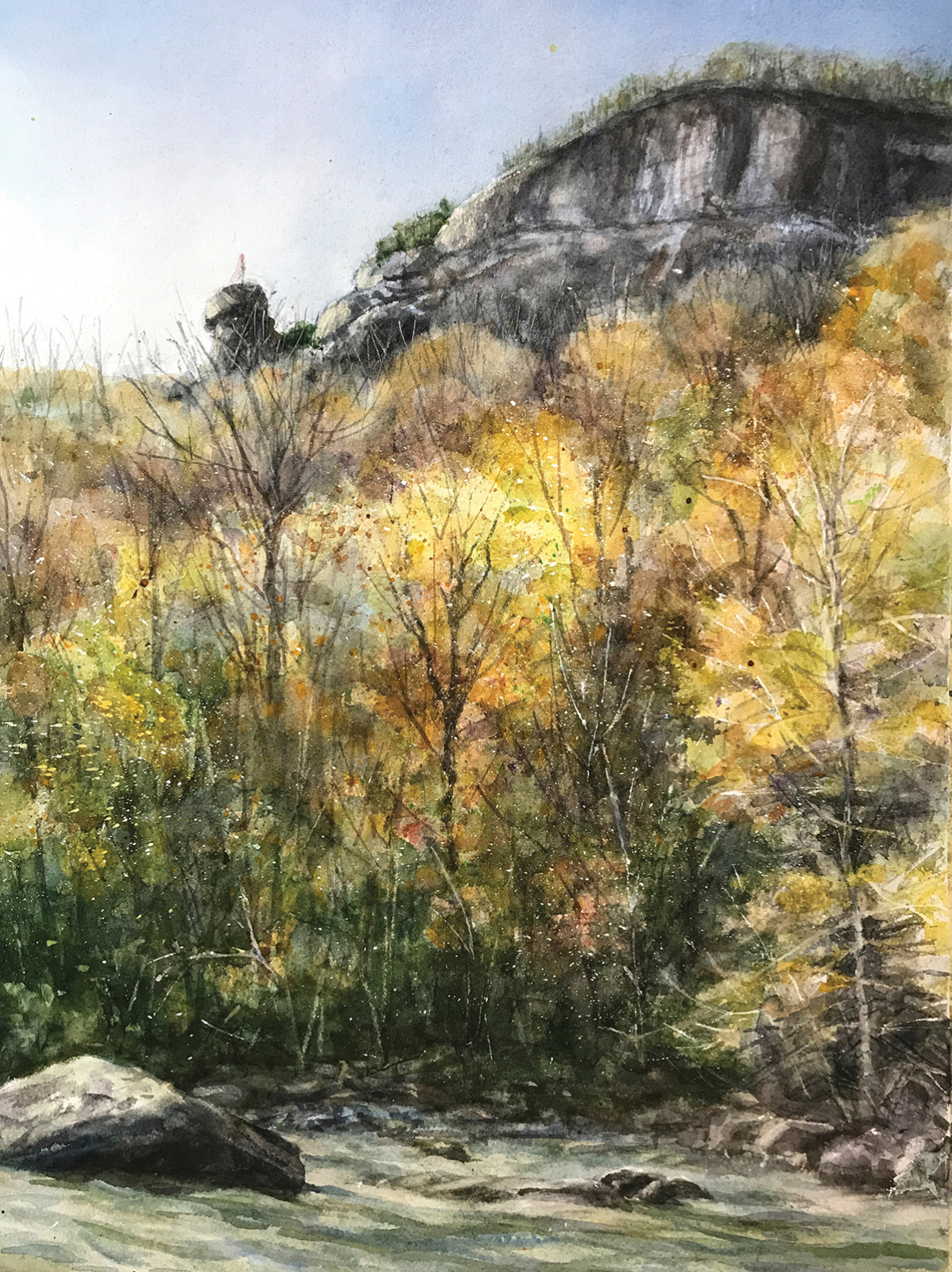
Chimney Rock. Sandra Brugh Moore, artist
When she lost her husband 12 years ago, Sandra says that being a “happy painter” was not something she could do. “My husband was a wonderful supporter of my work,” she says. “He believed in me. We would ride bikes in Bent Creek. He would help me get my supplies to Lake Powhatan where I would paint while he went mountain biking.” During her time of grieving, she found a way forward. “Since I could not produce new work for a while, I took unfinished paintings from my past and began to add curvilinear lines with pen and ink,” she says. “I call these Meditative Designs. The old became new. This kind of meditation kept my fascination with ‘what comes next’ alive—in my life and my art.” She continues the practice, seeing it as a way of recycling older work. “Sometimes the lines work so that the painting becomes ‘art,’” she says. “Other times they do not. But I like to try new ideas.”
For her, painting nature is a way of offering hope for the future. “I know, after Helene, many of the places where I used to paint are just gone,” she says. “It is hard knowing what was lost. I hope my work gives my viewers a sense of peace and hope for new places to paint yet to be discovered.”
Sandra Brugh Moore’s business is Dancing Tree Designs. Learn more at SandraMooreArt.com, and follow on Facebook (Sandra Brugh Moore Art) and Instagram (ncsandram). Find Moore’s work at the Asheville Gallery of Art and Trackside Studios.