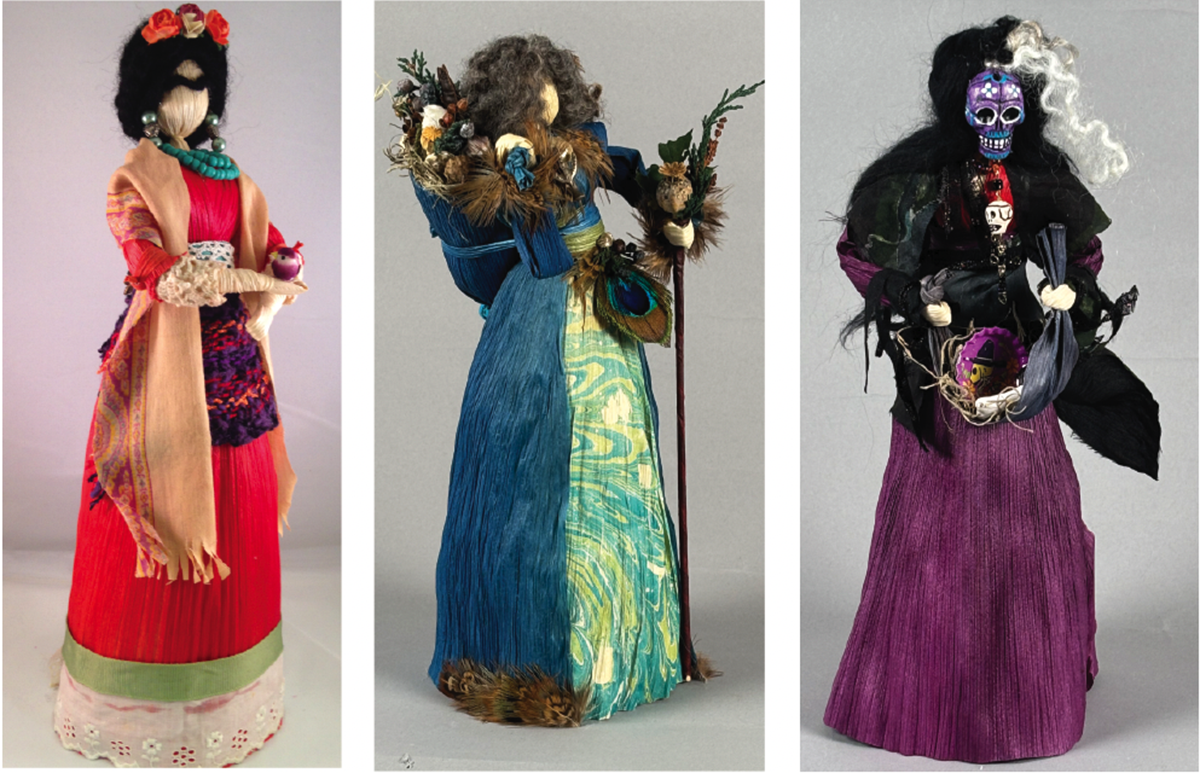
(From left) Frida Kahlo; Woodswoman; Day of the Dead. Anne Freels, artist
By Gina Malone
Anne Freels can trace her love of what she creates—finely detailed corn shuck dolls—to a high school class in Appalachian Studies. “We learned how to create several traditional Appalachian crafts, thanks to the tutelage of some local craftspeople willing to come to our school,” Anne says. “We cut down a white oak tree and made splints to make a basket and bottomed a chair. We made a broom from broom corn and churned raw milk to make butter. On the day we made a corn shuck doll my life changed. I was enchanted! I fell in love with this craft, and as soon as I finished making my first doll I asked if I could make another one.”
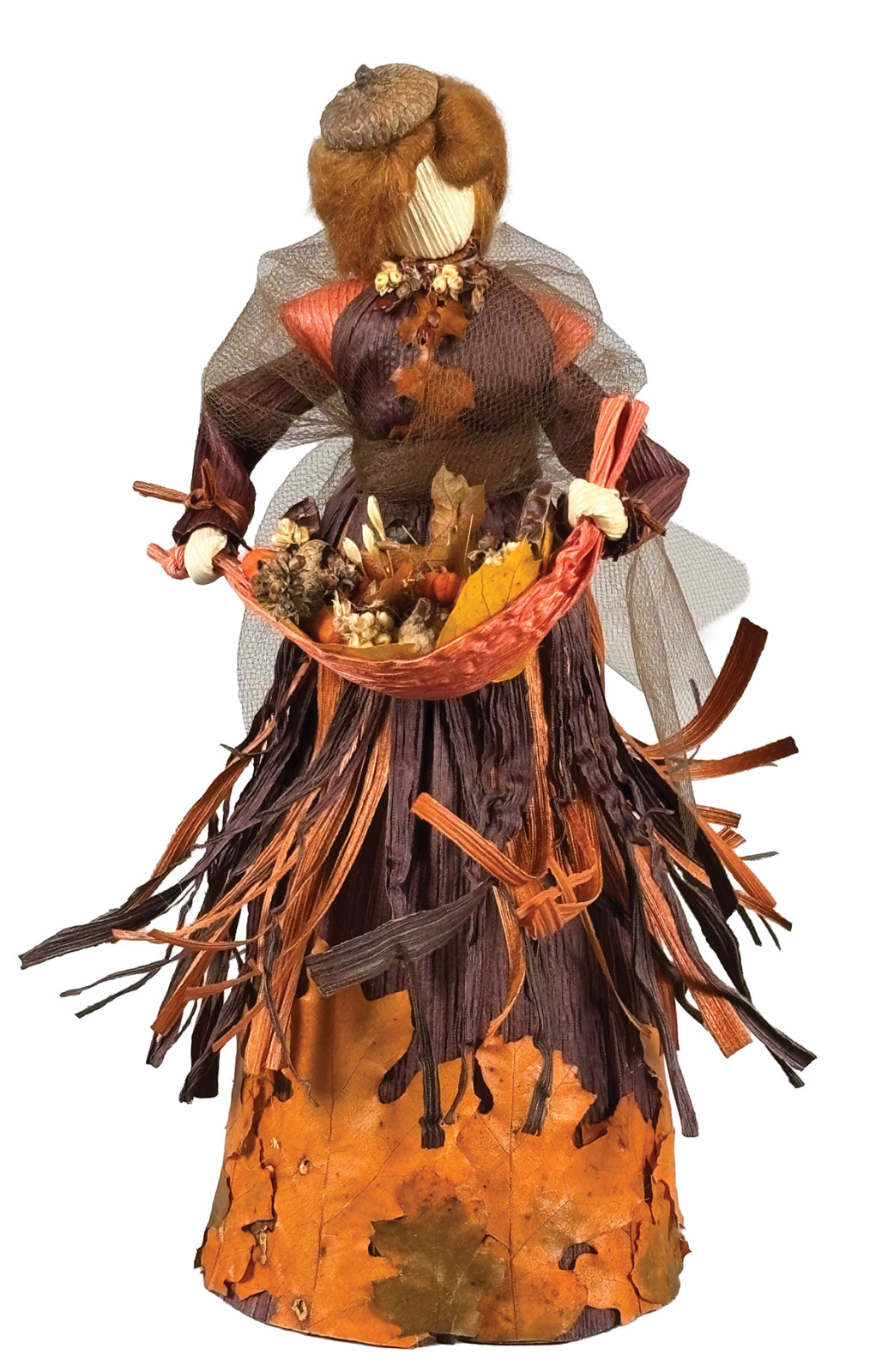
Autumn. Anne Freels, artist
As a child growing up in Oak Ridge, TN, art was the pastime that helped her cope with parents who were markedly different people. “My mother brought her Deep South drawl, Catholicism, Creole cooking, tailor-made dresses, love of the ocean, art, literature and lipstick to Tennessee,” Anne says. “My father contributed his joy of making music, a clever dry wit, a sharp mind, obligations to his family of origin, the notion of scarcity and the gift of keeping his opinions to himself. They were a handsome couple, but the things they brought to the table didn’t blend very well, and did not parlay into any kind of unified parenting strategy.”
There were five children in her family, and her mother kept them supplied with materials for creating. “Art was my favorite class all through school,” Anne says, “and my mother took me to art classes outside of school as well. I loved drawing, painting, collage, all of it, and when I learned to sew in home ec class, I started making clothes and repurposing old jeans into skirts and embellishing them with embroidery. It was the ‘70s after all.”
It was 1975 when she discovered her passion for making corn shuck dolls, but another 20 years would pass before she embraced the art full-time. After graduation, she got a job at a fabric shop. “Within a few months, two wonderful things happened,” Anne says. “I joined a local craft cooperative to sell my dolls, and they gifted me a scholarship to Arrowmont School of Arts and Crafts in Gatlinburg, TN for a week-long corn shuck doll workshop (I had no money so this was indeed a gift!). The workshop was led by Lila Marshall and her daughters, who were Southern Highland Craft Guild royalty (but I didn’t know that at the time), and I learned their techniques and was able to enhance the crude dolls I was making. Afterwards, I began experimenting with color and new styles.”
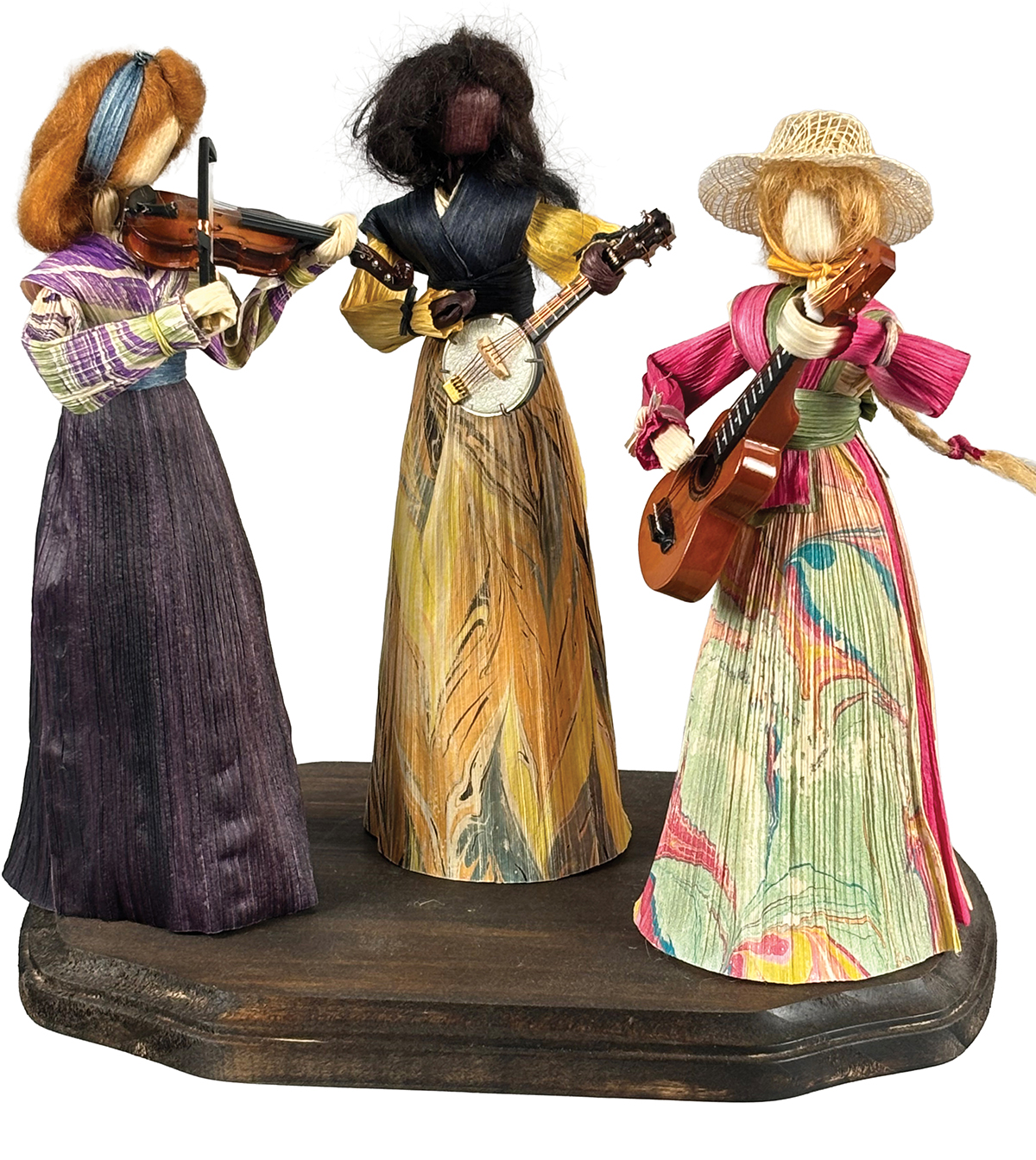
Marble City MayBelles. Anne Freels, artist
Her second break came in the form of an evening shift job that allowed her to attend community college, and buy a car and house. “The car was old, the house was old and needed remodeling, and I worked on both as money would allow and continued to make corn shuck dolls in my spare time,” she says. She worked hard for the next 10 years. “By 1989, I had earned my degree and graduated from the University of Tennessee, was promoted to a salaried position at work (no more shift work!) and my dolls were accepted into Tennessee Craft and the Southern Highland Craft Guild. It was a signature year for me and I was now able to participate in more prestigious craft fairs with amazing, established craft artists (which astounded me).”
She was then able to realize her dream of working full-time as an artist. Her early creations were in the Appalachian tradition, with dolls holding butter churns, flowers, babies and brooms. When she found herself tiring of these depictions, she tapped into her imagination for themes that excited her. “I wanted to convey aspects of the world I was discovering that suggested more of what I observe,” Anne says. “I became interested in the energy of the sky above us, the nature all around us, the myths and stories about the human experience, and the sacredness of everything. I started creating Goddesses and Gods, saints and sinners, and dolls depicting points along the wheel of the year, as well as altar dolls to honor special entities and sacred times.”
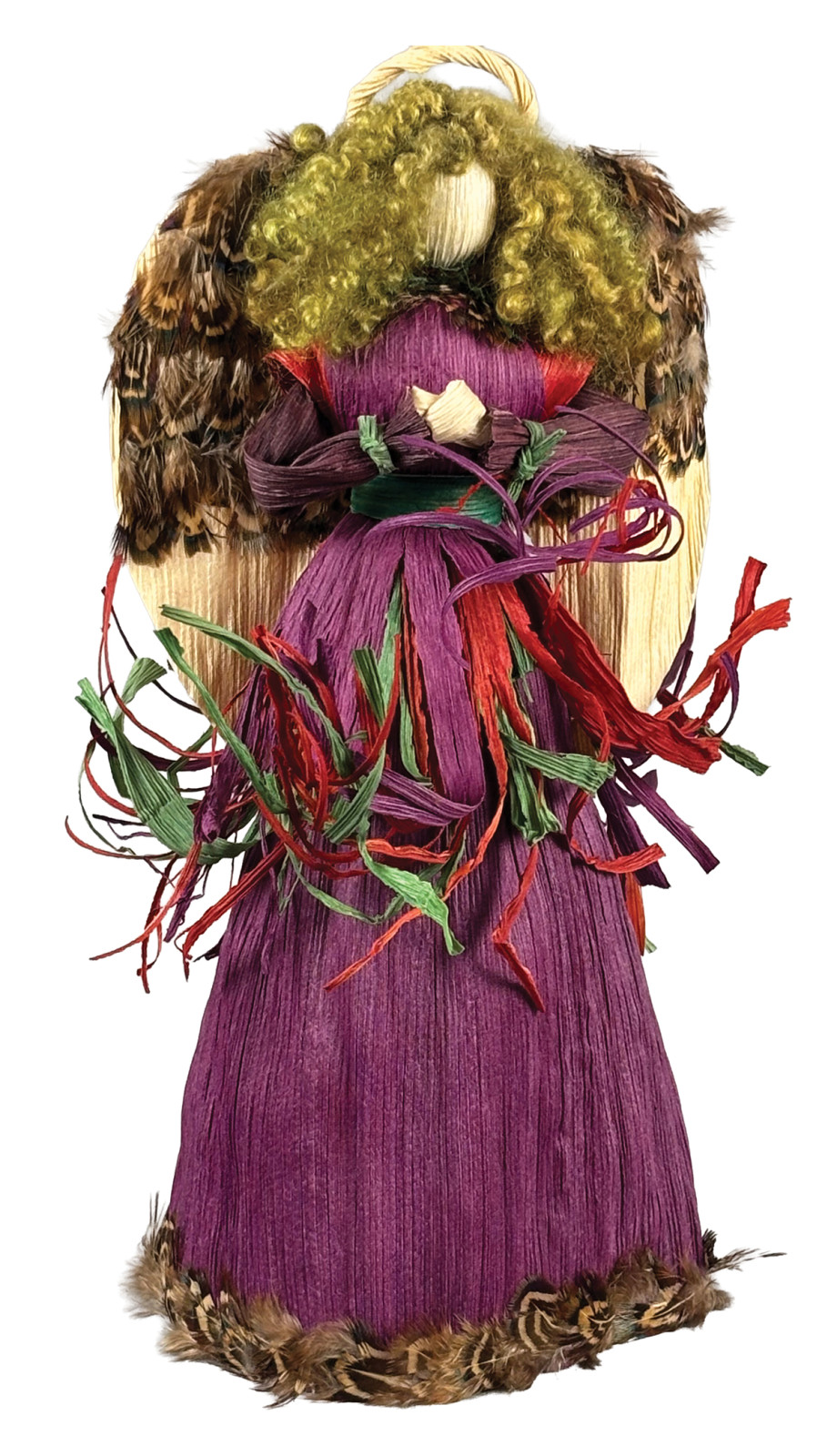
Angel. Anne Freels, artist
Each doll goes through three stages: the dyeing of the shucks, the building of the blank doll and the addition of embellishments. “My raw materials are natural, dried corn shucks, thread and wire,” Anne says. “The wire is rolled up inside the arms for more flexibility, but the rest of the doll is entirely corn shucks tied together with thread and twine. When I start the doll, I know what style it will become and bend the arms while they are damp to suit the style. After 24 hours, when the doll is dry, it is placed on a shelf, ready to be finished. The finish work includes adding wool or flax for the hair, and embellishments to give the doll its special signature. Embellishments may include feathers, beads, seeds, moss, shells, lichen, leather, silk, repurposed jewelry or anything else I have on hand. My studio is full of collected material and provides a never-ending source of possibilities.”
In 2011, her book Making Colorful Corn Shuck Dolls was published by Schiffer Publishing, a project she took on after realizing that there aren’t many comprehensive instructional materials for the craft. “It features over 250 photographs and step-by-step instructions on how to create your own corn shuck doll,” says Anne. “It has become a beneficial teaching tool, and with excerpts from the book I developed kits for people who just want to try it without going through all the prep work.”
Wingshuck Corn Shuck Dolls is located at Broadway Studios and Gallery, 1127 North Broadway, Knoxville, TN. The retail space is open from 10 a.m. to 2 p.m. on Saturdays. Visitors to Anne Freels’ studio can make an appointment at other times by calling 865.705.9755. Learn more at BroadwayStudiosAndGallery.com, and follow Anne on Facebook and Instagram (wingshuck). Find her work regionally at SouthernHighlandGuild.org and at the SHCG craft shops at Tunnel Road and the Folk Art Center, both in Asheville, and at Moses Cone Manor in Blowing Rock. Her work is part of SHCG’s Natural Wonders exhibition at the Folk Art Center through November 29.