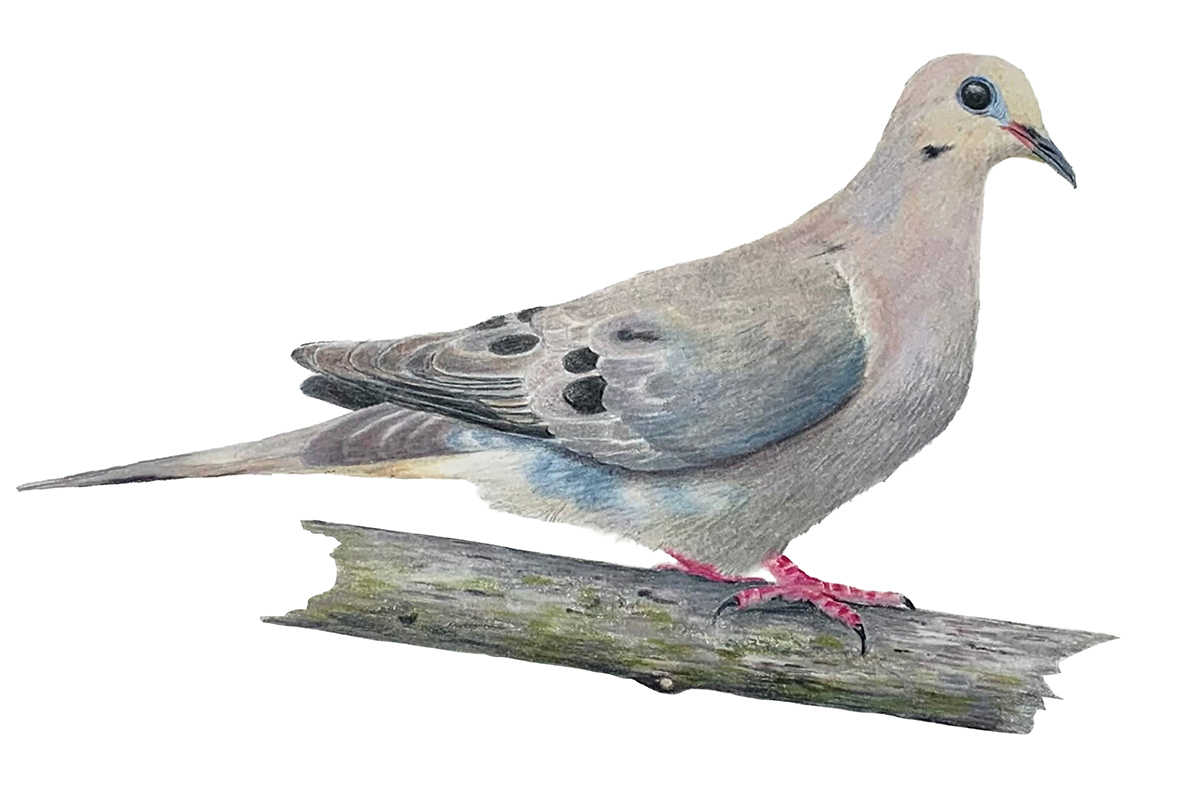
David Ballard, artist
By Casey First
The Mourning Dove (Zenaida macroura) is one of the most abundant and recognizable birds in North America, yet its rather understated beauty is often overlooked. A member of the Columbidae family, which includes pigeons, this plump and graceful bird gets its name from the soft, mournful cooing that is familiar to even the most novice backyard birder.
About the size of a White-winged Dove, but with a slimmer body and longer, tapered tail, the Mourning Dove has a small, rounded head and a short black bill. Its plumage is a soft blend of sandy browns, muted grays and subtle pinkish hues, with scattered black spots on the wings. Males and females look very similar, although the male often has a slightly rosier chest and a beautiful iridescent sheen around the neck.
Throughout much of the US, southern Canada, Mexico and parts of Central America, Mourning Doves are a familiar sight. Here in Western North Carolina, we’re fortunate to have them year-round in backyards, open fields, farms, parks and along woodland edges. They favor open areas for foraging, preferably with nearby trees or shrubs for protection. You may see a pair perched quietly on a telephone wire or a small flock scampering about beneath your backyard bird feeder. Almost exclusively seed eaters, Mourning Doves rely on seeds for roughly
99 percent of their diet.
Unlike many other birds, they swallow seeds whole, storing them in an enlarged part of their esophagus, called a crop, before digestion. Grasses, weeds and cultivated grains provide much of their nourishment in the wild. At home, try offering white millet, cracked corn or sunflower chips on an open platform feeder. They’ll also happily feast on seeds that have fallen beneath feeders. One thing to remember is to keep these feeding areas clean, as damp or spoiled seed can spread disease. One rather fascinating characteristic of the Mourning Dove is its ability to drink water without lifting its head between sips, something most other birds cannot do.
The Mourning Dove’s familiar, somewhat melancholy song is a soft, rhythmic coo-OO-oo-oo-oo, often mistaken for the call of an owl. Their wings produce an equally recognizable sound. When startled into flight, a sharp whistle breaks the silence as they take off, sometimes at speeds exceeding 50 miles per hour. Not bad for a bird that spends so much of its time quietly wandering about the ground.
When nesting season arrives, Mom and Dad work together to construct a rather flimsy platform of twigs, grasses and pine needles, usually tucked into the fork of a tree or shrub. Dad gathers the materials while Mom arranges them into a shallow nest. She’ll lay just two white eggs per clutch, but what these birds lack in clutch size they make up for in frequency, often raising several broods in a single season. Both parents share incubation duties and feed their young a highly nutritious substance called “crop milk,” produced in their digestive tract. After about two weeks, the young are ready to leave the nest.
Fortunately for us, Mourning Doves remain abundant throughout much of their range. Habitat loss, outdoor cats and window collisions still pose threats, however. Protecting our natural habitats and preserving the open fields, woodlands and green spaces they call home will help ensure that their gentle calls remain a familiar part of our landscape for generations to come.
Casey First is owner of North Asheville Wild Birds Unlimited, located at 946 Merrimon Avenue, Suite 120. Monthly bird events are free and open to the public, with no registration required. To learn more, visit NorthAsheville.wbu.com. Artist David Ballard lives in Candler. Find his work on Instagram at d.ballard.art.