By Elaine Smyth
From mid-June through early November, black-eyed Susans bloom all across the North American continent, adding bright splashes of golden yellow to roadsides and gardens from Baltimore (it’s the state flower of Maryland) to San Francisco, where masses of it grace the Golden Gate Park. In my garden in north Asheville, it frequently flowers more than once, starting in June. In the heat of late July, it dies back to its basal rosette after the first blossoms go to seed, then sends up new blooms late in the season, offering welcome supplies to late migrating butterflies. The seed heads, if left, will attract goldfinches.
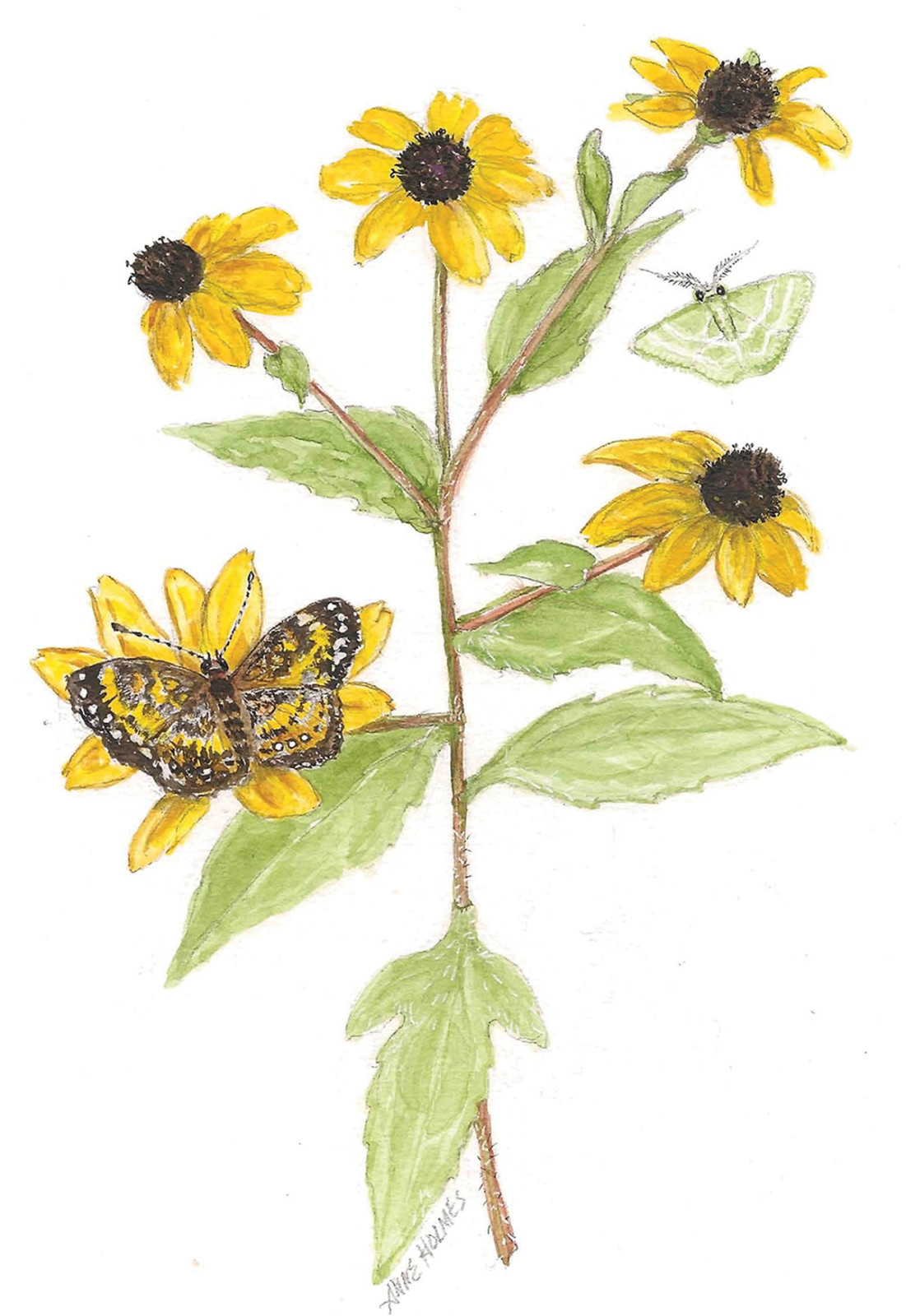
Anne Holmes, artist
Easily grown from seeds, black-eyed Susans bloom the first year they are planted. They are generally short-lived, but will stay in the garden through self-seeding. They are not picky about soil, and they tolerate partial shade and thrive in full sun if given adequate moisture. The flowers attract many types of small bees, as well as butterflies, and the plants themselves are a food source for the larvae of the Emerald (Synchlora aerata) and Silvery Checkerspot (Chlosyne nycteis) butterflies.
Black-eyed Susans are members of the huge and hugely important Aster Family, which numbers more than 32,000 species. When the family was first named in the 1740s, it was called the Composite Family, because its flowers are in fact composites made up of small flowers grouped together in a central disc and surrounded by petal-like ray flowers. Black-eyed Susans, Rudbeckia hirta, are named for Olaus Rudbeck (1630-1702), a Swedish scientist who established a botanical garden in Uppsala. The specific epithet hirta (meaning “rough-haired”) refers to the tiny hairs on its stems and leaves. The flower’s common name also comes from the 18th century, as it is commonly associated with a ballad written by English poet John Gay (1685-1732), “Sweet William’s Farewell to Black-Eyed Susan” (1720), which was set to music and became a popular song of the time.
Upcoming Events at Asheville Botanical Garden
Learn more and register for classes online via the ABG website at AshevilleBotanicalGarden.org.
Tuesday, November 3
Pamper Your Pollinators This Winter, with Phyllis Stiles (Certified Pollinator Advocate series)
Saturday, November 14
Tree Selection, Climate Change, and Helene: Growing a Legacy, with Andy Tait
Tuesday, December 1
Bee My Little Baby: Intro to Bee Nesting, with Brannen Basham (Certified Pollinator Advocate series)
Saturday, December 5
Pruning for the Natural Gardener, with Alison Arnold
Asheville Botanical Garden, 151 W.T. Weaver Boulevard, is an independent nonprofit public garden showcasing 750+ species of native plants on 14 acres. Our mission is to promote and showcase the value and diversity of plants native to the Southern Appalachian region by serving as an educational resource and urban destination for nature study and enjoyment. Supported by members, donors and volunteers since 1960, the Garden is open daily, sunrise to sunset, year-round, free to all. The ABG Visitor Center and Gift Shop are open 10 a.m. to 4 p.m. daily, featuring local products, garden-themed art, toys, tools, cards and books.