Cherokee Stickball. Photo courtesy of WCU
Uncovering the Cherokee Stickball Tradition
By Lauren Stepp
Thousands of years before football was adopted as America’s favorite pastime, this land was ruled by a grittier sport: stickball.
“Some of the earliest Europeans who visited our area wrote about the game,” says Michael Slee, a player for the Hummingbirds stickball team on The Qualla Boundary. Slee is also the director of operations at the Museum of the Cherokee Indian. “But the sport is as old as these mountains,” he adds.
Known to the Eastern Band of Cherokee Indians as the “little brother of war,” stickball emerged as a way of keeping players fit and ready for battle. The ritualized contest was also employed to resolve grievances, often concerning hunting grounds, between individuals, clans and townships. “If a dispute needed to be settled, but the Cherokee didn’t want men to die, stickball was used,” says Slee.
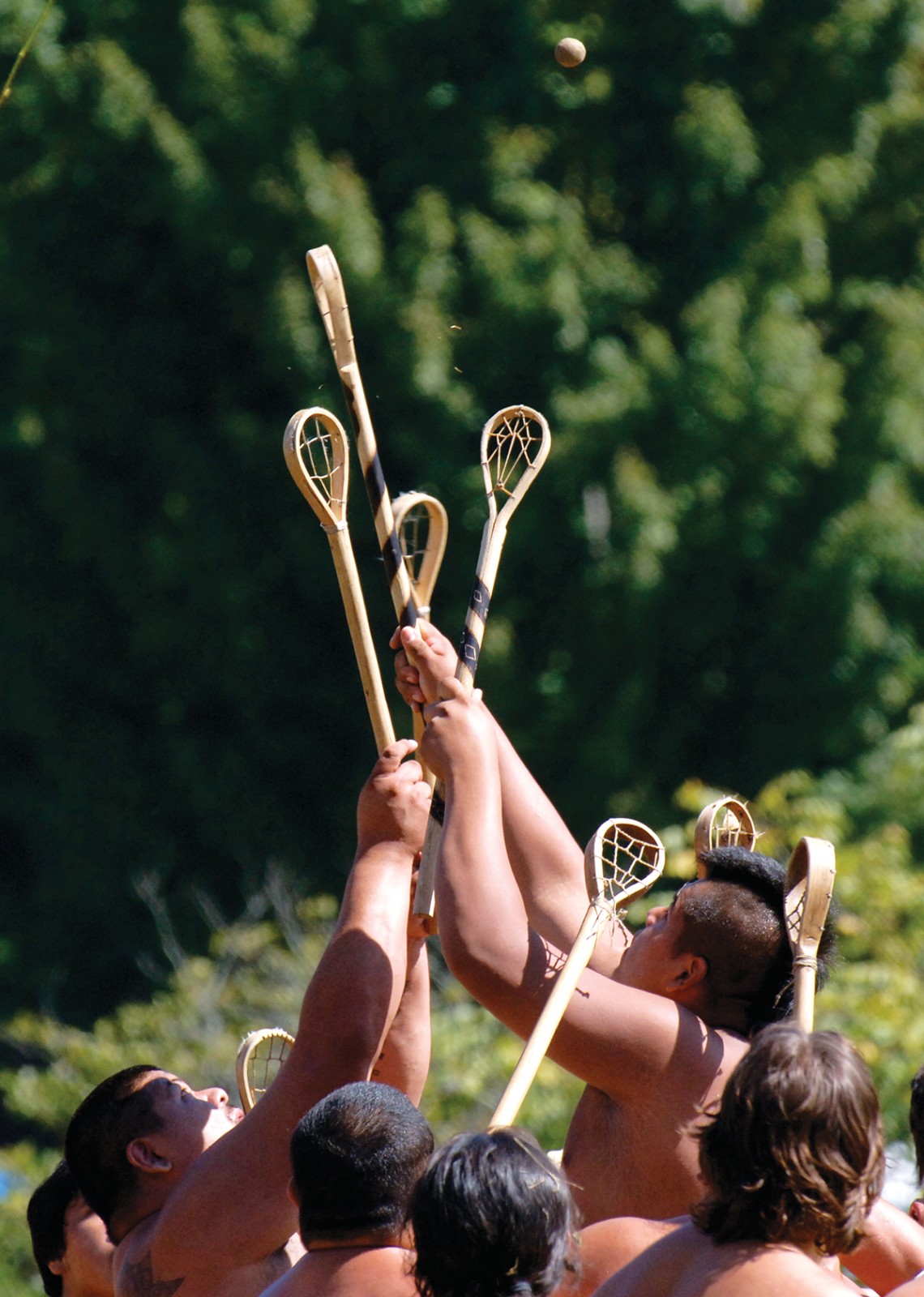
Ball thrown into play, Cherokee stickball. Photo courtesy of WCU
But that’s not to say blood wasn’t shed. When ethnologist James Mooney lived among the Cherokee in the 1880s, he described the game as “very exciting” as well as “very rough.” He wrote: “Almost everything short of murder is allowable in the game, and both parties sometimes go into the contest with the deliberate purpose of crippling … the best players.”
Today, more than a century later, stickball is still notoriously physical. Slee has walked away from many matches bruised, battered and in need of stitches. But, contrary to Mooney’s observations, stickball isn’t entirely lawless.
A predecessor to lacrosse, stickball is played on a field with two goal posts. Each player carries either one or two sticks. The sticks are traditionally carved from hickory, with one end featuring a scoop made of leather or sinew webbing.
After a small, walnut-sized ball is tossed into play, the players rush to scoop it off the ground. Once lifted above the knees, players can transfer the ball to their hands and race down the field to score a goal. Whichever team scores 12 points first, wins.
According to Slee, these are the fundamentals. However, there are countless variations of the game. For example, during some matches, teams must run past the goal with the ball to score. During other matches, they must throw the ball past the goal to score. The exact rules are predetermined by the “drivers.”
“There are two drivers for each team, and they essentially serve as referees,” Slee explains. “They try to keep things in order, but if the players decide to play a certain way, there’s not much the drivers can do.”
Simply put, stickball isn’t for the faint of heart. Without protective padding, shirts or even shoes, players feel the full force of every tackle. Though Slee admits this can be intimidating, he sees the sport as a spirited means of preserving history.
“The game reminds players and spectators of where they are,” he says. “It reminds people that, no matter who holds a deed, this land is and always has been ours.”
Each fall, a stickball demonstration is hosted at Mountain Heritage Day, a vibrant festival celebrating Appalachian culture. (See story, page 20). This year, the festival is slated for Saturday, September 24, from 10 a.m. to 5 p.m., at Western Carolina University (1 University Way, Cullowhee). For more information, visit wcu.edu.