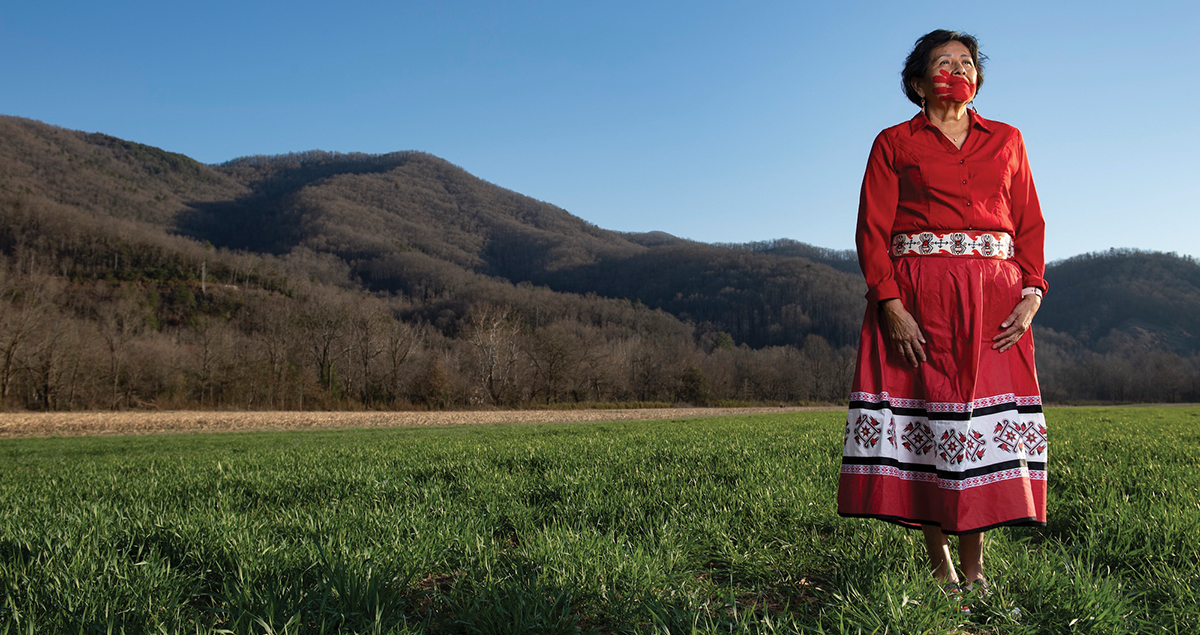
Mothering a Movement. Ashley Tyler Evans, artist
By Emma Castleberry
Through December 9, the WCU Fine Art Museum presents We Will Not Be Silenced: Standing for Missing and Murdered Indigenous Women, an exhibition developed in partnership with the WCU Cherokee Center. There will be a reception for the exhibition on Wednesday, November 2, from 5–7 p.m.
We Will Not Be Silenced aims to raise awareness of the high rates of violence experienced by Indigenous women in the US through photographs and sculptures by six Indigenous artists: Ashley Tyler Evans, Dylan Rose, Moe Hernandez, R.A. Johnson, Chi Myriah Shipman and Jaime Black.

Strong and Resilient. Dylan Rose, artist
According to the National Institute of Justice, more than 84 percent of Indigenous women experience violence in their lifetime, and the Centers for Disease Control report that murder is the third leading cause of death for this demographic. Sky Sampson, director of the WCU Cherokee Center, says the exhibition started as a small collection of photos intended to educate the public about Missing and Murdered Indigenous Women (MMIW). Sampson organized a photography session at Kituwah Mound with several Indigenous women. “We selected the Kituwah Mound site mainly because of its significance to our people but also because the mountains in the background show our location here in the southeast,” says Sampson. “Once we were there, ideas began to spread and some of the women mentioned that we could make this into something bigger and we discussed an official exhibit that might travel the US to bring even more awareness to MMIW.”
Sampson organized two more portrait sessions with professional photographers Hernandez, Evans and Rose. “When I got the call for MMIW, I remember thinking, ‘This is going to be epic,’” says Rose, who has lived in Cherokee for most of his life. “Kituwah is our mother town, our women are the givers of life, Cherokee life. It meant a lot to me to take such powerful photos there.”
After the portrait sessions, Sampson broadened the exhibition’s scope to include sculpture. Rose says the art comes together as a cohesive whole because of the exhibition’s focus. “The similarities in everyone’s work all connect us back to one goal, which is to honor the victims and give the power to spread awareness of the harsh reality as an Indigenous woman,” he says.
“We hope everyone enjoys it on a local level but also takes away the sadness that missing and murdered indigenous families feel across the US,” says Sampson. “This is a real problem and we want people to know that we are going to be loud to raise awareness in the southeast.”
Visit arts.wcu.edu/wwnbs to learn more about the exhibition. To learn more about MMIW, visit mmiwusa.org.