By Leah Shapiro
We never know when inspiration will strike. And for sculptor Alan Carter, that’s an important part of the process. “If you look too hard for it, it’s never there,” he says. “It has to come to you, unaided—just smack you in the face, make your eyes open wide, and you go, ‘Well, yeah, that’s it!’” He says he finds inspiration in “pretty much everything.” Perhaps this is why Alan’s artistic journey has had many twists and turns. When asked how he became a sculptor, Alan tells me it all started in third grade when his school band needed a trombone player.
Alan’s music teacher in town of Connersville, Indiana, was George Ewing. Alan recalls, “He was the epitome of a great educator…He instilled in me a love of music, and that in turn led to a love of all art. The cliché is to say that I now make beautiful music with my sculpture.”
In 1960, when Alan began high school, his family moved to Rochester, New York. At that time, the Eastman School of Music offered a special program for high school students where they could sit in on conducting classes and attend performances of the Rochester Philharmonic Orchestra. “It was like a football scholarship for music nerds!” says Alan.
Alan attended Indiana University in Bloomington from 1965–1969 and earned a degree in music. As a junior, he met Penny, a freshman, in the fall of 1967. The couple was married by January 1968. Two years later, their daughter Theresa was born.
Shortly after college, Alan began working for a major retailer in a management training program with the hopes of managing his own store. “Talk about a 180-degree turn of events,” says Alan. He was transferred to different stores over the years in midwestern cities such as Indianapolis and Gary, where his son Adam was born in 1973. While in Glenn Ellen, a fellow employee named Ed Paulson encouraged him to take up painting as a hobby. After a couple of years, Alan became a full-time professional artist in 1977.

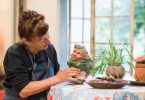
Alan Carter (photo by Leah Shapiro)
“My subject matter was the urban environment done in a highly photorealistic style,” says Alan, whose work was placed in a large number of private, public, and corporate collections.
In 1999, however, he hit a creative wall. “Painting was becoming more of a chore than a calling. I simply wasn’t enjoying it any more…As a result I was looking for a new outlet for my creative talents, whatever that meant. I had a workshop of sorts and had made some furniture and accessories for our own use for several years so I thought, What could I do that would require a large investment in tools and materials and generate minimal income? Furniture making was right there at the top.”
At this time, he and his family were living in a suburb of Chicago. He worked with a few handcrafted furniture galleries and created a variety of pieces, such as dining room sets, as well as boxes, clocks, and mirrors.
When the economy tanked in the 2000s, however, Alan’s custom furniture business sank with it. While looking for a new creative pursuit, Alan discovered woodturning. “I really don’t know what the spark was,” he admits. “I joined the local woodturning club in Chicago and began to learn all about the craft. My original thoughts were focused on using woodturning as a vehicle to produce artistic sculpture and that focus hasn’t changed in the last several years.” Alan and Penny moved to Western North Carolina in 2014.
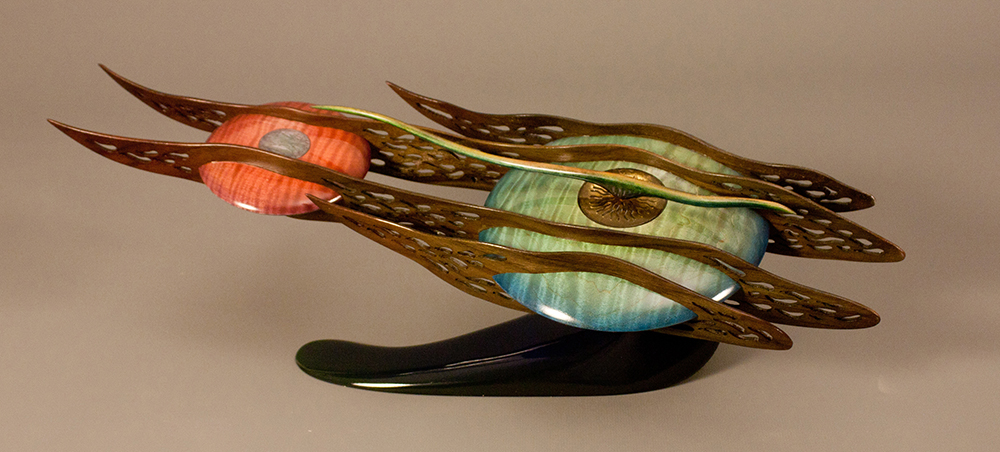
Alan’s work is vibrantly colored and contemporary, with a decidedly concrete form and structure. “Virtually all of my work contains a turned element of some sort,” he says. “My intent is to have the turned element be the focal point of the piece. All the supporting structures and additional components are designed to draw the viewer’s eye to that turned part, making it the star of the show. It’s the one constant present in everything I make.”

For the sake of keeping things interesting, however, Alan says he has been thinking about creating pieces that have no turning involved. “I also intend to incorporate more disparate materials, such as metal, glass, and so on.”
Alan says he is influenced by art deco for its sense of motion and also by many Asian designs for their elegant simplicity. “As the piece takes shape, I’ll fine tune it…The time spent on the woodturning part is usually a fairly small portion of the overall process. I use a band saw for shaping many of the components and spend quite a bit of time carving and shaping the various parts. Painting and other surface embellishment can take quite a bit of time as well.” Alan thinks of wood as a basic building material in his art, much as clay is to a ceramicist. “Many of my pieces are completely painted, virtually eliminating any evidence of the source material. For those, I like to use maple and poplar because they’re durable, easy to work with, reasonably priced, and provide an excellent blank canvas to build on.”
From painting to trombone playing, each discipline has informed Alan’s current work. After hearing about Alan’s journey, it may come as no surprise that one of his favorite Yogi Berra quotes is, “When you come to a fork in the road, take it.”
From July 21–24, check out Alan’s work at The Craft Fair of the Southern Highlands. Other upcoming events include a Southern Highland Craft Guild collaborative exhibit titled Fellowship beginning in August at the Folk Art Center. His work will also be in a group show in the Focus Gallery at the Folk Art Center beginning in November.
You can see more of Alan Carter’s works (Alan Carter Studio) at alancarterstudio.com, and at the Grovewood Gallery in Asheville, Miya Gallery in Weaverville, Seven Sisters Gallery in Black Mountain, Allanstand Craft Shop, Southern Highland Craft Gallery in Biltmore Village, and Parkway Craft Center in Blowing Rock. His studio (visits by appointment only) is located 7 Cane Creek Circle in Fairview. You can reach Alan at 630.390.8821.