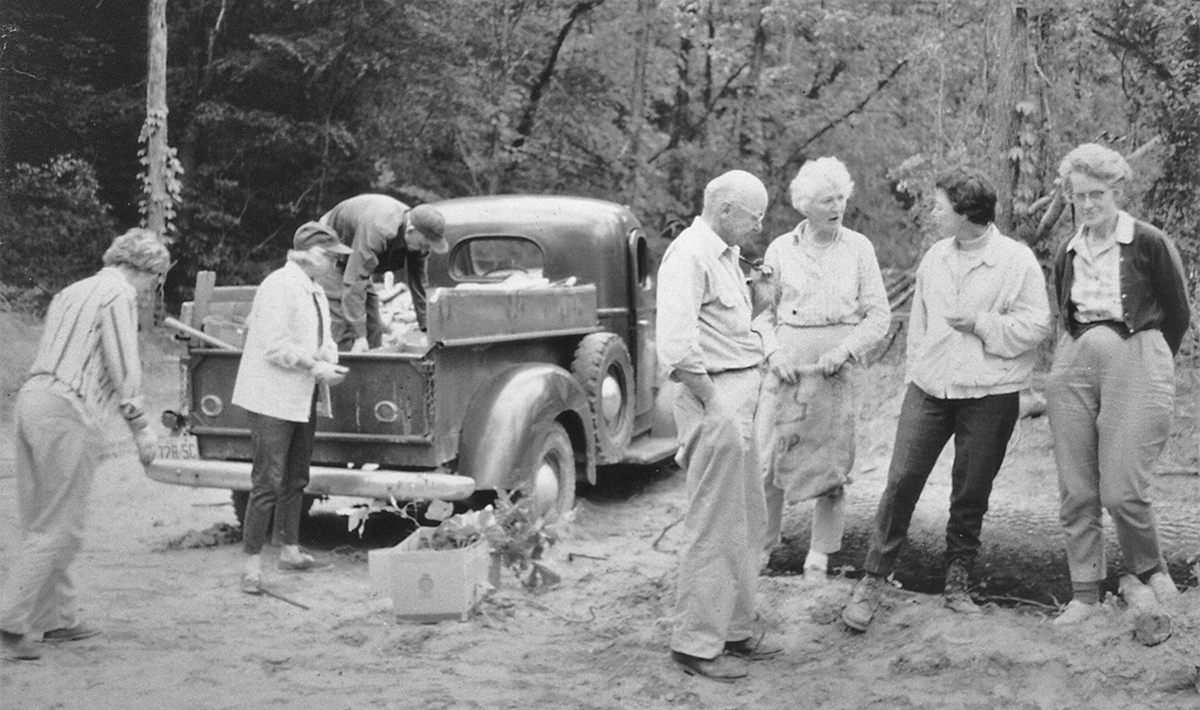
Early volunteers. Photo courtesy of the Asheville Botanical Garden
By Lauren Stepp
In 1960, long before plants like Oconee Bells and Indian Pink bloomed along Reed Creek, the land that is now the Asheville Botanical Garden (ABG) was a pasture tangled with weeds, poison ivy and discarded trash. To most, the neglected land was an eyesore. But local resident Bruce Shinn saw something there.
For years, Shinn and a small circle of plant lovers had been rescuing native wildflowers from bulldozers as postwar development reshaped WNC. As their private gardens filled up, they imagined a public space devoted entirely to the native plants of the Southern Appalachians.
“In those days, most gardeners were focused on highly ornamental gardens with roses, tulips and other very visually stunning plants,” says Kaita Collier, executive director of the ABG. “Focusing on natives was quite a radical mission at the time.”
Momentum gathered quickly after Shinn persuaded the editor of the Asheville Citizen to publish an editorial supporting the creation of a plant preserve. After it ran on January 17, 1960, donations began arriving soon after.
That November, civic leaders and nature enthusiasts gathered at Seely’s Castle to formalize the effort, establishing the Asheville-Biltmore College Botanical Association. By early 1961, the fledgling preserve had incorporation papers, officers and a designated tract of land, then owned by Asheville-Biltmore College, the forerunner of UNC Asheville.
Asheville landscape architect Doan R. Ogden soon agreed to develop the master plan. What followed was far from romantic: volunteers hauled detritus from the undergrowth, cut back invasive vines and carved the first trails by hand. “It was a labor of love,” says Collier.
Today, the 13-acre garden contains more than 750 plant species native to the Southern Appalachians, including many that are rare or endangered. “You can actually find a higher diversity of native plants on a walk here than if you were to hike 13 acres in the Smokies,” says Collier.
That biodiversity is an asset to the UNCA community. Though independently operated, the garden has remained closely connected to the university since its creation. In 2021, the property was included within UNCA’s Millennial Campus, a designation that allows UNC institutions to use certain university-owned properties in ways that strengthen their teaching, research and service missions while also supporting the broader community.
For students, that connection translates into immersive field experience. Every year, the garden awards several Izard Scholarships, allowing UNCA undergraduates to spend three months conducting research or working on stewardship projects in the preserve.
Those experiences can shape career trajectories. UNCA alumni in environmental science, biology and related fields have gone on to positions with organizations such as The Nature Conservancy and the National Oceanic and Atmospheric Administration, says Eden Bloss, a representative for the university. “At UNC Asheville, we believe a liberal arts and sciences education should prepare students not just to understand the world but to engage with it,” Bloss says. “Experiential learning, research and community partnerships are central to our mission.”
For information, visit AshevilleBotanicalGarden.org.