By Elaine Smyth
May in the Smokies is a glorious time, with spring ephemerals in full bloom. Among the many beauties, the bright petals of the yellow trillium (Trillium luteum) stand out against fallen leaves on the forest floor. Bend down close, and you may catch the flower’s faint lemony scent.
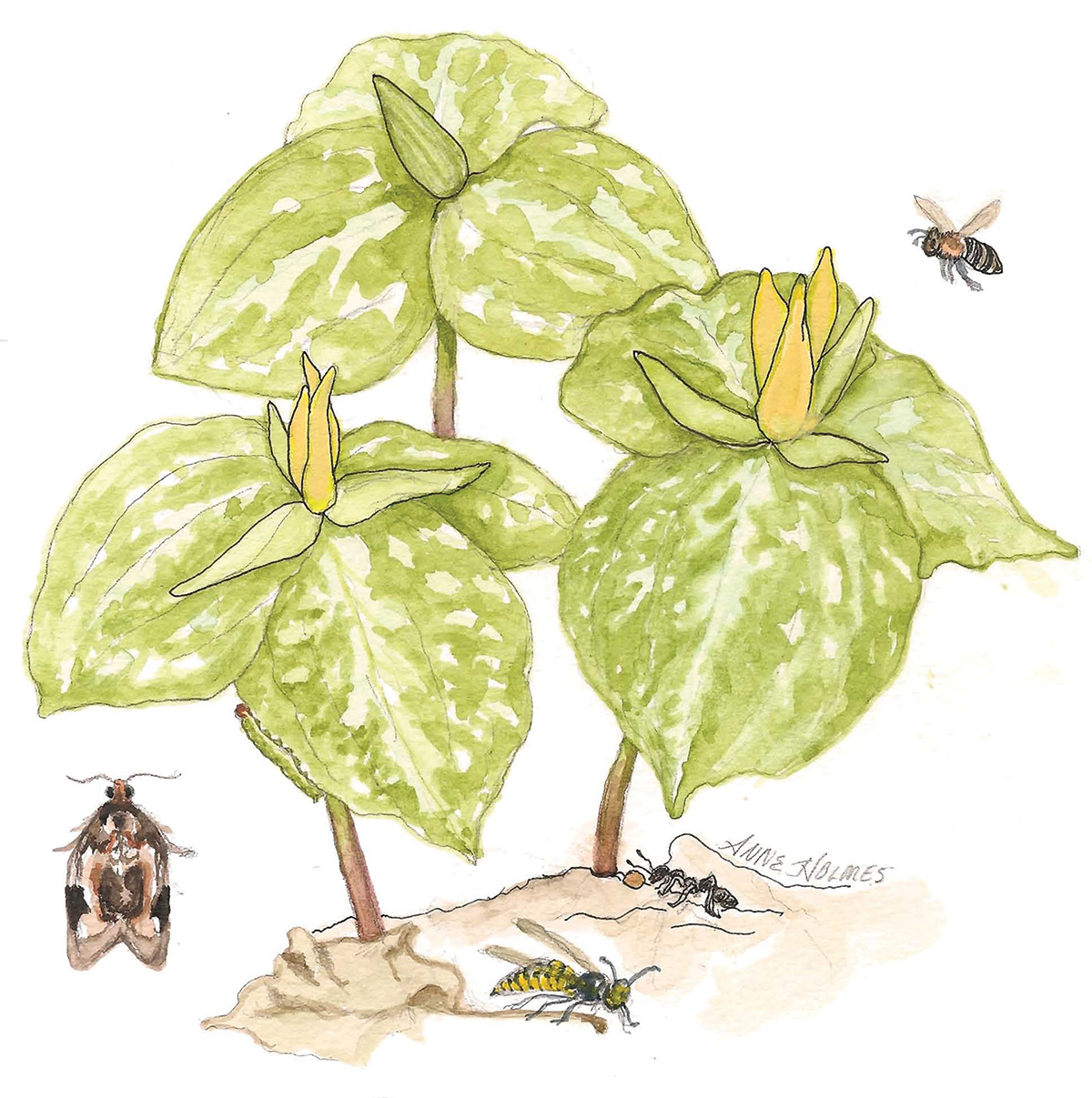
Ann Holmes, artist
In the Southern Appalachians, yellow trillium grows in the wild from Madison County ranging southwestward into Georgia and Alabama. Surprisingly, it also occurs far north of here, in Michigan and up into Canada. Often cultivated by patient gardeners, it makes an attractive if slow-growing addition to any woodland garden.
There are some 38 species of trilliums native to North America, with more than a dozen growing wild here in Western North Carolina. Their colors may range from white to yellow to red to purple and deep maroon, with some displaying patterns and some changing color as the flowers age. Although they are all beautiful, not all trilliums have pleasant scents. Indeed, one is called Stinking Trillium (Trillium foetidissimum)!
Despite their differences, trilliums have a very characteristic look and are easily recognized. All are constructed with parts in triplet: three petals rise above (or nod below) three leaf-like bracts. Some trillium species hold their flowers on pedicels, either upright or nodding, while others—like the yellow trillium—have flowers that are sessile, lacking any stalk and sitting directly above the bracts.
Yellow trilliums offer both pollen and nectar to early spring pollinators, and they are a larval host plant for the Black-patched Clepsis (Clepsis melaleucanus) and the American Angle Shades (Euplexia benesimilis) moths. Its fruits are enjoyed by small animals and especially by ants, who help to disperse the seeds. It also spreads through rhizomes, and if left undisturbed, it forms lovely colonies over time.
Upcoming Events at Asheville Botanical Garden
Saturday, May 2: North Carolina Native Plant Society, Land of the Sky Chapter Meeting
Sunday, May 3: Wild by Design: Container Gardening with Natives, with Molly Pritchard
Tuesday, May 5: C.P.A Series — All About Our Native Bees, with Brannen Basham
Friday & Saturday, May 15-16: Spring Native Plant Sale
Sunday, May 24: Introduction to Sedges, with Gary Kauffman
Saturday, May 30: All About Soils: Understanding and Improving Soils of the Southern Appalachians, with Dalton Buchanan
Sunday, May 31: How to Design a Rain Garden, with Ashley Haywood
The ABG Visitor Center and Gift Shop are open 10 a.m. to 4 p.m. daily, featuring local products, garden-themed art, toys, tools, cards, and books. Asheville Botanical Garden, 151 W.T. Weaver Boulevard, is an independent nonprofit public garden showcasing 750+ species of native plants. ABG’s mission is to promote and showcase the value and diversity of plants native to the Southern Appalachian region by serving as an educational resource and urban destination for nature study and enjoyment. Supported by members, donors and volunteers since 1960, the Garden is free to all. Open daily sunrise to sunset, year-round. Learn more and register for classes at AshevilleBotanicalGarden.org.