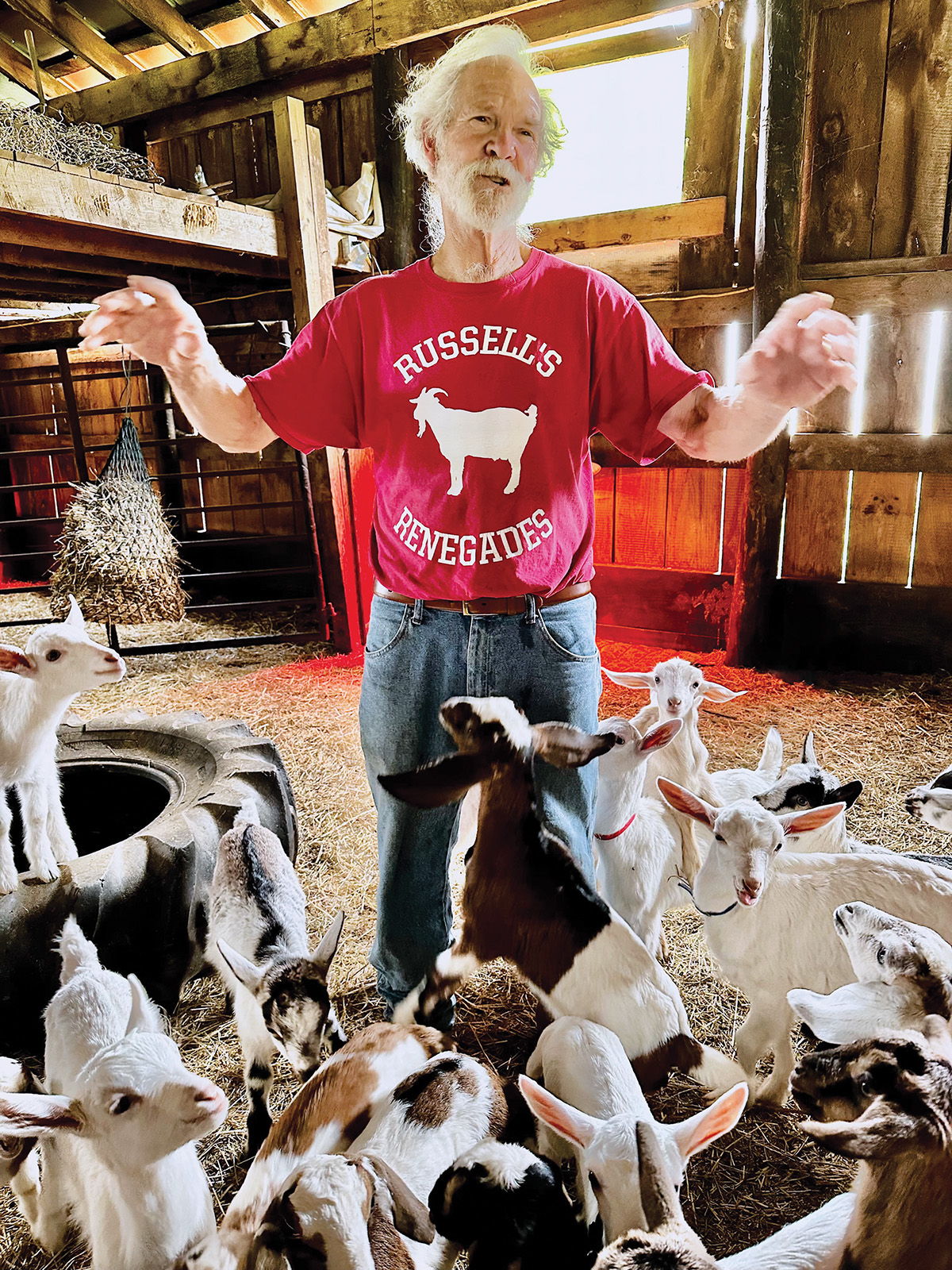
Robert Russell with his goats at Mount Gilead Farm. Photo by Marilynne Herbert
By Paula Musto
Robert Russell holds a Ph.D. in art history from Princeton and spent decades in academia. For years, he studied medieval architecture and visited the great cathedrals of Europe. But today he’s a Leicester farmer whose world revolves around goats, more than 50 does and bucks he tends at his home, Mount Gilead Farm.
The journey from college professor to dairy farmer was unexpected, but there’s no place Russell would rather be than the peaceful valley. Why goats? Well, while living in Italy for a few years, Russell and his wife Kathleen grew fond of soft, creamy formaggio di capra. Back in the US, and tiring of faculty life, Russell searched for options away from scholarly pursuits. Farming was appealing, especially after the couple discovered a 50-acre dairy farm for sale. Soon the goats began arriving, a herd that today produces an array of cheeses marketed under the brand French Broad Creamery.
Russell revels in sharing his passion. During spring kidding (when the females give birth), the public can visit, see the newborns and even bottle-feed the little ones. He expects to have 50 or 60 babies this season.
“Goats are unique animals and there’s no critter cuter than a baby with their soft, expressive faces,” says Russell, who describes goats as more like dogs than sheep with whom they are related. “Goats are naturally curious and do not fear humans. They love to interact and play with people—especially if they think they can weasel a treat out of you.”
Goats are also considerable work. During kidding season, beginning in March and lasting until June, Russell awakes in the middle of the night, sometimes more than once, to check on his does. “Everything goes right 95 percent of the time, but you are there for the five percent,” he says. Despite the long hours, he loves the husbandry life.
“Too many people seem to equate comfort and status with sleeping in,” he says. “But I am most happy to be outside, watching the world wake up. Going from dark to light is a wonderful transformation that I enjoy.”
While lovable, these highly intelligent animals are known, in human terms, to be naughty. “Don’t let that angelic face fool you,” Russell says. “They love to push boundaries. A goat would rather steal food than have it given to them.”
If any fencing can be overcome, goats almost inevitably escape. While commonly thought to be grass grazers, goats are browsers and unlike sheep, who feed side by side, goats are independent-minded souls who like to spread out and explore. If free to roam, Russell says, a goat will eat every garden leaf and ornamental flower in sight rather than feed in a nearby pasture full of grass. They are quick learners, known to figure how to open gate latches and barn doors.
Here are some facts about these wily animals:
• Goats are thought to be the earliest livestock species, domesticated 10,000 years ago. Because they could travel with people and survive droughts, goats were sometimes called “the poor person’s cow.”
• Perhaps, the most famous goats—mountain goats—are not goats at all. They are not even closely related. Early explorers thought the mountain animals looked like goats (they do have horns, beards and hooves) so the name stuck. But mountain goats are more closely related to the musk ox and other members of the goat-antelope group, having split off from true goats millions of years ago.
• Goats and sheep are closely related. But despite physical similarities, the animals behave quite differently. Goats are super-smart problem-solvers, while sheep—well, not so much. Goats are highly social animals, while sheep are more reserved, usually avoid human interaction and have a strong flock instinct.
• Goats have unusual horizontal eyes with rectangular pupils designed for a wide field of vision and predator awareness. They can keep a watch from almost any direction without lifting their head.
There are more than 200 domestic goat breeds found worldwide, raised for dairy, meat and fiber. Russell has three: Alpine, a breed that originated in the Alps; Nubian, recognized by their long, Roman-like noses; and Saanens, a popular Swiss breed.
Russell first learned about cheesemaking the academic way—by reading books. But that only went so far. Hands-on experience, along with a lot of initial mistakes, was necessary to create fine artisan cheeses. “I enjoy experimenting with various flavors and try to avoid relegating cheese to a vehicle that carries the flavor of whatever has been added,” he says. “I want to bring to the foreground the cheese itself with hints of additional flavor, like an echo that is heard in our mountains.”
Tangy chèvre is always in high demand, but also popular are his bloomy rind and aged, raw-milk cheeses. The cheeses are sold on the property as well as at local farmers markets and restaurants.
Does Russell miss academia? “The goats are much more inquisitive than most students were and more grateful,” he says. “And I do not have to go to any more committee meetings.”
Visit MountGilead.com to learn more about goats, cheese and farm visits.