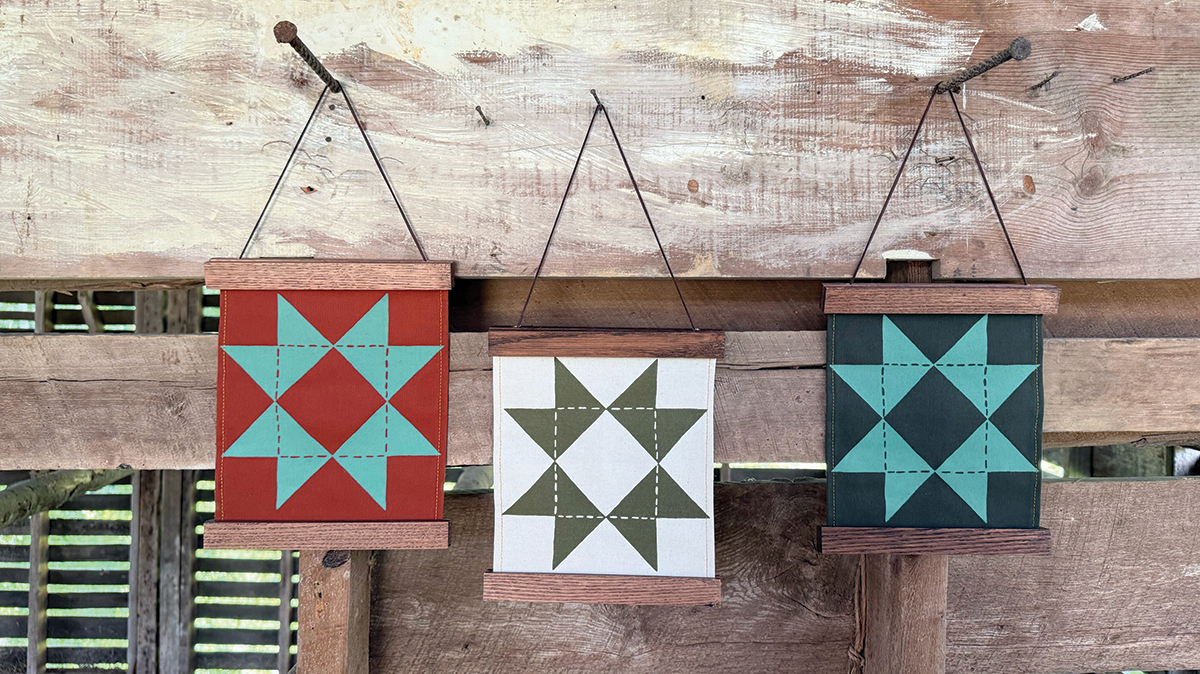
Barn Quilts. Rachel Elise, artist
By Gina Malone
When Rachel Elise Aughtry was growing up in Houston, TX, her mother made painted t-shirts, scrunchies and hair bows, selling them at craft shows to help pay for her daughters’ preschool. And just as her mother had with her, she passed the knowledge of sewing on to Rachel when she turned ten. “One of the first things she taught me to sew was a little drawstring bag that I used to carry my pencils and markers to school,” says Rachel. “My friends all wanted one, too, and after a few weeks, I’m pretty sure every girl in the fourth grade had one. So, it didn’t take long for making bags to become my thing.”
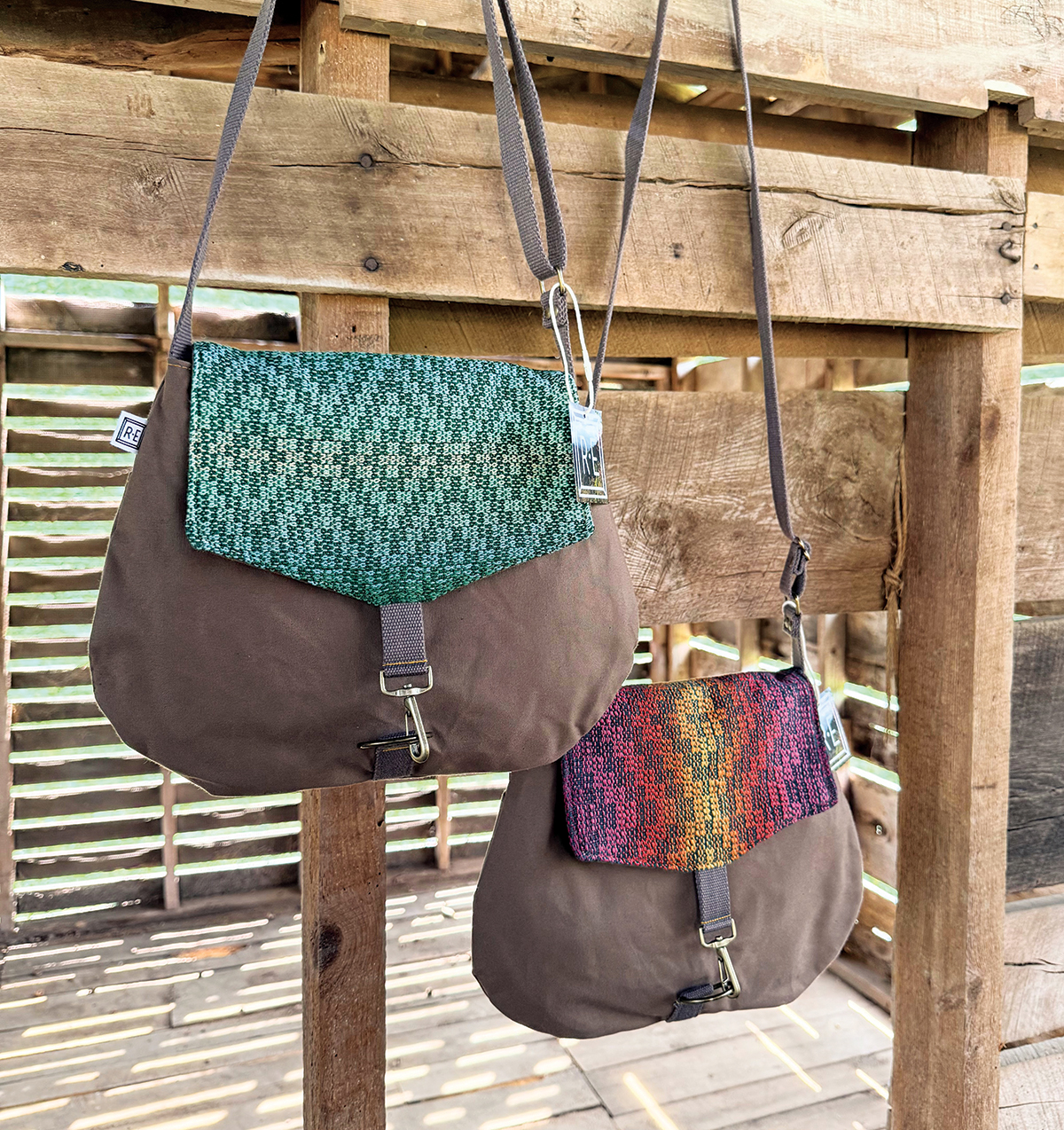
Woven Satchels. Rachel Elise, artist
She continued to learn from her mother and took as many art classes as she could while in school. After briefly considering a career in photography and then graphic design, she ultimately, at the direction of a college advisor at the University of North Texas, decided to explore fiber art. “I had no idea what that was,” she says, “but I quickly learned this was the place for me.”
After her first year at college, she began making bags and selling them at a local coffee shop and on Etsy, a new platform at the time. “As I learned new skills, including screen printing and weaving, I started to grow my little bag business—at first just to make a little money, but I soon wondered if it could be more,” Rachel says. “At the time, Etsy put out a weekly article called ‘Quit your Day Job,’ interviewing artists that left their careers to pursue their art businesses full time. I eagerly awaited the publishing of that article every single week, and I began to think that maybe this was the path for me.”
Her boyfriend at the time, Bo—now her husband—offered practical advice. She was graduating in the midst of the Great Recession. She might go to work for someone else, he told her, then have a hard time leaving the job, whereas if she started her own business, she could get a job later if it didn’t work out.
Bo worked to support them the first year while the business got off the ground. And her father helped her make a spreadsheet to determine what the business would need to bring in to offset expenses. “We still refer to this spreadsheet whenever a big financial shift is happening in the business or in my life,” she says.
Her early bags were made with vintage and found materials, embellished with techniques such as appliqué and embroidery. When demand increased for her work, however, she brought her screen-printing skills into play, printing her own textiles. During this time, Bo joined her in the running of the business and, with that change, they decided to move the business to Western North Carolina, where Elementality and another shop already carried her work.
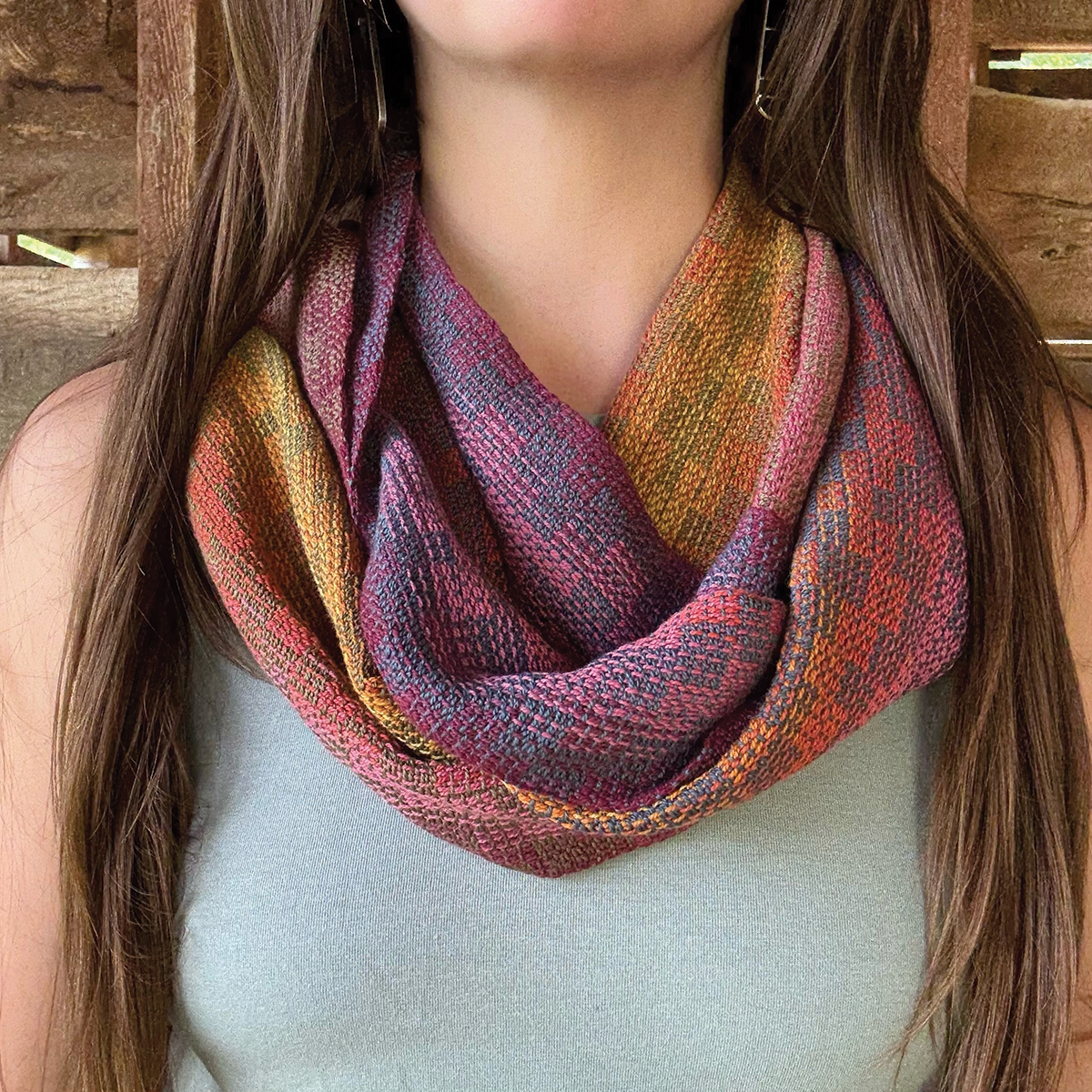
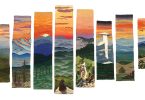
Sunset Scarf. Rachel Elise, artist
“Moving to WNC really changed my relationship with nature, and in turn, the imagery in my work,” Rachel says. “In Texas, my work largely focused on geometric designs, but once I was in the mountains and spending so much more time outside, local scenery, flora and fauna started popping up in my photography, then my sketchbook, and then on the textiles for my bags.”
She hand paints her designs onto mesh screens to create the stencils used in the printing. “Once I’ve printed the image onto canvas fabric, I cut the fabric to the correct size and shape and sew it into a bag, paired with other canvas fabrics, including many that are weather-resistant,” she says. “All of my inks are non-toxic and my fabrics are made of completely vegan, natural fibers. I really strive for my bags to be equally functional, durable and beautiful, with materials that honor our planet as much as possible.”
During the pandemic, she found people willing to support local businesses both for the sake of their survival and because of the realization that supply chains were unstable at the time. “By 2022, Bo and I had scaled the business to a point that it didn’t fit inside our home anymore, so we rented 1500 square feet at 10 North Main Street in Mars Hill,” Rachel says. “This now houses the studio as well as a gallery and gift shop. I’m not sure we would have made that leap without the pressure and fast growth of the late-pandemic economy.”
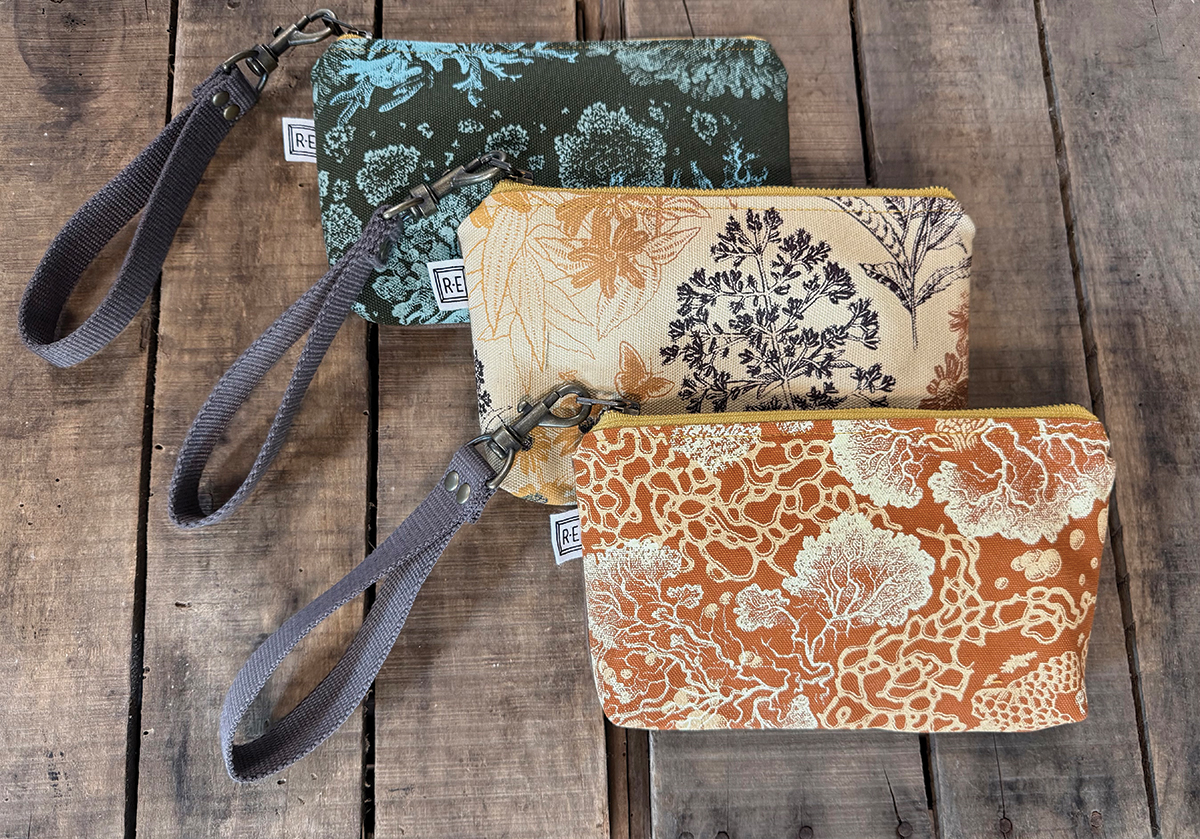
Rachel Elise and Solstice Handmade, artists
It was a time of excitement but also burnout as she felt the pressures of more time manufacturing and less time being creative. She scaled down a bit and took up an old passion: weaving. Today, the business, with the help of her studio assistant, Ellie Weiner, is on an even keel.
“Reintroducing weaving into my life has been such a gift,” Rachel says. “While my printed line of bags is my bread and butter, I usually only come out with two to three new print designs a year, which means most of my time is spent producing rather than being creative. Weaving changes that. I do a lot of designing at the loom, so it’s a fresh and creative practice every time I sit down.” Visitors to Mars Hill’s First Friday events, held each month from 5–8 p.m., can find Rachel demonstrating weaving at her studio.
The Rachel Elise Studio is located at 10 North Main Street, Mars Hill. Hours are 11 a.m. to 3 p.m., Wednesday through Saturday. Learn more at RachelElise.com and follow on Instagram @rachelelise_studio and Facebook (rachelelisestudio). Regional galleries carrying her work include the Southern Highland Craft Guild shops at the Folk Art Center and on Tunnel Road, and Grovewood Gallery. During the Craft Fair of the Southern Highlands (story, p. 24), Rachel Elise Aughtry will demonstrate weaving on Thursday, July 16, and Friday, July 17.