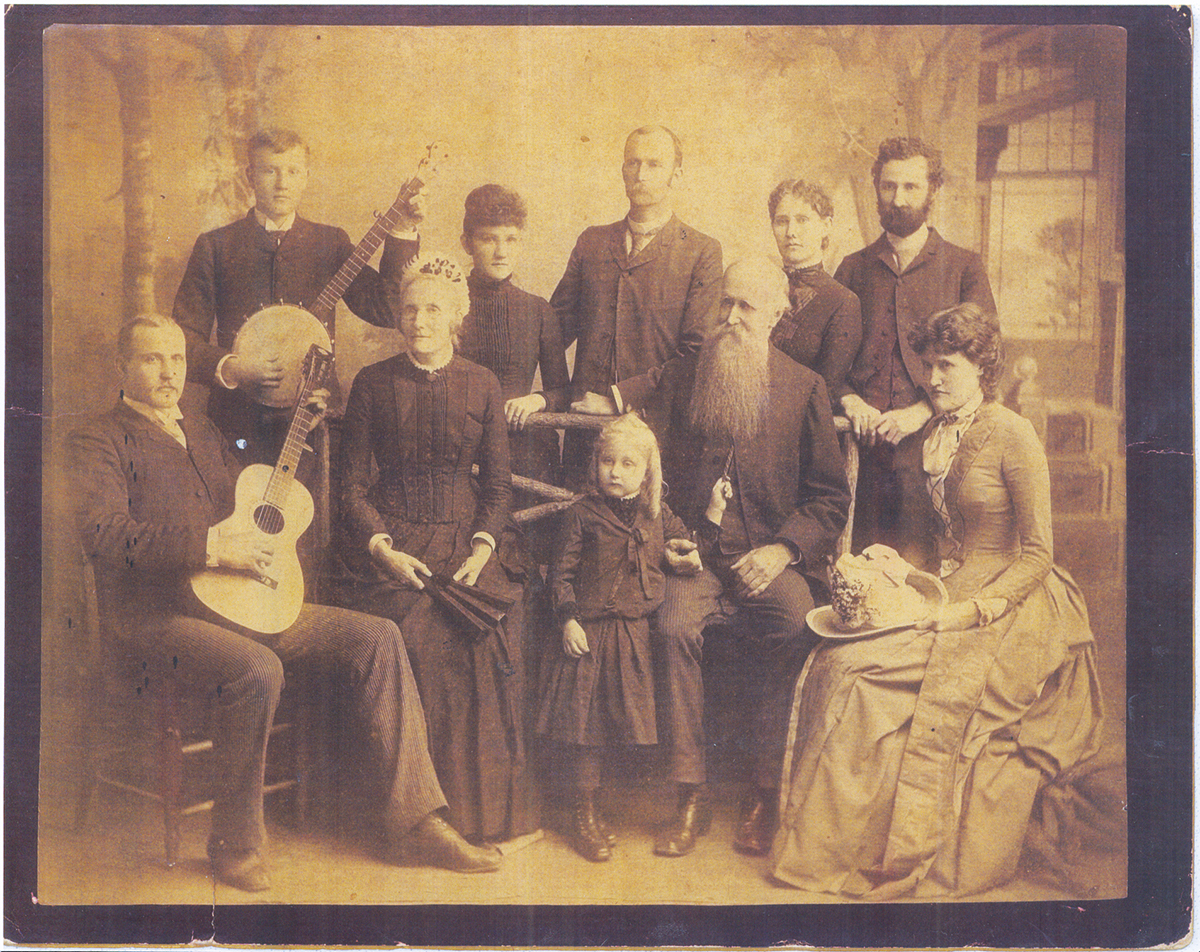
Leicester Chapman and his family. Photo courtesy of Atkins and Chapman Family Papers,
Buncombe County Special Collections
By Lauren Stepp
There are stories in the northwest reaches of Buncombe County that never made it into history books. They live instead in dusty photo albums, handwritten letters and yellowing newspaper clippings. Now, through the Leicester Community History Project, those stories are finding a more permanent home.
Created in partnership with Buncombe County Special Collections and the Leicester Branch Library, the project is collecting oral histories, photographs, scrapbooks and personal artifacts tied to the Leicester, Sandy Mush and French Broad townships. According to Katherine Calhoun Cutshall, a public historian who manages Special Collections, the initiative is the latest in a series of community-based archive projects that have previously documented West Asheville, North Asheville and, most recently, Fairview.
“The bulk of our collection focuses on Asheville, but we know that Buncombe County is far more than its urban center,” says Cutshall. “When planning to embark on a new community history project, we wanted to continue the trend we started with the Fairview project and keep our rural communities in focus.”
The Leicester archive already includes contributed materials ranging from the Plemmons-Snelson family scrapbook—a sprawling collection of photographs and ephemera documenting family life from the late 1800s through the early 2000s—to newspaper clippings detailing the 1900 discovery of magnetic iron ore on Turkey Creek.
The materials offer a glimpse into a community with deep roots in Buncombe County. Originally known as Turkey Creek, Leicester established its first post office in 1829 before being renamed in 1859 for English immigrant and postmaster Leicester Chapman. By the late 1800s and early 1900s, daily life largely revolved around agriculture, with families raising tobacco, dairy cattle and beef livestock.
Cutshall says preserving the past is especially important in rural communities like Leicester, where historical records are often incomplete or scattered across private collections rather than in centralized archives.
“Maps, photographs and other types of documentation of downtown Asheville and the surrounding suburbs are abundant, and frequently, we are able to assist folks whose questions concentrate on these communities with ease,” she says. “However, when it comes to similar questions about rural neighborhoods, this becomes a lot more difficult because of archival absences.”
Filling those gaps requires active participation from the community itself.
As Cutshall says, “By building relationships with those who hold these stories and equipping the community with resources to protect and share them, we’re able to fill archival silences and ensure the preservation of community memory through oral history and the preservation of historical materials.”
To learn more about the Leicester Community History Project, volunteer or contribute materials, visit LeicesterNC.omeka.net or contact Buncombe County Special Collections at 828.250.4740.