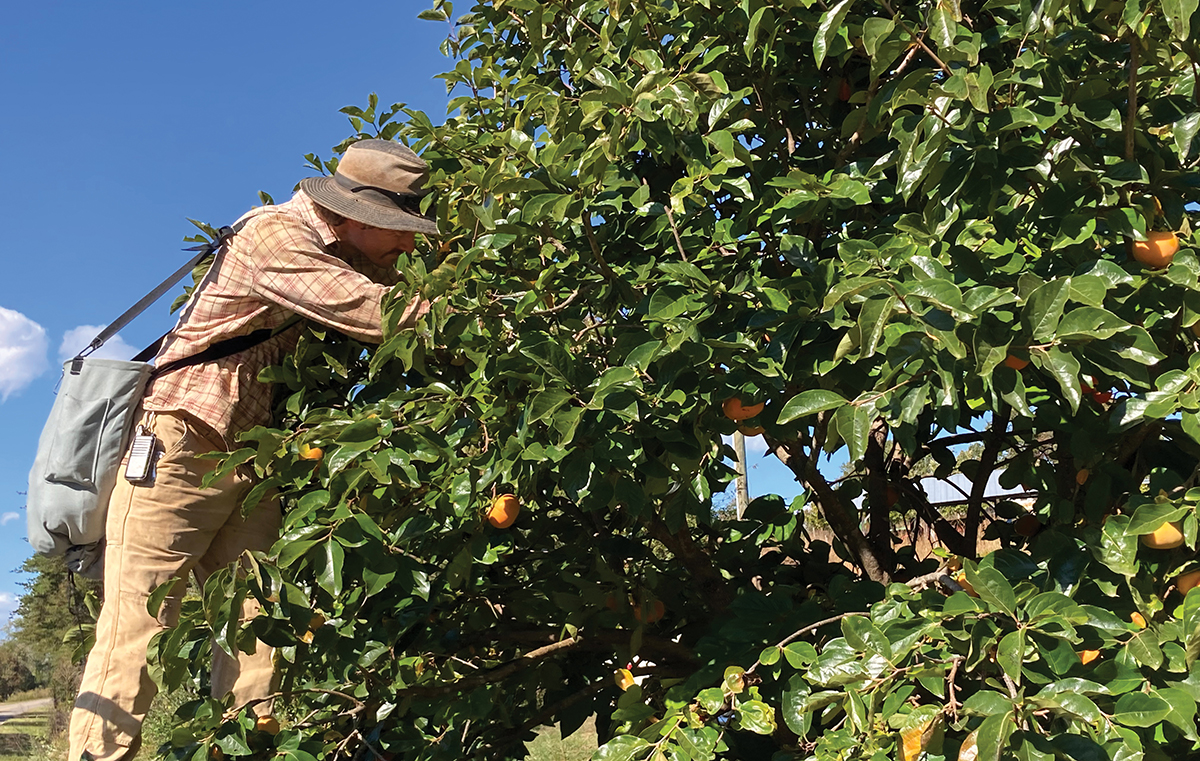
Jamie Davis harvesting persimmons at A Way of Life Farm. Photo courtesy of AWOLF
By Lyric East
I try to remain adamant about not picking favorites in life. Asserting a favorite color, food, plant or season feels antithetical to the deep love and appreciation I feel for all of them and their different gifts, timings and teachings.
So, I cannot tell you that persimmons are my favorite flavor of autumn. But I can tell you that the experience of licking sweet, caramel-y amber persimmon goo from my fingers in September is a fall-on-my-knees reverie of deliciousness that holds a distinct seasonal pleasure all its own. And that I really, really want you to experience it, too.
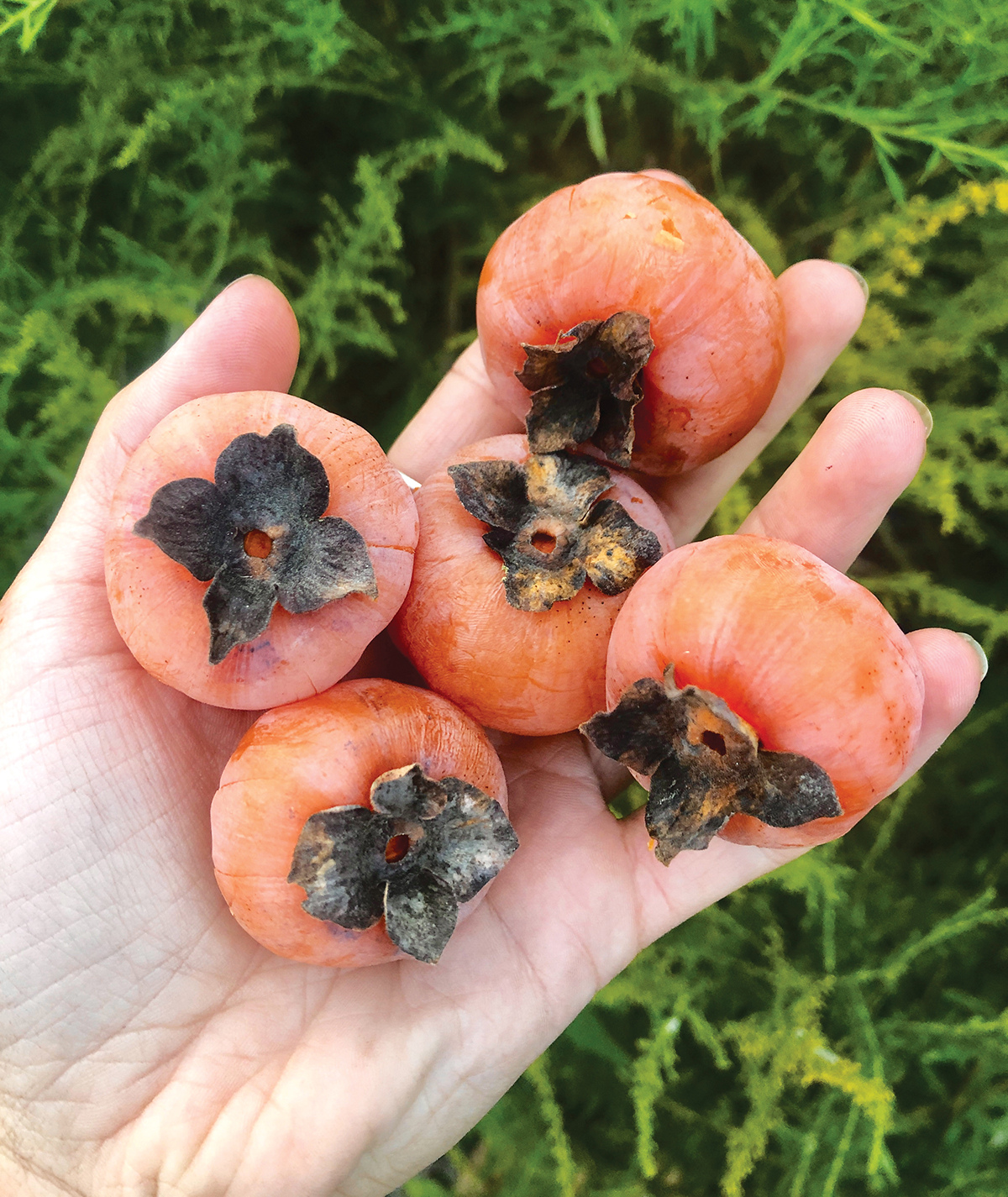
American persimmon. Photo by Lyric East
This reverie is a gift from the American persimmon (Diospyros virginiana), a common native canopy tree of the South. The trees tend to be slender with chunky bark full of deep, orange-toned grooves. The leaves are simple, dark green and slightly glossy. American persimmon trees can be most easily spotted in September and October, when their fruits begin to turn orange and fall to the ground around the base of the tree.
American persimmons are a tricksy and humorous fruit, containing a strong astringent tannin content before fully ripening. This creates a drying effect in the mouth that is quite intense. A longstanding autumn prank of mischievous folk is to encourage someone to eat an unripe persimmon—which understandably can ingrain a lifelong detestation of the fruit.
To avoid this, be sure to harvest American persimmons after they have softened and fallen. Ensure you are harvesting from a clean place and examine your fruits for insects or molds. Remove the hard brown “hats” from the fruits before eating or preserving. Depending on the tree, there may be a number of hard seeds inside which are generally too large to eat. These can be removed by hand or with a food mill.
If you’re not the foraging type, local farmers are privy to the compatibility of our climate for growing different varieties of the American and Asian persimmon (Diospyros kaki). As a tree crop, persimmons are a long-game investment as it takes several years before the plants produce fruit.
A Way of Life Farm (AWOLF) in Rutherford County maintains a diverse fruit and nut orchard, first planted in 2019, in addition to its extensive vegetable gardens and organic pork operation. They harvested their first American persimmon fruits in 2025. “Not enough to sell, but enough to taste,” recalls Jamie Davis, co-owner of AWOLF. “We grow both Asian and American persimmons on our farm. In 2025, we sold Asian persimmons for the first time at the farmers market. We have only a few mature, fruit-producing Asian persimmons now, but we have planted more young trees that we hope will be producing in a few years. Hopefully, we will have enough fruit either this September or next year to start bringing American persimmons to the farmers market. In the future, as these trees mature, they should produce enough to supply wholesale markets as well.”
As they learn from the different varieties they are growing, Davis shares some key qualities offered by Asian persimmons: versatility and storability. “My favorite Asian persimmon variety so far is called Jiro,” Davis says. “Being a non-astringent variety, it can be eaten while crisp like an apple, or allowed to soften fully before eating. Our Asian persimmons ripen in October and we have been able to store them refrigerated until late December.”
Both the American and Asian persimmon fruits freeze well for later enjoyment in smoothies, pies, cinnamon roll filling and whatever other autumnal spiced treat you may dream up.
A Way of Life Farm offers a longstanding CSA program with a pickup location at All Souls Pizza in Asheville. Learn more at AWayofLifeFarm.com. Look for persimmons at area farmers markets in September and October. Lyric East is an artist, writer and owner of Wild East Farm. Find her photos and quarterly publications at WildEastFarm.com. Her farm-grown foods are available weekly at the RAD Farmers Market and the North Asheville Tailgate Market.
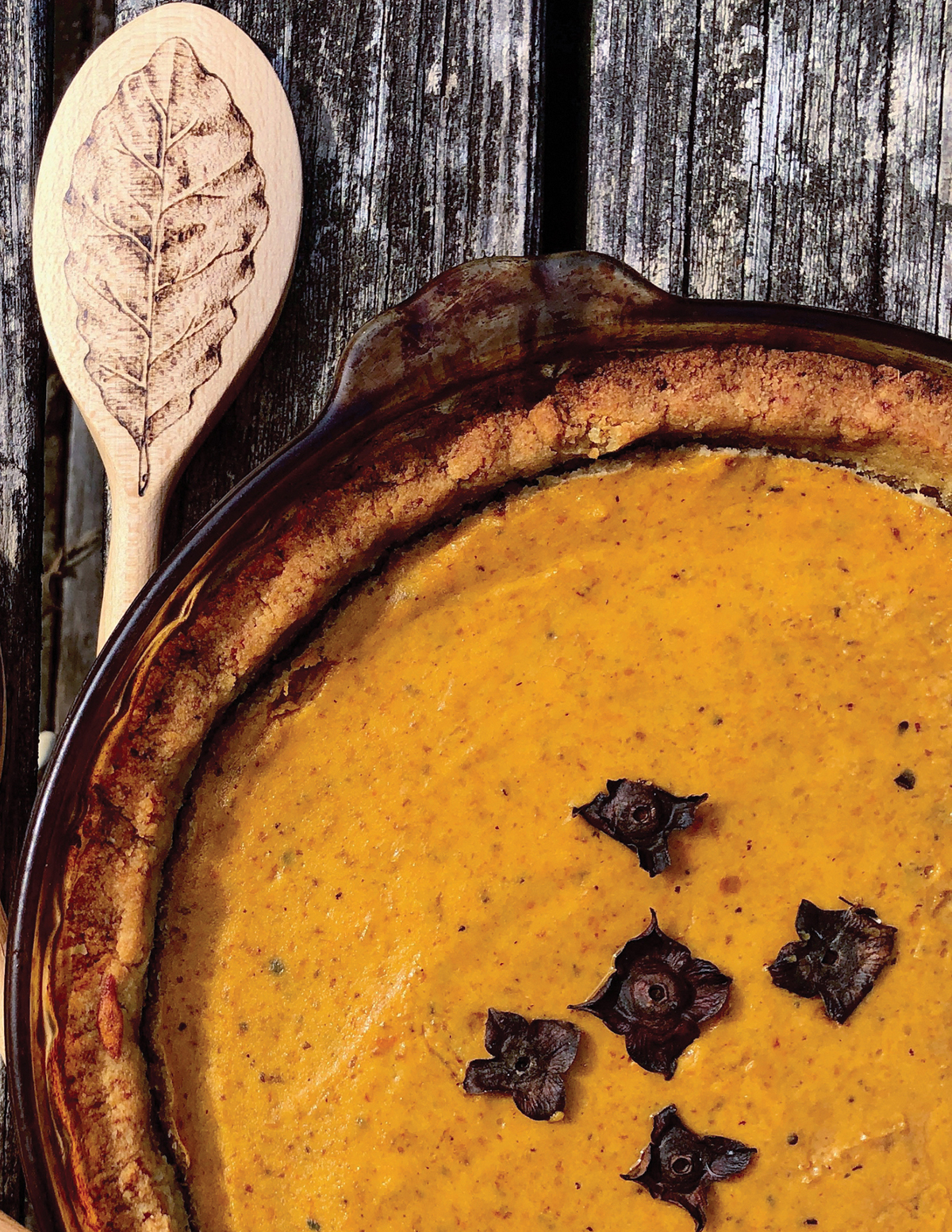
Persimmon pie. Photo by Lyric East
Simple American Persimmon Pie
Pie crust:
Use your favorite pumpkin pie-style crust recipe that meets your dietary needs.
Be sure to par bake.
Pie filling:
1-1/2 cups thawed or fresh American persimmons
1/2 cup full fat coconut milk
1/4 cup maple syrup
pinch salt
Optional:
1 tsp ground spicebush berries
1 tbsp ground ginger
1. Preheat oven to 325°. Par bake pie crust according to crust instructions.
2. Ensure all seeds are removed from persimmons.
3. Blend all filling ingredients in a blender or food processor until completely smooth. Check for any straggler persimmon seeds at this stage by stirring through the mixture.
4. Spoon the filling into your pie crust. The mixture will be thick and will require scooping out of your blender.
5. Bake at 325° for about 25 minutes, until the center is just firm to the touch. Do not overbake.
Allow to cool completely before eating. Pie is best enjoyed the next day after chilling in the fridge. Try serving with homemade vanilla ice cream.