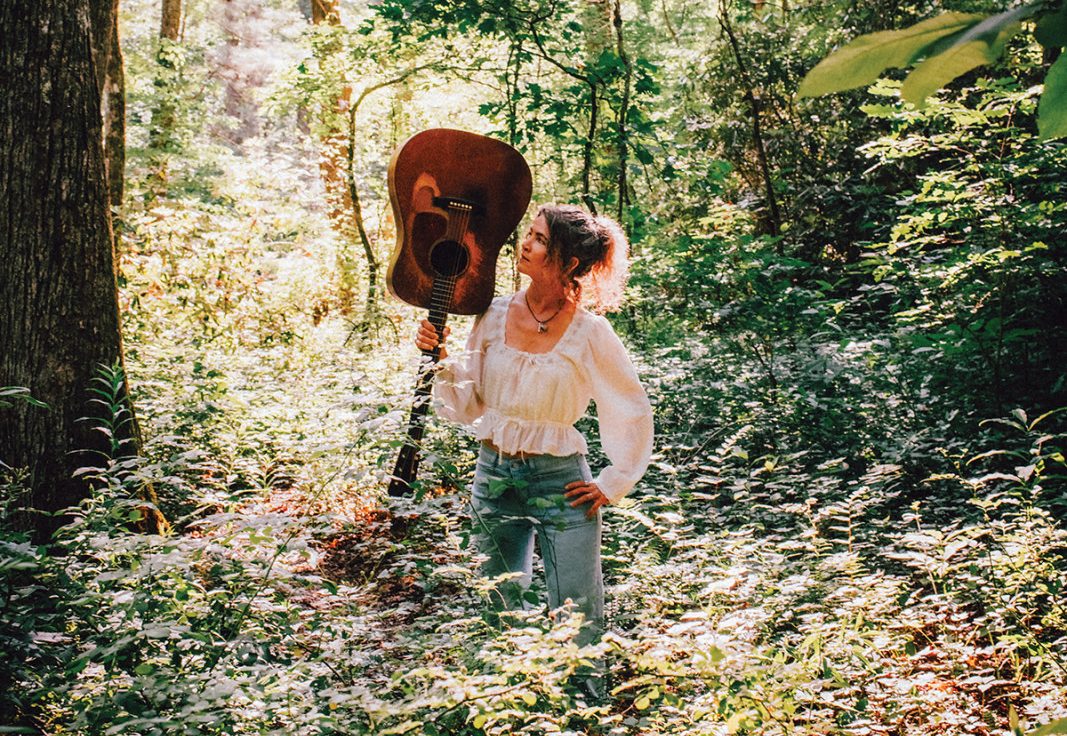
Miriam Allen. Photo by Sandlin Gaither
By Gina Malone
When it comes to environmental and social justice causes, Miriam Allen is not standing still or staying silent. In September, she released a song titled “The Queen of Buncombe County” about one of the county’s oldest white oaks, estimated at more than 300 years old and designated a Treasured Tree. The magnificent and majestic tree stands in the Hominy Creek Valley.
“There aren’t many white oaks that old or big in the county (according to my arborist),” Allen says, “and her canopy is just ridiculous. There’s a whole village of critters living up in there. I have no idea why or how she never got logged. She’s part of a stand that spreads through my neighborhood. She’s been through a lot. She deserves a song in her honor.”
Allen’s close relationship with the natural world often draws her into the woods. In January, she will release a song titled “Walk A Mile” that encompasses her thoughts and experiences over 35 years of backpacking. “I’ve been ‘hiding’ in the woods since I was a young child,” she says. “I’ve backpacked around 1,500 miles since I worked in Yellowstone in my early twenties, slept in remote Appalachian lake coves alone in my little sailboat around 300 nights, hiked over 10,000 miles and, this morning, I woke up in the maritime forest of Maine to the rare sound of a Hermit Thrush singing his full song in September. I’ve been up here hiking/backpacking alone for three weeks now listening to all the birds.”
Alexandra Miller became friends with Allen after suffering injuries from a fall shortly after the two met on a full-moon night hike. “Miriam stepped up to walk my dog while I was in hospital, and drove me to appointments for months,” Miller says. “I am still so grateful for all her support and encouragement and amazed at how generous she was with someone she barely knew.”
Miller, too, has a long history of rugged back country hiking and backpacking, and when she was healed enough, Allen coaxed her back out onto the trails. “Luckily, both of us tend to want to be in the woods more for the curiosity, birdsong, bug chasing and rich habitats than for the athletic conquering of mountains with fast, high-mile days,” Miller says. “I can always count on her to stop with me to peer into moss and talk about plants, bash our way off trail for a skinny dip in a tiny mountain creek pool or stop mid-sentence if we hear a Wood Thrush sing.”
Allen says that while she has raised awareness by writing songs and organizing events for causes like immigrant awareness and mental health she feels less sure of where to begin to advocate for the natural world. “Environmentally, I can’t wrap my brain about what I can do to stop the ‘fire hazard mitigation’ the National Park Service is doing on the Parkway in the fragile ecosystem of the high-elevation conifers,” she says. “I’m terrified about the USGS plans to mine lithium throughout the Appalachians. I’m heartbroken about the repealing of the Roadless Rule.”
On a recent backpacking trip in the Black Mountains, Allen and Miller counted 22 Hermit Thrushes over a three-day period. “That’s not many,” Allen says. “I cry every year when I hear the first one. It is the sound of magic. So I’ve made lots of short videos and social media posts to keep people informed and send them in the right direction to protest. I talk to folks at MountainTrue and ask them to ask the NPS to, at least, wait until after brooding season to log.”
“The Queen of Buncombe County” was written at the request of the Hemlock Restoration Initiative (HRI). “HRI has been honored and fortunate to have Miriam believe in our mission and support it through her actions as a volunteer, and her voice as a songwriter,” says HRI director Margot Wallston. “I have been further blessed to have her as a longtime friend; she has served as a cheerleader and inspiration for me, seeing and celebrating the work I have put so much of my own energy into over the past decade.”
Allen writes music for every listener—from the group home residents she plays for weekly to young children. “Maybe if someone listens to ‘The Queen of Buncombe County,’ they’ll think differently about what forests are doing for us, for their children, and vote to keep what’s left of it,” she says. “Or maybe someone who’s been through violent trauma and experienced the unfortunately normal societal blame for it will listen to ‘Kentucky Angels’ and feel validated and understand their worth.”
Miller says that Allen exhibits the same concern on a personal level: rescuing abandoned pets, injured wildlife and distressed humans. “In my experience, if she sees someone in need and they’re stumbling or flailing in even remotely the right direction,” Miller says, “they will find themselves with a strong wind at their back in the shape of a feisty 5-foot-not-much force of nature with good food and construction skills and spirited songs at hand.”
Find Miriam Allen’s music and upcoming events at MiriamAllen.net.