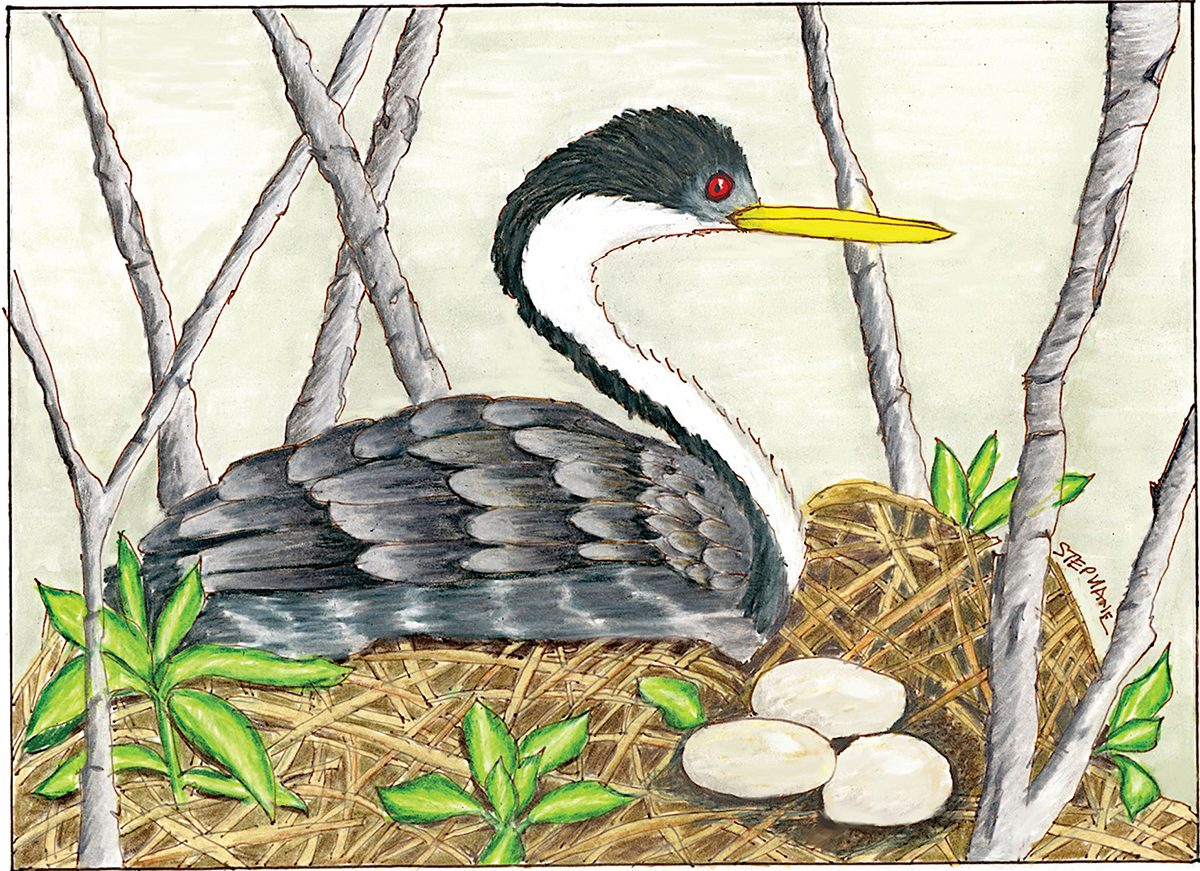
Western Grebe. Stephanie Sipp, illustrator
By Carol Howard
On January 17, 1971—fifty years ago this month—a young African American man named John Francis witnessed the effects of a catastrophic oil spill in San Francisco Bay, the result of two tankers colliding. More than 800,000 gallons of oil poured into the waters, threatening the vegetation of coastal habitats and claiming the lives of thousands of long-necked Western Grebes and other birds. Francis was among the volunteers who rushed to the beaches in an attempt to rescue oil-soaked birds. Out of this disaster, he found his calling as an environmental activist.
As he recounts in the memoir Planetwalker (2005), Francis spent several months following the incident mulling over the possibility that he might raise public awareness of environmental degradation if he were to renounce gas-powered travel. He asked himself whether a one-man boycott could make a difference. He thought, too, about how disruptive to his own life it would be not to ride in cars, trains, buses or planes. For starters, he would lose the job to which he commuted. It would also become difficult to visit distant family. One day, during these months of soul-searching, a friend of his died in a boating accident. Francis was so affected by the sudden loss that he spontaneously set off on a twenty-mile walk to celebrate his friend’s life. During the walk, he gathered the courage and determination to live his life purposefully.
Francis walked for the next twenty-two years. He gave up speaking for seventeen of those years because he wanted to learn how to listen to others. To be sure, he could have traveled much more quickly on a bicycle, and he sometimes did. But walking and communicating silently became a mindfulness practice as well as a form of activism. He had become an environmental pilgrim—one with a sense of humor: he saw the comic absurdity of walking several hundred miles just to keep an appointment. He began choosing his appointments carefully.
During his early years of silent walking, he searched for wilderness, painted scenes from nature and played the banjo. His guiding text was The Autobiography of Malcolm X, as he found the account of Malcolm’s hajj pilgrimage to Mecca a compelling model. His dismayed but supportive father observed that “things are difficult enough for black folks.” Why was he making his life harder? The dangers to an African American man walking alone on a highway were all too present, as he learned on one occasion when two white men threatened his life.
As his adventures began to gain media attention, he went to college and later earned a doctorate in environmental studies, all while remaining silent. He founded the non-profit educational organization Planetwalk and was hired by the Coast Guard to write oil spill regulations. He won international renown and was named a United Nations Goodwill Ambassador for his mission to foster the understanding that environmental protection and social justice are inseparable: “If we as human beings are an integral part of the environment,” he writes, “then how we treat each other” profoundly affects the natural world around us.
Francis eventually started speaking and using motorized transportation in response to “a growing sense of responsibility to my family, and my education, as well as to the communities and groups of people I was meeting on my journey.” Today, Dr. Francis serves as a commissioner in West Cape May, NJ. He continues to raise awareness about sustainability and the environment by hosting “Planetwalks” for college students in China and other locations around the world.
Carol Howard is dean of academics at Warren Wilson College. Planetwalker is available through the National Geographic Society. John Francis offers a summary of his journey in a TED Talk at Planetwalk.org.