David Ballard, artist
By Casey First
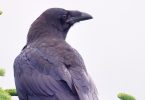
The American Crow (Corvus brachyrhynchos) is a highly adaptable, socially complex and extremely intelligent bird that can be found just about everywhere in North America. A glossy, all-black bird that is a member of the populous Corvid family, the American Crow is a close relative to other well-known birds like Ravens, Jays and Magpies. The Crow is a songbird, but you would not know it based on the hoarse, cawing sounds this bird emits.
What is far more impressive for the American Crow versus other songbirds is their diverse and complex language patterns, problem-solving skills and cognitive abilities. The American Crow is one of the smartest birds in the world. They have long been studied and revered for their extraordinary talents, such as facial recognition and their ability to use tools. They play tricks on one another and even hold funerals for their own deceased members.
If you feed the Crows in your backyard, don’t be surprised if you find that shiny gifts of metal and glass shards appear at your doorstep as their way of saying “thank you.” Due to their large size (about twice the size of a Blue Jay and with a wingspan of more than three feet) and the fact that they like to forage on the ground, they won’t come to your typical backyard bird feeder. Instead, offer peanuts or food scraps on a much lower ground feeder to try to win them over. In the wild, their diet is extremely varied and opportunistic. Depending on where they are located, they will readily eat everything from grains, nuts and fruits to carrion and small animals like mice and snakes. American Crows found along the coastal areas and near water like to snack on turtles and a wide variety of seafood.
Unfortunately, these birds can also be aggressive and will invade smaller birds’ nests, eating their eggs and nestlings. They’re territorial and not at all shy. They will put up a good fight to scare off other birds, even larger birds of prey like hawks and owls. American Crows are highly adaptive and can be seen all over North America, but they’re most prevalent in areas that tend to be more open and spacious, like parks, cemeteries, golf courses, sandy stretches or the edges of woodlands.
Highly social creatures, American Crows are found in groups (a “murder of crows”) rather than being seen alone. They communicate as they forage and pick up on each other’s social queues and language to divert threats and stay safe. In the winter months, Crows congregate in much, much larger numbers and sleep in communal roosts that number up to the millions to provide warmth and protection!
When spring rolls around, nest building begins and Mom and Dad Crow will work together to gather large pencil-width twigs to frame the outside of a nest that is about one and one-half feet wide. Nests are typically tucked away high in the fork of an evergreen tree. However, much like their adaptability with diet and habitat, the same is true for nesting. Urban Crows have been known to nest in eaves of large skyscrapers or on open ledges of buildings. Once the nest is built, Momma Crow will lay up to nine eggs per clutch and will have one to two broods per season. This provides plentiful offspring, which has helped sustain this species’ global numbers over the course of the last 50 years.
Casey First is owner of North Asheville Wild Birds Unlimited, located at 946 Merrimon Avenue, Suite 120. Monthly bird events are free and open to the public, with no registration required. To learn more, visit NorthAsheville.wbu.com. Artist David Ballard lives in Candler. Find his work on Instagram at d.ballard.art.