By Elaine Smyth
If you read the title of this article and thought, “Mosses don’t bloom,” you are assuredly correct! However, allowing a small stretch into metaphorical meaning, mosses do “blossom” in the winter months, taking center stage with vibrant shades of green, red and gold. When flowering plants are dormant, mosses have their moment on the center stage.
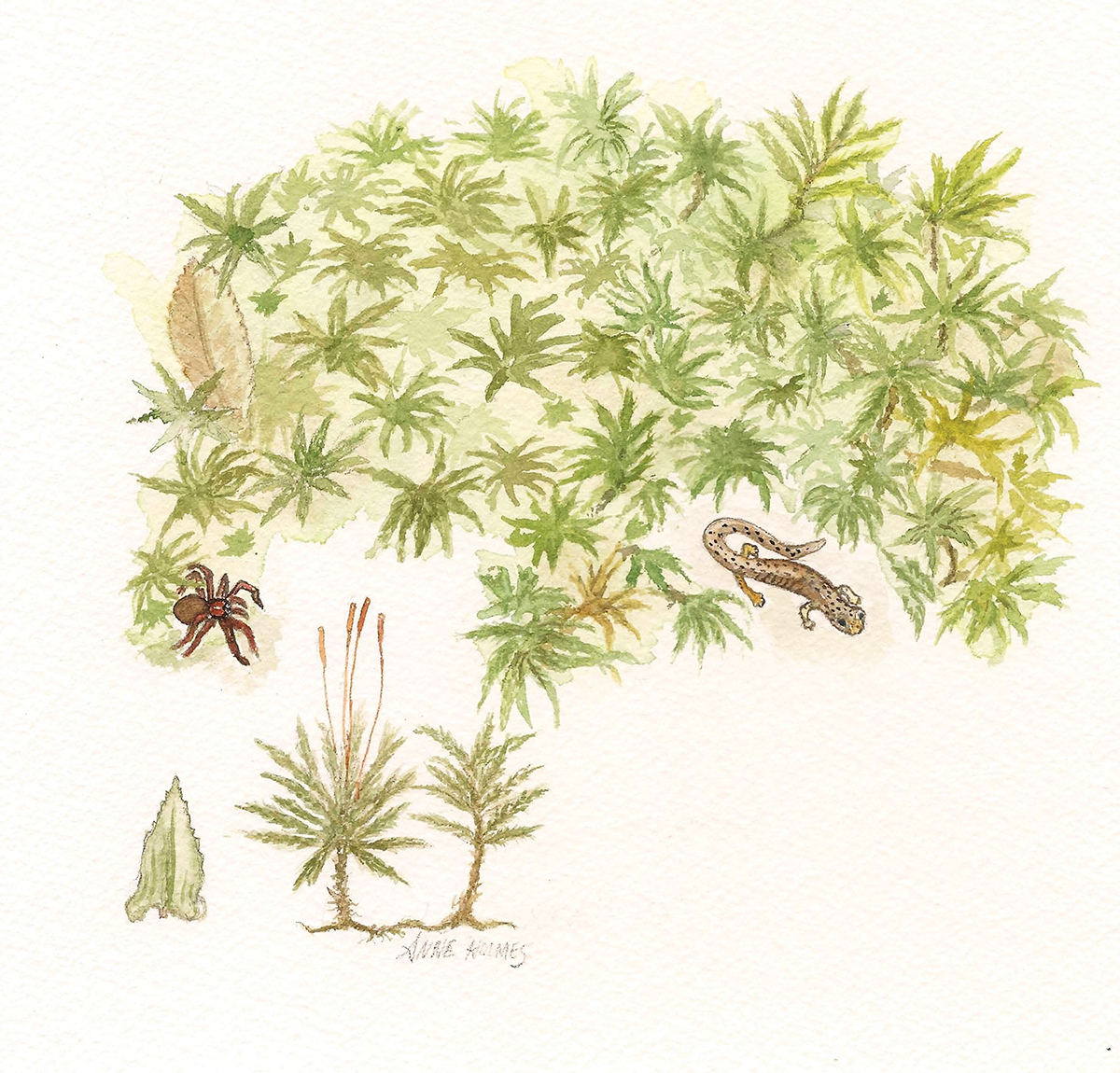
Anne Holmes, artist
Mosses live on every continent and are quite varied, with some 25,000 species known. They have an ancient lineage, tracing back 450 million years ago. As a group, they are remarkable survivors, having persisted through five mass extinction events, including the disappearance of the dinosaurs. They’re also remarkable survivors individually, having an amazing ability to endure desiccation, as well as extreme heat and cold, to seemingly come back from the dead when conditions improve.
In the southern Appalachians, our cool, moist coves, waterfall splash pools, grassy balds and rock outcrops are home to more than 400 species of mosses, which thrive in our diverse ecosystems. Asheville Botanical Garden (ABG) alone is home to at least 100 species of bryophytes—mosses, liverworts and hornworts.
Among them is American tree moss, Climacium americanum, so named because its individual stems resemble miniature trees. It thrives in moist conditions and will form lovely, thick mats to make a lush, wonderfully textured ground cover. In the ABG, you’ll find a fine stand of American tree moss growing near the water feature, just above the Cherokee Garden.
Mosses render many ecological services, as well. They are tremendous at soaking up rainfall, and they help to hold water and maintain moisture for other surrounding plants. They also provide important insulation, cooling plant roots and sheltering small creatures from the cold. When fires, floods and landslides happen, mosses are among the first to move onto the disturbed ground, stabilizing the soil surface and retaining water to help plants to grow. Post-Helene, we certainly need their help!
Upcoming Events at Asheville Botanical Garden
Learn more and register for classes online via the ABG website at AshevilleBotanicalGarden.org.
Tuesday, December 1
C.P.A.: Bee My Little Baby—Intro to Bee Nesting, with Brannen Basham
Saturday, December 5
Pruning for the Natural Gardener, with Alison Arnold
Sunday, December 6
Cultivating Experiences and Supporting Wildlife with the Winter Garden, with Preston Montague
Saturday, December 12
Beautiful and Beneficial Home Landscapes with Three Local Landscape Experts
Monday, January 11
C.P.A: Introduction to Plant-Pollinator Co-Evolution, with Phyllis Stiles
The ABG Visitor Center and Gift Shop are open 10 a.m. to 4 p.m. daily, featuring local products, garden-themed art, toys, tools, cards and books.
Asheville Botanical Garden, 151 W.T. Weaver Boulevard, is an independent non-profit public garden showcasing 750+ species of native plants on 14 acres. Our mission is to promote and showcase the value and diversity of plants native to the Southern Appalachian region by serving as an educational resource and urban destination for nature study and enjoyment. Supported by members, donors and volunteers since 1960, the Garden is open daily, sunrise to sunset, year-round, free to all.