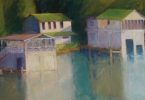
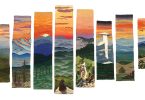
(Left) Mount Mitchell. (Right) Mount Jefferson Mountain. Robert Johnson, artist
By Gina Malone
Most artists claim a kinship with nature—love of playing in the natural world as a child; inspiration in the colors, lines and shapes found there; its ability to inspire art in all of its forms. For Robert Johnson, who grew up in a science-oriented family and was not guided toward expressing himself with art, it was the natural world that beckoned and embraced when he was a child. “My love of nature came first and is still my first love,” he says. “I would much prefer talking with a naturalist than with an artist.”
He was in third grade, he recalls, when something formative and transcendent happened to him while he was sitting in the woods. “I remember it as being an experience of totally becoming one with the natural world around me and merging with it,” he says. “A lot of people feel this when sitting by the ocean or outside on a starry night, where there is a sense of infinitude and of merging with it—a spiritual experience.”

Chimney Rock. Robert Johnson, artist
Finding art, which he did when he was a junior in high school, and deciding, eventually, to become an artist was a way to honor what happened to him. “My life, I realize now, has been dedicated to connecting with and expressing this experience, but, at the same time, staying grounded in the material world through careful observation and a scientific understanding of it.”
Johnson paints and draws nature not just because he loves it or because it’s pretty, but in order to share with others what is there for all to behold and admire and cherish. “My mission is to connect people with the natural world through aesthetic and spiritual avenues,” says Johnson. “I feel like I am fighting a trend of people living more and more disconnected from nature. The more we disconnect, the more likely it is for us to move closer and closer to impending disasters that seem to be looming on the horizon.”
Johnson’s paintings, journal entries and notebook pages are like microcosms in and of themselves. “I like to put a lot of detail in the work so that the viewer will get lost in the painting and enter the world I have created,” he says. The worlds he creates include geographical features, plants, insects and animals. To create these detailed, often fantastical renderings, he hiked out into wild places, sat, observed and took notes.
“My notebook pages are like descriptive essays, recording what I found at a particular place and time,” says Johnson. “My journal pages are more like fiction or poetry, where I reflect on what I found. Usually, there is some sort of narrative element involved, connecting to the history of the place or an experience I had there or some image from the place that acts as a metaphor adding another layer of meaning to the work.”
Johnson grew up in Venezuela, where his father was a field geologist who taught his children to observe and love nature. Later travels would include the countries of Peru, Ecuador, Panama, Cuba and New Zealand. Besides observing nature in other parts of the world, Johnson has also absorbed and studied other cultures and artistic techniques. Religious art from Italy’s late medieval period, Indian miniature painting, Tibetan Thangka painting and folk art are all styles he has explored and, he adds, are ones “from which I have freely stolen.” It makes sense that he would borrow from sacred art since he often compares natural worlds to cathedrals and his own visitation to them as pilgrimages.
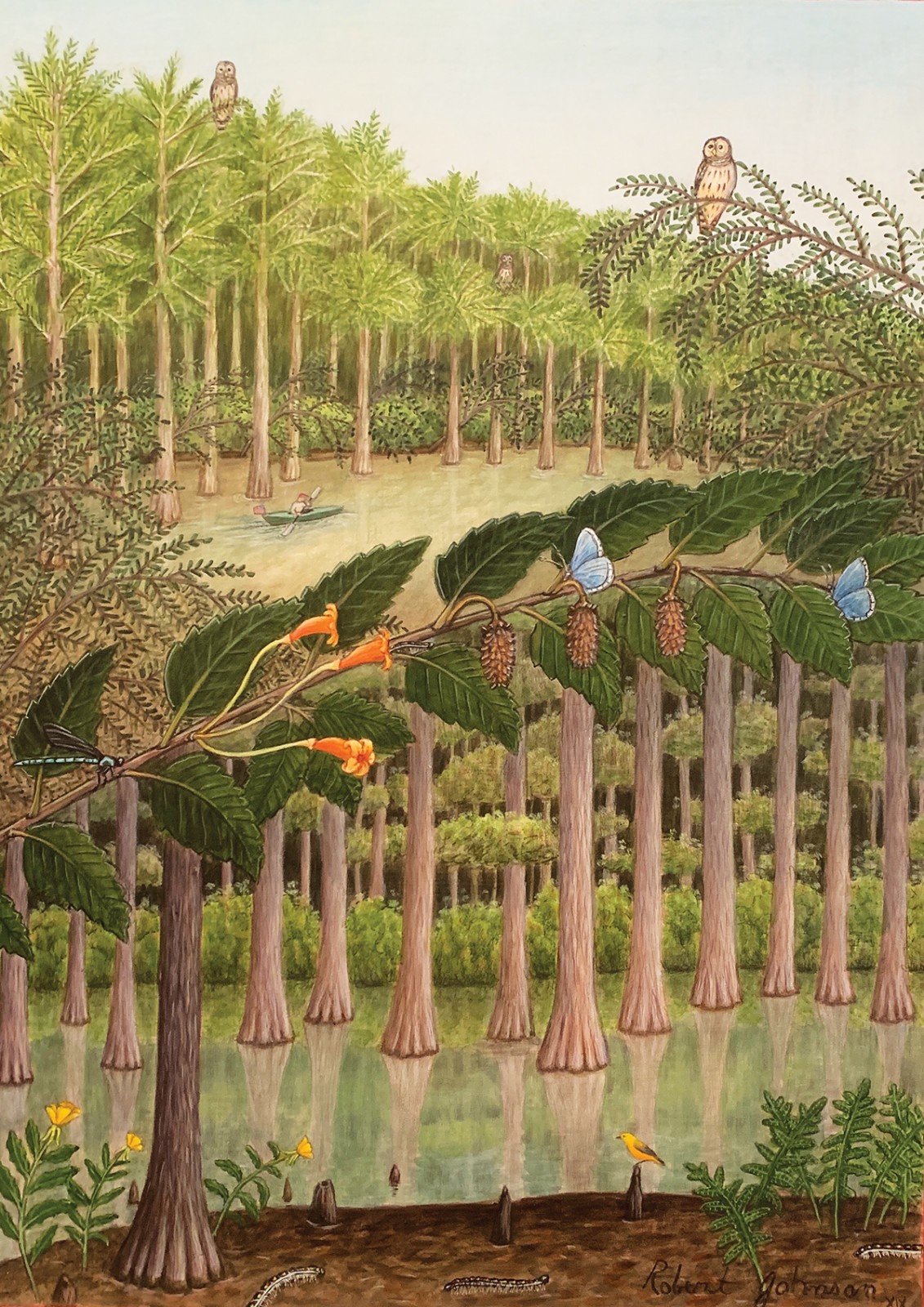
Lumber River State Park. Robert Johnson, artist
“Johnson’s unique talent is his ability to simultaneously capture the detail and realism of flora and fauna with a naturalist’s eye and a sensitivity to the intricacies of natural ecosystems and to meld that with an artistic eye and imagination that transcend the physical world,” writes Linda Johnson Dougherty in her essay Robert Johnson: Artist/Naturalist/Activist. Dougherty grew up a neighbor and close friend to Johnson’s family in Celo near Mt. Mitchell. “Similar to Audubon’s avian portraits, Johnson’s work is a unique hybrid of what he sees—his realistic, objective field recordings—and what he feels—his personal, subjective experience of a place that transcends the material, physical world,” she writes.
From 2017 until 2020, Johnson traveled to all 41 state parks in North Carolina. The result is an exhibition of 100 paintings that includes at least one work from each of the spectacular parks that he visited: Grandfather Mountain, Eno River, Lake James, Carolina Beach and Chimney Rock, among them. Safe Places: Robert Johnson, exhibited most recently at Cameron Museum of Art in Wilmington. Blue Spiral 1 presents Safe Spaces, North Carolina: A Memorial to Robert Johnson with William Baker and Bryant Holsenbeck, opening Friday, September 3, and running through October 29.
“Robert Johnson is more than an artist; he is an observer and recorder of the natural environment,” says Michael Manes, gallery director and co-owner of Blue Spiral 1. “Through his painting and teaching, Robert has beautifully captured various ecosystems around the world and, in particular, our beloved national parks and forest.”
There are traditional ways in which nature has been depicted that miss the larger picture, Johnson believes. “I feel like art should have something to say,” he says, “that art for art’s sake just to bring decoration to the world is a good thing, but misses out on the deeper communicative power that art can have. My paintings are about connecting with others in ways that can be accessed by a fairly large audience in a new way and, hopefully, will help people to see nature in a new way.”
To learn more about Robert Johnson’s work, visit RobertJohnsonPaintings.com. For more about the upcoming exhibit and work represented by Blue Spiral 1, visit BlueSpiral1.com.