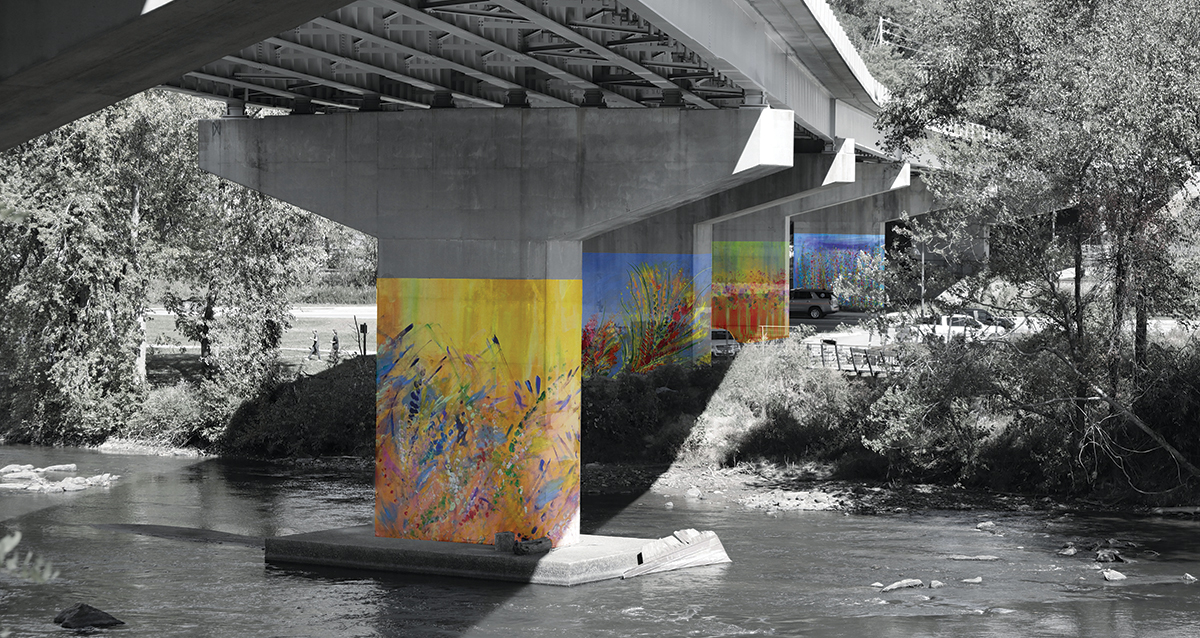
Art: Emergence; Wildflower Bouquet; Summer Joy; and Hint of Spring. Raphaella Vaisseau, artist. Photo and rendering by Holden McCullough
By Gina Malone
Holden McCullough grew up in South Carolina, but after college Asheville became home and a place to practice landscape architecture. Like many Asheville residents, some of his favorite leisure spots were in the River Arts District. “I have a deep appreciation for the arts,” he says. “I firmly believe that Asheville artists are a core element of what makes the city captivating to locals and visitors alike.”
In August 2024, he left to begin graduate work at the University of Georgia Athens. “Driving down the mountain towards Georgia, I assumed that I would be able to return to the same Asheville I had grown so fond of,” he says. “However, Helene changed much of this familiarity about a month later, altering the landscape and its people significantly.”
McCullough obtained a master’s degree in landscape architecture and graduated in May. During his studies, he completed work on a project titled Reclaiming Space. “A spontaneous memorial that appeared in the RAD days after the flooding inspired my initial vision for the project,” he says. “It was a stack of cinder blocks made from flood debris and painted with the words ‘Flood back Love.’ Given the nature of the RAD and the monumental amount of art that had been lost, it felt appropriate to consider art as a form of love and the application of it as a deliberate act of reclaiming the places, objects and structures impacted by flooding.”
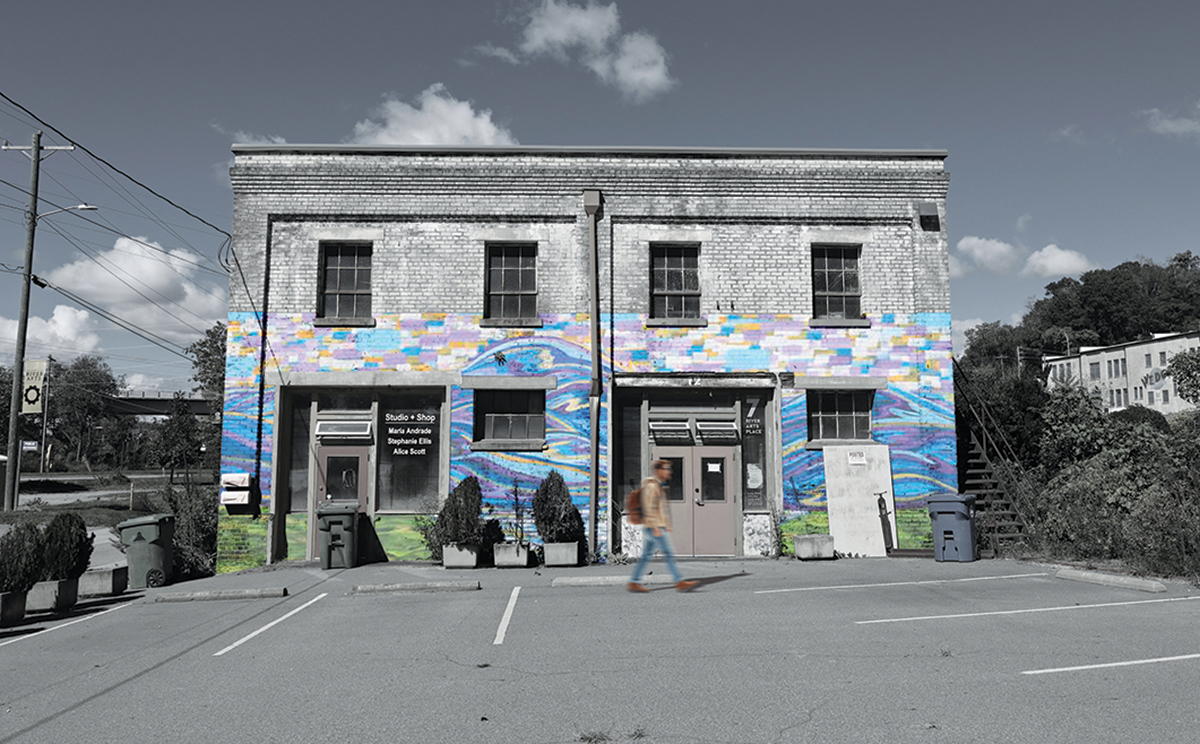
Art: Alive. Angela Alexander, artist. Photo and rendering by Holden McCullough
McCullough interviewed others who experienced the storm’s impacts firsthand for ideas about appropriate and meaningful ways to acknowledge what had been lost. “During these interviews, strong points of agreement across all participants were that the initial and ongoing impacts were devastating, that the community response to action and collaboration was remarkable and that the intensity of the flooding is an opportunity to educate on the realities of a changing climate,” he says.
Reclaiming Space envisions artwork by RAD artists marking, temporarily, some of the vertical surfaces that were impacted by flooding: bridge supports, utility poles and buildings. “This proposal is left up to the interpretation of local communities and artists who are encouraged to select the media and application of this design intervention, as well as telling their own narrative through original artwork,” McCullough’s project states.
Several artists, including Raphaella Vaisseau, allowed McCullough to use their work in his proposal as an example of what implementation of the idea might look like. “I found it interesting to see his vision of art rendered on the structures that were submerged in floodwater,” she says. “I do think it would increase understanding of the enormity of our loss to have a visual representation.” For now, however, Vaisseau says she would rather focus on optimism—embracing the present and looking to the future—instead of putting creative energy into a memorial.
McCullough has presented the project to community members and organizations and has been met with both positive and negative responses to the idea of a memorial, even one that would not permanently alter any of the structures. “I expected to be confronted with a wide range of responses, especially given the sensitivity of the area I was working in,” he says. “I fully acknowledge that different people had vastly different experiences and responses to Helene and that no single proposal can accommodate all of the preferences and opinions of the community. I tried to approach this project with a light touch and give as much room for community opinions as possible while still staying true to the original idea.” He also says that there would be hurdles before this or another plan could come to pass.
“Since Helene, RiverLink has been committed to supporting the RAD’s recovery—through partnerships, community visioning and thoughtful planning,” says Lisa Raleigh, executive director of RiverLink. “Public art is an extraordinary catalyst for the RAD’s resilient return, and Holden’s proposed vision offers a creative resource for exploring how Helene’s impact can be honored in ways that are both artistically compelling and highly informative of the power of the river.”
Although he was away from Asheville during Helene, McCullough has experienced the devastation a flood can bring to a community. In 2015, Hurricane Joaquin caused flooding in his hometown of Columbia, SC. “Nearly 20 inches of rain fell across much of the state, and I witnessed areas of my community become unrecognizable,” he says. “From this experience, I am unfortunately familiar with the sites, smells and emotions of seeing a place and a community you love change forever.”
Angela Alexander, who also lent her art to the proposal, likes the idea of a memorial for a reason that others in WNC may understand. “Many of us have shared our experiences of the flood countless times over the past months,” she says. “While those stories are important, repeatedly revisiting the trauma can be emotionally exhausting. A memorial that acknowledges the loss while focusing on recovery, creativity and the strength of our community could provide a meaningful way to honor the past without remaining defined by it.”
For more about the project, visit ced.uga.edu and put “Reclaiming Space” in the search bar. To find out about upcoming events in the River Arts District, including monthly Second Saturdays, and to support artists, visit RiverArtsDistrict.com.