A Brief History of Asheville’s South Slope
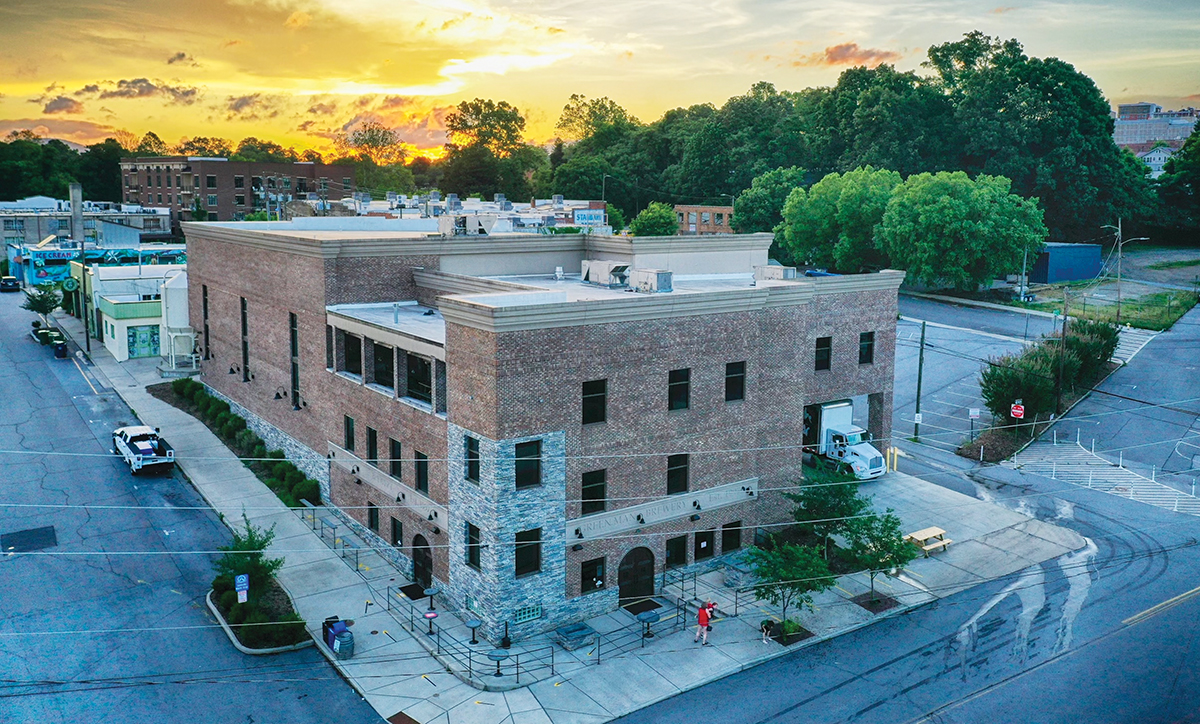
South Slope. Photo courtesy of Dennis Thies
By Lauren Stepp
Asheville’s prolific brewery scene was an accident, really. In 2003, when Green Man Brewery opened a production facility on Buxton Avenue called Dirty Jack’s, the goal was to produce beer for Jack of the Wood, a Patton Avenue brewpub founded in 1997.
But when locals started sipping hoppy porters inside the warehouse, the concept caught on and the neighborhood loosely framed by Asheland, Biltmore, Southside and Hilliard avenues quickly emerged as the beer capital of Western North Carolina. Today, 19 years later, the South Slope is a blur of adult beverage purveyors.
“In the 1990s and early 2000s, going to a brewery for a pint was this shady, unclear thing,” says Dennis Thies, who co-owns Green Man with his wife Wendy. “We’re pretty proud of our heritage as downtown’s first tasting room and as the pioneer of the South Slope.”
But what did this place look like before Ashevillians started sipping French toast-infused stouts and gummy bear IPAs? According to historian Dale Slusser, the South Slope some 120 years ago was mostly farmland owned by Jarvis Buxton, an Episcopal clergyman who founded the Ravenscroft School.
After Buxton’s death in 1896, his daughter inherited the estate and leased a portion of the home to North State Fitting School, a private institution attended by literary icon Thomas Wolfe. The school even makes an appearance in Wolfe’s famed novel, Look Homeward Angel, in which he describes the tract as a “hill wooded by magnificent trees.”
The bucolic backdrop was bulldozed in 1926 when the entire property sold for $630,000—a record at the time. A real estate group called the Buxton Hill Investment Company soon formed and began searching for entrepreneurs interested in purchasing subdivided lots. Meanwhile, contractors demolished the reverend’s old home and moved 300,000 yards of soil from Buxton Hill, exposing a sheer cliff of red clay.
Needless to say, this once quiet pocket of downtown was starting to flourish. Anne Chesky Smith, executive director of the Western North Carolina Historical Association, reviewed newspaper articles written between 1925 and 1927 to confirm that “there was significant marketing of Buxton Hill.”
Of course, every corner of Asheville seemed to be on the precipice of greatness in the late 1920s. The real estate market was running hot, and the city had money to spend. “You can really start to see the development boom at this time,” says Chesky Smith.
However, after the stock market crash of 1929, construction on the South Slope slowed to a standstill. Investors sold off lots for dirt cheap, which ushered in auto repair shops, bottling plants and filling stations after the Second World War. These boom-and-bust cycles continued into the early 2000s when property values spiked, only for burgeoning South Slope businesses to be blindsided by the recession.
This brings us to modern times. After Green Man set up shop in 2003, Asheville Brewing Company and Craggie Brewing Company (now Hi-Wire Brewing) scrambled to get a foothold. Then came another wave of other brewers—Burial, Twin Leaf, Wicked Weed and the likes. Today, the neighborhood is a hotspot for folks looking to drink a cold one.
But whispers of the South Slope’s past remain. For instance, the steep bank of exposed dirt caused by the razing of Buxton Hill is still there, says Slusser. You just have to look past a few breweries to see it.
Green Man Brewery will celebrate its 25th anniversary with free music from Thursday, March 17, to Saturday, March 19. To learn more, visit GreenManBrewery.com.