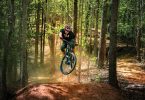
Scott’s Ridge. Photo by Holly Wilbur
By Paula Musto
How often in life do you have an opportunity to save a mountain? One that’s right in your own backyard? When the question arose for homeowners in Biltmore Lake last spring, the residents did something extraordinary—they raised $1.8 million to buy a mountaintop.
Biltmore Lake, a community of 800 homes just west of Asheville, sits in the shadow of the Pisgah National Forest. Homeowners there take great pride in their handsome neighborhoods with stunning views of surrounding ridgelines and adjacent natural habitats that boast diverse populations of wildlife and native plants. But when a 139-acre parcel called Scott’s Ridge, adjacent to the community, was marketed last spring for new development red flags went up. What would happen to the wildlife and miles of hiking trails that crisscrossed the ridge? Or the water quality of Enka Lake, a much-loved recreational lake around which the community is built? From Scott’s Ridge the headwaters of two streams flow into Enka Lake. If adjacent lands were further developed, residents worried the ensuing construction would denigrate the lake’s water quality.
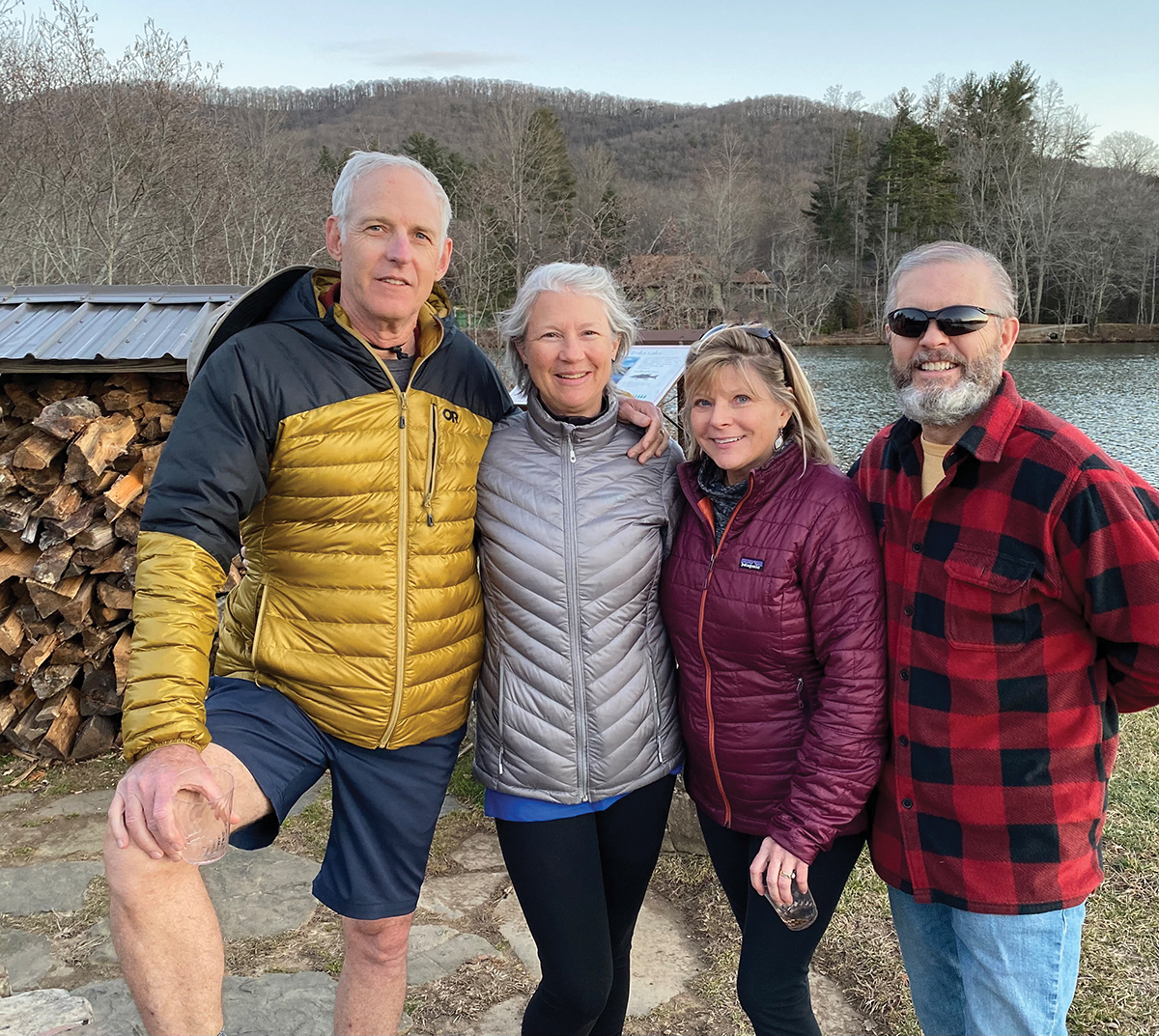
Biltmore Lake residents Phil Murphy, Marie-Louise Murphy, Laura Olson and Brad Olson. Photo courtesy of Laura Olson
Acting quickly, the homeowners accomplished what some thought impossible. Led by a small cadre of residents, a Save Scott’s Ridge campaign raised the money in partnership with the Southern Appalachian Highlands Conservancy (SAHC), a nonprofit which purchased the property from its seller, the Enka Land Development One LLC. The conservancy will manage the property, ensuring that Scott’s Ridge remains an undisturbed habitat into perpetuity. More than half of Biltmore Lake’s residents dug into their pockets and raised the money in a little more than two months with contributions large and small. Other SAHC donors contributed another $700,000 to cover the $2.5 million cost.
“It’s truly impressive what Biltmore Lake homeowners did,” says Angela Shepherd, SAHC’s communications director. “The community came together in a grassroots effort to accomplish something unprecedented in Western North Carolina.”
Shepherd says the size of the Scott’s Ridge parcel and proximity to the Pisgah National Forest make it an ecologically significant property that future generations can continue to enjoy as a wildlife habitat and for the splendid scenic views of its distinctive ridgeline. Halting Scott’s Ridge development, Shepherd says, is also an important factor in maintaining the nearby lake’s water quality. The forested land on the ridge absorbs and disperses rainwater thereby reducing flooding and the runoff that leads to harmful sedimentation in the lake’s waters.
While the Scott’s Ridge purchase was privately funded, there are many avenues to protecting environmentally important lands in the region. Certainly, there is the legacy of the Vanderbilt family and its vast land contributions, including what is now the nucleus of the Pisgah Forest. There are a number of federal and state conservation programs and for years the Buncombe County’s annual budget has included modest funding for land conservation. Significantly, in November local voters made a major commitment to further invest public dollars for conservation efforts with passage of the $30 million Open Space Bond Program. The bond monies will be used for the protection of local mountain, forest and agricultural lands along with the development of recreational trails and greenways.
The goal is to preserve an additional 6,000 acres which would ensure that 20 percent of land in Buncombe remains permanently protected from development by 2030. The cost to county taxpayers is approximately $14 annually per household for the next 20 years.
In addition to funding outright land purchases, the bond monies can be leveraged to bring additional dollars here through state and federal grants or private partnerships. “It’s a win-win for the people of the county now, and for future generations to come,” Shepherd says. “The local funds become critical seeds that grow with additional matching grants and other contributions.”
Marc Hunt, a former Asheville vice-mayor and city council member who led the Better with Bonds campaign, applauded the bipartisan support for the bond referendum. “Our local leaders should be congratulated for stepping up to the plate and placing the question to voters,” Hunt says. “People understand what is at stake. Buncombe County has suffered from sprawled development and has lost a great deal of its forest and farmland. Now, for the first time, we have a dedicated source of funding which will go a long way in helping to protect important parcels.”
Biltmore Lakes resident Phil Murphy, who led the Scott’s Ridge effort, is hopeful that the trend—both private and public efforts—will continue. “It’s wonderful to live in an area that cares enough,” Murphy said. “It’s a really big deal for anyone who cares about the environment.”
Paula Musto is a writer and volunteer for Appalachian Wild, a nonprofit whose mission is to help injured or orphaned wildlife, support WNC’s wildlife rehabilitation network and provide wildlife conservation education. To help save wildlife, donate and learn more, visit AppalachianWild.org.