By Paula Musto
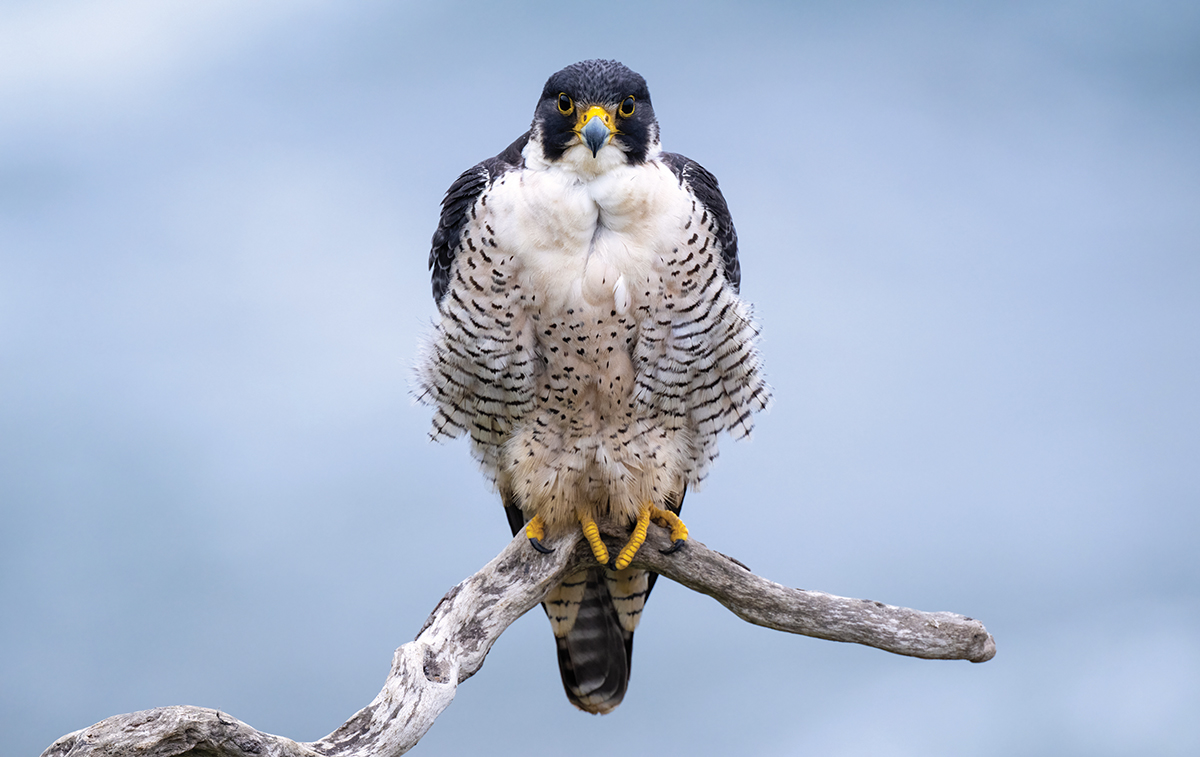
The Central Asian country of Kazakhstan once topped my travel wish list. A National Geographic documentary on falconry sparked interest in this remote region where the ancient sport is revered. But traveling halfway around the world to see falcons, I’ve learned, is not necessary. The fast and furious creatures, including the magnificent Peregrine Falcon, live among us in Western North Carolina.
These raptors are the fastest birds on the planet and among the most formidable predators in the animal kingdom. Peregrine Falcons are also a conservation success story. The species disappeared from our region in the last century, but thanks to an ambitious conservation effort, Peregrines were reintroduced into the Southern Appalachians where they now nest in the cliffs surrounding Asheville.
“Peregrine Falcons are incredible creatures renowned for their speed and mastery of flight,” says John Koon, president of the Blue Ridge Chapter of the National Audubon Society. Scientists have measured their speed in excess of 200 mph, on par with the fastest Formula One race cars. “When in a hunting dive, the birds have almost the same aerodynamic profile as a B-2,” Koon says. “Its sleek body and pointy, swept-back wings are built for speed and precision hunting.”
Peregrine Falcons employ a dramatic way of capturing prey called the stoop. In a high-altitude ambush, the bird climbs above its target—most often another bird in flight—and strikes in mid-air, stunning the prey or even killing it instantly. This precise aerial interception is what makes their style of snagging prey unique.
The bird’s distinctive, helmet-like head reminds Koon of a gladiator—it’s one of the easiest ways to identify the species. But what also makes the species special, Koon says, is its adaptability. Peregrines are widespread throughout the world (found on every continent other than Antarctica) and, while traditionally cliff dwellers, they happily nest on the ledges of skyscrapers. Koon has watched them atop tall buildings in cities as diverse as New York, Nashville and Boise, Idaho.
Chris Kelly, a wildlife biologist with the North Carolina Wildlife Resources Commission (NCWRC), has watched and studied falcons for more than two decades. “What superpower do people want?” Kelly asks. “Flying, of course. Their aerial acrobatics make it seem so easy. Peregrine Falcons are magical in the air.”
DDT caused Peregrine populations in the eastern US to decline in the 1950s, and by the mid-1960s they had disappeared. Small birds, which make up most of the falcon’s diet, ingested the pesticide by eating contaminated insects. When Peregrines ate those birds, the toxin moved up the food chain and prevented them from producing viable eggs. Although DDT was banned in the early 1970s, the damage to the population had already been done.
NCWRC, in partnership with the U.S. Fish and Wildlife Service and other regional partners, launched an aggressive program in the mid-1980s to reintroduce captive-raised Peregrines into the wild, hoping to rebuild their numbers. The effort succeeded—today, NCWRC monitors 18 breeding pairs in WNC. “Peregrines have made a comeback here,” Kelly says, “but due to the small population, they remain a protected species.” In NC, the birds are listed as threatened, signifying that the once-native species could again become endangered.
One challenge is suitable and undisturbed habitat. Peregrines do not build nests, but rather lay their eggs directly on ledges. Mated pairs return year after year to the same spot to raise their chicks. Extremely territorial, they are unwilling to share limited cliff space and will chase off competitors, reducing the opportunity for hatchlings.
A further hindrance is that nesting will not succeed if eggs are disturbed. Unfortunately, many popular outdoor recreational activities, such as rock climbing, are inherently disruptive to nesting birds. To curtail disturbances, land managers, including the U.S. Forest Service, issue seasonal cliff closures. NCWRC partners with climbing organizations to dissuade climbers from vulnerable nesting areas during the breeding season. Groups like the Carolina Climbers Coalition have not only cooperated, Kelly says, but have assisted in placing trail cameras to monitor the birds.
There are numerous open-sky vistas throughout the Southern Appalachians to catch a glimpse of these birds in the wild, including areas off the Blue Ridge Parkway at Devil’s Courthouse and Looking Glass Falls. The best times of day are early morning and late afternoon.
Another opportunity for viewing is at the Carolina Raptor Center in Charlotte where a resident Peregrine named Aries resides among other raptors including hawks, owls and eagles.
I never made it to Kazakhstan, but falconry can be experienced much closer to home. Licensed falconer Jeff Curtis offers an opportunity to experience the ancient sport through Curtis Wright Outfitters in Weaverville and at the Biltmore Estate. “There is nothing like handling and flying a bird of prey and seeing these magnificent creatures up close,” Curtis says. “It’s once in a lifetime to experience an art form that dates back thousands of years.”
Paula Musto is a writer and volunteer for Appalachian Wildlife Refuge. To learn more about the Peregrine conservation program, visit NCWildlife.gov/species/peregrine-falcon. For more about falconry, visit CurtisWrightOutfitters.com.