

Photo by Joye Ardyn Durham
The Many Past Lives of Cedar Crest Inn
By John Turk
As with so many of Asheville’s historic properties, the Cedar Crest Inn has stories to tell—stories that reflect the ups and downs of the area’s economy.
William E. Breese, a prominent banker and Civil War veteran from Charleston, South Carolina, moved to Asheville in 1885 so that his son, who had contracted tuberculosis, could benefit from the area’s clean mountain air. He founded the First National Bank of Asheville and played a leading role in the city’s first economic boom.
In 1891, William built the Queen Anne-style mansion, which still stands on a hill high above the Swannanoa River. Artisans employed at Biltmore during its construction created the home’s dramatic interior woodwork. He named it Swannanoa Hill.
Six years later, Asheville’s economy tanked. The area’s vaulted tobacco market failed and William’s bank closed. He was arrested and charged with “conspiracy, embezzlement, abstraction and misapplication.” After six trials and no convictions, he moved to Brevard, North Carolina.
Arthur F. Rees from New York City purchased the property in 1902 and renamed it Kenilworth Lodge. The good times returned. The house and its family thrived through the boomtown years of the 1920s. Arthur hosted lavish parties, dinners, and outings for the upper crust of Asheville society. The house was filled with music and light.
Even before the stock market crash of 1929, however, the family began to experience financial difficulties. The music left and the parties were over. The Rees family lived in the house until Arthur’s death in 1926. For the next year, standing vacant, it was owned by a series of banks.
Miss Mildred E. Sherwood rented the mansion in 1927 and converted it into Sherwood Sanitarium. It closed in 1932 and, once again, spent a number of years in the hands of financial institutions. In 1936, it was leased to Mrs. Sara L. Cole who changed its name to The Arden and briefly ran it as a boarding house.
Then, when the future of the structure seemed most bleak, John L. and Minnie Page purchased the building in 1937, named it Cedar Crest, and made it their home. When John died in 1939, Minnie converted it to a boarding house again and it began its new life as a tourist stopover. She passed away in 1976 and left the property to her two daughters. In 1996 Jack and Barbara McEwan bought the property, restored it to its original magnificence, and opened it as one of Asheville’s first bed and breakfasts, the Cedar Crest Inn.
In 2000, Bruce Wightman took over as owner and caretaker of Cedar Crest. Seven years later it was sold to its current owners. It is now officially certified as an inn with 17 rooms on four acres. Cedar Crest Inn’s breathtaking interiors are just as amazing today as they were in 1891.
John Turk, Professor Emeritus, Youngstown State University, leads city walking and bus tours with History@Hand (history_at_hand.com). He can be reached at jrturk@ysu.edu.


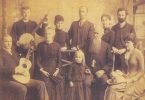

There’s not a single photo of the Cedar Crest Inn on this page, even though I clicked the best photo I could find to get here (a photo by Joye Ardyn Durham). Unsolved mysteries of the Internet…
Thank you for catching this oversight. We’ve fixed that problem now.
Cedar Crest was a Bed and Breakfast well before 1996. I know this because I lived in Kenilworth all my life, and got married at Cedar Crest in 1985. Our out of town guests stayed at the Bed and Breakfast. I’m interested to know why the color changed from yellow to pink. Was this the original color of the house?
I noticed that also, Nancy. For I stayed there in 1987 on my way to Indianapolis from Camp LeJeune. At the time it was yellow. Wish I could add a picture to show the yellow house.
I just wanted to add more clout that it was a bed and breakfast before 1996! My husband and I honeymooned in the then “yellow lady” back in 1993! (Ahh – to be newlyweds with the future all out in front of you….🥰) Currently on our way there now for a weekend rendezvous! It’s a sweet and fun getaway for us that we feel blessed to do often!♥️
We stayed there in 1994 for our 10th anniversary. We’re back for our 42nd! I really liked it much better before it was painted that horrid PINK!