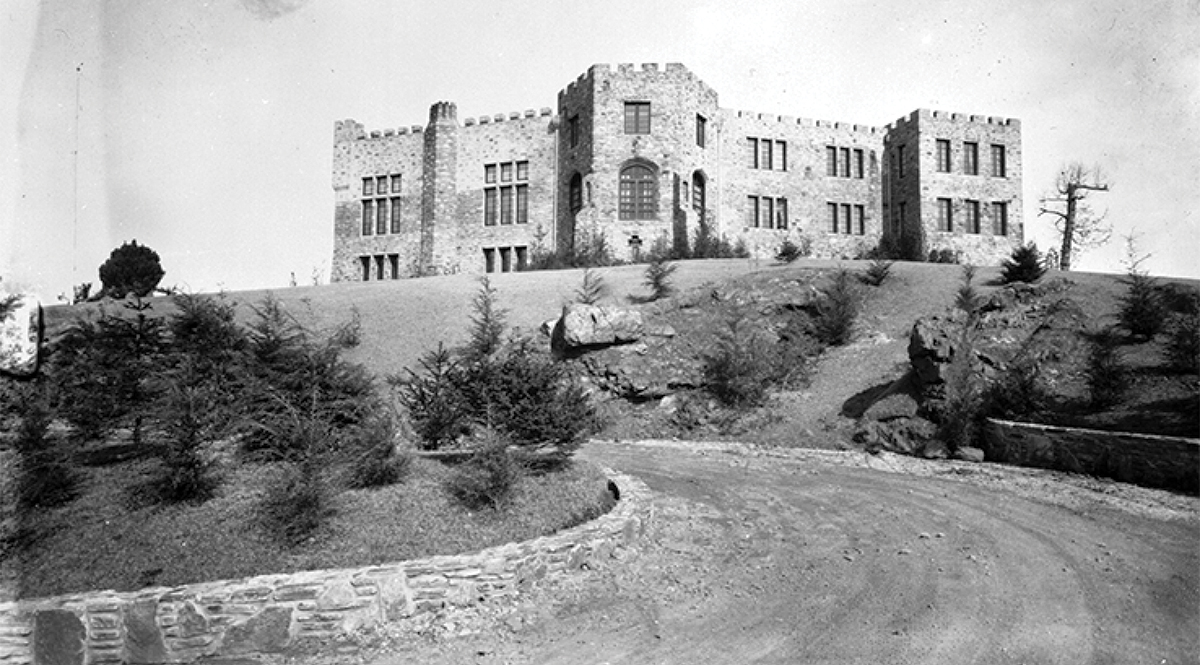
Overlook Castle. Photo courtesy of D.H. Ramsey Library Special Collections, UNC Asheville
Asheville was growing fast in the years after World War I. As tourism surged and land deals multiplied, the city was beginning to see itself as a place of possibility rather than a remote outpost. That momentum brought opportunity, but it also brought challenges.
“This population increase led to the expansion of its public school system, with two separate high schools bursting at the seams by the mid-1920s,” says Ashley M. Whittle, director of special collections and university archivist at UNC Asheville. “Incidentally, this also created a corresponding demand for higher education options that were accessible and affordable for residents of Western North Carolina.”
That need was met in 1927, when Buncombe County Junior College opened in a basement classroom. Tuition was free for Asheville residents, and getting to class often meant walking, riding a streetcar or carpooling.
Students quickly began shaping a campus culture of their own. Football and basketball teams took form, followed by a glee club and a student newspaper. “There was even a dean of women during this time, with Virginia Bryan joining the faculty in 1928,” says Whittle.
By the middle of the 20th century, enrollment had grown from 86 students to 280. That momentum carried the college from basement classrooms to a series of new locations, including—briefly—a castle.
“The campus was located in the 20,000-square-foot Seely’s Castle—also known as Overlook Castle—on Sunset Mountain from 1949 to 1961,” says Whittle. “This is also how UNC Asheville received the moniker, ‘The College in the Sky.’”
In 1961, the institution moved to its present campus in North Asheville. In the years that followed, the college took on a more defined role within North Carolina’s public higher education landscape, becoming a four-year state college in 1963, officially joining the University of North Carolina System in 1969 and being designated as the UNC System’s liberal arts university in 1992.
Through it all, the university has remained grounded in a commitment to liberal arts education.
“To me, the most enduring aspect of UNC Asheville’s history is its steadfast role as a publicly accessible institution of higher education with an emphasis on liberal arts,” says Whittle.
Today, nearly a century after its founding, UNC Asheville is facing shifting enrollment patterns, rising costs and increased competition for resources—pressures confronting many smaller public universities nationwide. In response, the institution has launched Asheville 2030, a long-term planning effort aligning enrollment strategy, academic direction, financial planning and campus considerations.
Work already underway ranges from expanding affordability through programs such as Access Asheville, to reviewing academic offerings to better match student demand, to the renovation of Lipinsky Hall into a state-of-the-art performance and learning hub with collaborative classrooms, modern music technology labs, acoustically optimized rehearsal spaces and private practice rooms.
“Our past reminds us that UNC Asheville has always adapted while staying true to its mission,” says UNC Asheville’s chancellor, Kimberly van Noort. “As we look ahead, Asheville 2030 is about thoughtfully planning to protect access, strengthen our academic foundation and prepare the university to serve WNC well into its next century.”
To learn more, visit go.UNCA.edu.