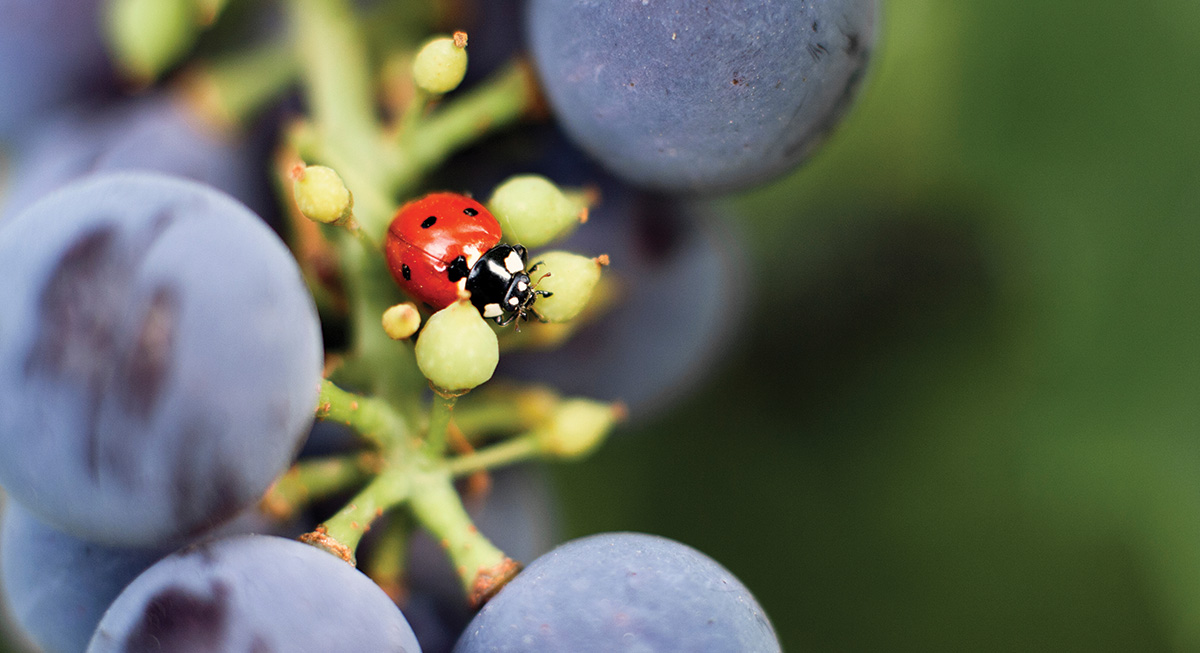
Ladybug on a grape bunch
By Elspeth Brown
When my daughter was little, she loved the book The Grouchy Ladybug by Eric Carle. She had me read it to her every night before bed. I got so sick of that book that I secretly donated it to the public library and claimed ignorance when she asked where it was.
The Grouchy Ladybug is about a bad-tempered ladybug who will not share aphids with the friendly ladybug. The ladybug meets an array of other animals, all different sizes, along its journey. Finally, the grouchy ladybug makes it back to the original leaf where it shares the aphids with the friendly ladybug. The leaf says, “thank you,” and “the fireflies, who had been sleeping all day, came out to dance around the moon.”
Ladybugs, or lady beetles, are nature’s tiny guardians, a perfect pest management system. One ladybug can eat hundreds of aphids per day. For a vineyard owner, the ladybug is a lovely option to help significantly with pest control.
They look beautiful and idyllic while strolling around vineyards, but they are quietly working on saving the vines’ health. They consume mites, aphids, mealybugs and fruit flies. If the winery introduces ladybugs to vines, then they do not have to spray herbicides that absorb into the grapes and ultimately into the wine that you consume.
Wineries that use the ladybug method for pest control also use a low-input farming approach and are very ecologically aware. Introducing ladybugs early in the vineyard season is most beneficial when the grapes have not developed yet. Once the fruit begins to develop, the ladybugs will feed on the fruit that is already damaged, but they won’t feed on the undamaged fruit or the leaves.
There are multiple wineries that release ladybugs to have a more sustainable approach to pest control. Badia a Coltibuono in Italy is one such winery that depends on the help of ladybugs. It has one wine completely dedicated to the ladybugs called Chill Ya Jolo. It is bright, fruity and fresh. The tannins are light and the wine has ripe cherry fruit that makes it a perfect red wine to chill for the hot summer days. The entire property has been organically managed since 1994, and certified organic since 2000.
Playing devil’s advocate, I must say that the winemaker does have to be extremely careful that no ladybugs end up in the fermented wine. When a ladybug is drowning in a vat of wine, it will emit a compound called alkyl-methoxypyrazine to deter predators. This is called ladybug taint, and even one ladybug can make the wine have off-putting flavors such as peanut shells, rotten coconut and green beans. While very laborious, if the winery can hand-sort the grapes before they are fermented, they can avoid ladybug taint.
While ladybugs are extremely cute and said to be a sign of good luck, they are also extremely beneficial for a winery if well-managed. Just like the leaf in The Grouchy Ladybug, I want to say thank you to them for helping keep beautiful wines pesticide-free and delicious. Enjoy!
Elspeth Brown is the owner of Maggie B’s Wine & Specialty Store, 10 C South Main Street in Weaverville. For information, visit MaggieBsWine.com or call 828.645.1111.