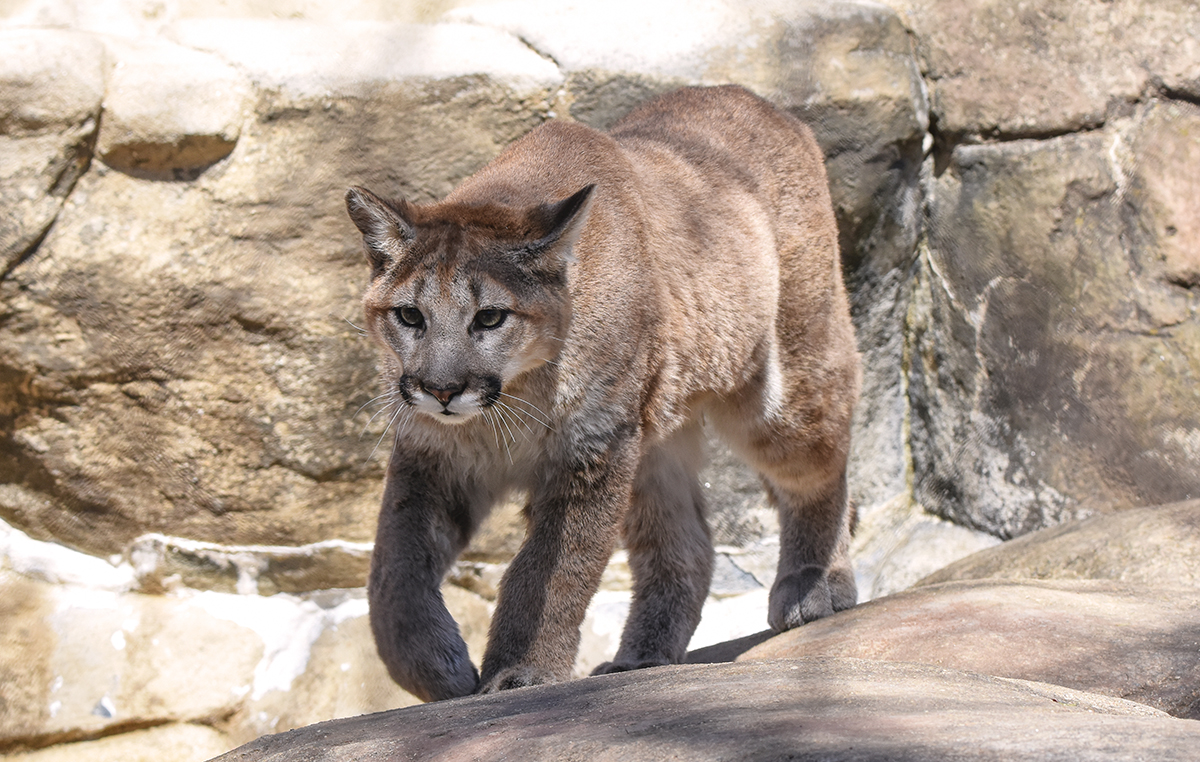
Photo courtesy of the Western North Carolina Nature Center
By Paula Musto
A message popped up in my inbox recently: a mountain lion had possibly been spotted in the neighborhood. Really? I live in a quiet urban community where bear warnings are common and deer wander through backyards, but mountain lions aren’t supposed to exist here—not in this region, this state or anywhere else on the East Coast.
Or do they?
Few wild animals have inspired more lore in these parts. Before the European settlement, these big cats were common throughout the Appalachians, with ridges, creeks, swamps and mountains named for a species known as cougar, panther, puma, catamount and, colloquially, “painter.” But like elk and wolves, mountain lion populations east of the Mississippi River were devastated by large-scale hunting and habitat loss more than a century ago. The animal remains common in the West, but the last verified sighting in NC was in 1886.
Yet, reported sightings, like the one just blocks from my home, have surfaced across the region for years.
“We get so many reports that even I start to believe the elusive mountain lion is out there,” says Anna Gurney, a communications manager with the North Carolina Wildlife Resources Commission (NCWRC). But Gurney is clear: the eastern mountain lion, once native to this region, is listed as extinct by the U.S. Fish and Wildlife Service. Along with the NCWRC, the agency has investigated such claims for years without finding evidence of the species—no DNA samples, no verifiable images, no roadkill.
Still, people here are convinced they’ve seen one. Candler resident Elizabeth Joiner has video footage of a shadowy animal moving through her backyard that left neighbors wondering if a mountain lion might be roaming. The homeowners’ association emailed a precautionary warning.
A big-cat enthusiast posted a YouTube video that drew thousands of comments, largely from people across Appalachia who said they’d seen one. Seasoned outdoorsmen, hunters and families with deep roots in these hills detailed their encounters.
NCWRC biologists and most other wildlife experts believe these reports are often cases of misidentification. Domestic cats and dogs, coyotes, bobcats and foxes are commonly mistaken for cougars. Other sightings may involve captive cougars—some kept as pets—that escaped or were illegally released.
“People are prone to misidentify an animal they glimpse in shadows or see in the brush,” says Carlton Burke, a Mills River naturalist who has studied the species. “It’s easy to misjudge size. A large housecat or bobcat can seem like a much bigger animal.” He estimates that 98 percent of reported sightings are misidentifications or hoaxes; pranksters have been known to doctor photos. But what about the other 2 percent?
That’s where the story gets interesting. It starts with a young male mountain lion in the Black Hills of South Dakota, searching for new territory and, most important, females. This cougar traveled more than 1,500 miles over roughly two years. Researchers pieced together its journey from hair and other biological evidence found along a route through several states. Sadly, the cougar was struck and killed on a Connecticut highway in 2011.
“This was a bona fide cougar sighting,” Burke says. “It provided a gold mine of verifiable evidence. It was a rare occurrence, but it showed that at least one cougar could make its way into the East.”
That discovery didn’t change the eastern mountain lion’s official status. Without evidence of a stable population of breeding pairs, the animal is still officially listed as extinct in this region.
Burke, who teaches wildlife classes at the North Carolina Arboretum, believes the big cats could eventually find their way back. With its rugged terrain and sizable population of deer (their primary prey), WNC would provide suitable habitat. But for the species to be considered truly back, there would have to be females, breeding pairs and, eventually, a self-sustaining population.
Andrea Shipley, an NCWRC mammalogist, is doubtful this would happen. “There’s always a chance,” she says, “but with climate change ramping up, I’d postulate that the chances are slim.”
Shipley, who does extensive camera trapping work in remote parts of the state, has never seen evidence of a mountain lion. She reviews many of the purported trail camera photos and videos submitted to the commission, most of which are low-quality images. “Without high-resolution images, it’s almost impossible to make identification,” Shipley says.
There is one sure way to see a mountain lion. Two reside at the Western North Carolina Nature Center. Found as orphaned cubs in Washington State and unable to survive on their own, the pair now serve as ambassador animals—reminders of a legendary species that still captures our imagination.
Paula Musto is a writer and volunteer for Appalachian Wildlife Refuge.