Lisa Thomson
Often growing to heights well over a hundred feet with diameters of more than ten feet, the American chestnut tree is a mighty and fast-growing species. By the turn of the 20th century, the American chestnut comprised a quarter of all hardwood tree populations in the eastern United States with numbers in the billions. It’s known as the “cradle-to-grave tree” because of its range of uses, such as a resource for building and architectural purposes and provider of nutritious food for wildlife.
You may have heard of the effects of the blight that decimated these trees beginning in the early 1900s. The blight (an Asian fungus) was discovered in 1904 on chestnuts in New York. Advancing 20–50 miles per year, it devastated trees from Maine to Georgia. The species was ecologically extinct by 1950. Since the fungus doesn’t kill the root system, you’ll continue to find ghost stumps today where mighty trees once stood.
In 1983, a group of concerned scientists and citizens established The American Chestnut Foundation (TACF) as a step toward restoring this great American icon where it once thrived. Since then, this membership-based nonprofit organization has made a lot of progress in carrying out its mission, with the help of cutting edge science, a successful breeding program, and the support of members and volunteers, lovingly referred to as “chestnutters.”
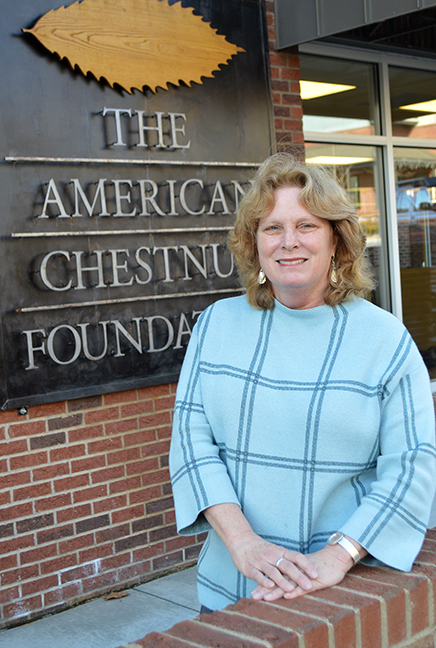
Did you know that TACF’s national office is right here in Asheville? There are a total of 16 TACF chapters from Maine to Alabama that represent the range of the species, with some regions combined into one. President and CEO Lisa Thomson was appointed to her position in January of last year. “I’ve always been interested in the environmental movement,” says Lisa, whose experience includes 28 years with The Nature Conservancy in leadership capacities with conservation land management and fundraising. She adds, “One of my goals is to work more closely with researchers on our breeding programs so we can speed up science.”
While the American chestnut succumbed to the fungus, the Chinese chestnut will not. TACF’s breeding program is currently on its seventh generation of hybridizing the native American chestnut with the blight-resistant Chinese chestnut. These plants are 1/16 Chinese chestnut and 15/16 American chestnut. Over the years, thousands of trees have been planted by volunteers across the area represented by the 16 chapters to be closely monitored for blight resistance. “It’s a very instant gratification world and this is a very long-term deliberate goal,” says Lisa. In Asheville, you’ll find young chestnut trees at The Biltmore Estate, Warren-Wilson College, and the Smith-McDowell House.
On the 166 acres of Meadowview Research Farms in Virginia, you’ll find more than 50,000 chestnut trees at various stages of breeding. Lisa says, “The goal in the next three to five years in the breeding program is to do our final selections out here at Meadowview Farms of the best of the best.” Along with the US Forest Service and state agencies, several dozens of universities are also vital partners with TACF in research, testing, and breeding initiatives.
If we were to tell the story of the American chestnut, it would certainly be the underdog. Perhaps most widely known as keyboardist with The Rolling Stones, Chuck Leavell is a tree farmer and a spokesperson for TACF. “This is much more than a tree, this is a miracle,” says Chuck. “Through the great work of The American Chestnut Foundation and other researchers, this guy is coming back.”
When asked why younger generations are also taking part in this restoration when they didn’t know the chestnut personally, Lisa says with a smile, “We think it’s a very iconic species. Unfortunately, it’s not a charismatic megafauna like a polar bear, but we think it’s a pretty cool tree.”
She says, with a more serious tone, “It’s up to us to teach (the younger generations) about it. They’re going to be the ones to carry out this mission … We hope that in our grandchildren’s lifetimes, there will be cathedrals of chestnut trees again.”
TACF’s national office is located at 50 N. Merrimon Avenue, Suite 115, in Asheville. To learn more, visit acf.org or call 828.281.0047. (Tree photo courtesy of The American Chestnut Foundation. Photo of Lisa Thomson by Leah Shapiro)