By Paul M. Howey
 When asked to explain her creative process, Cynthia Decker promised to explain it to me “in a non-irritatingly techy way.” For that, I was grateful.
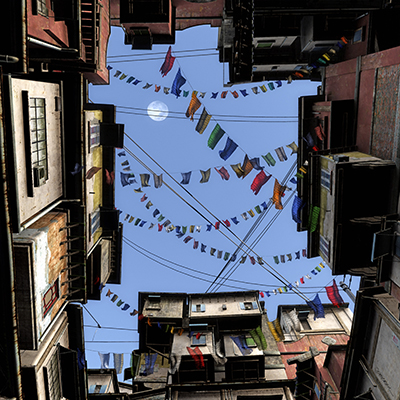
“The oversimplified explanation is to imagine you are making a diorama in a big shoebox,” says Cynthia. “You have to create each element that makes up the scene in your diorama out of papier–mâché. So you form the shapes out of wire, and you cover them and paint them to look the way you want, and you assemble your scene, and you get the light just right. And then you get a camera and you take a picture of that diorama.”
 She says, in her case, she uses the computer to create the elements of the scene and to make a high-resolution image of the final piece. “When I render an image, I am essentially taking 3-D data and instructing the computer to evaluate that data and create a two-dimensional, pixel-based image.”
From there, the explanation of her art veered off into a discussion of modeling, textures, reflection, transparency, bump, light composition, and atmospherics.
“Oh, got techy there at the end,” she confesses. “Can’t help myself!” Perhaps a trip back to the beginning will show the road that brought her to this fascinating stage of her professional life.
 Cynthia’s father was an aerospace engineer and her mother a college computer science teacher and author of textbooks about programming languages. As a result, their family home in Cupertino, California, was one of the early ones to have a computer. By the time Cynthia was 13, she was becoming adept at drawing on the family’s Apple IIe. “I wanted to create and sell clip art of pixelated people doing everyday things.”
She attended San Francisco State University where she was a business major, but she also took as many design and art classes as her schedule would permit. She eventually left school to take a job working for a window blind company where she created technical drawings of the inner mechanical workings of the blinds.
 It was no doubt good training for an eventual career in art that she had yet to envision. Later, she went to work in the marketing department of an analog semiconductor company, eventually establishing a successful career as a graphic designer.
It was in the late 1990s that Cynthia first saw some images created using 3-D software and decided to give it a try. “I was fascinated by both the process and the result,” she says. “I loved the software’s handling of light and shadow and texture.
It let me play with some real world parameters like atmospheric effects, reflection, (and) specularity.” She says it changed how she looked at the world.
 “I started deconstructing things in my head, breaking them down until I understood how they interacted with the world, and why I saw them the way they appeared.” A pathway to a new world of creativity began to open up for her.
In 2005, six years after moving to Asheville, Cynthia took the plunge and became a full-time artist. Of that decision, she says, “It was thrilling. It was daunting. I really wanted to make it work.”
With her husband Randy’s support, she had given herself a five-year timeframe to transition from hobby to art career. “Every year got a little better, financially and artistically. At the end of the five years, we both knew that I could make a go of it.”
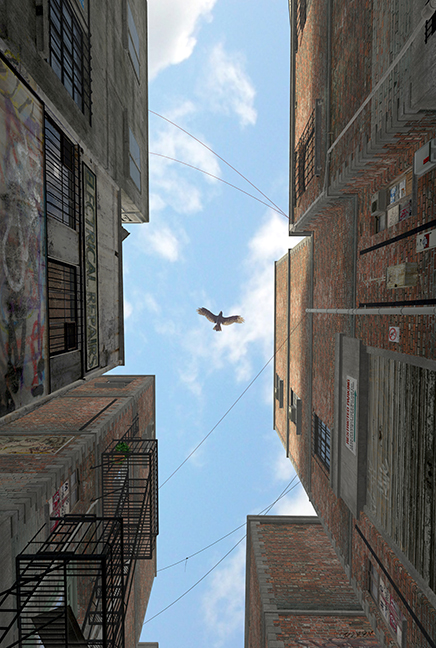 Cynthia says she often visualizes in advance what her finished renderings will look like. “My images are just about exactly what I see when I begin to work on them. Details and individual colors may change slightly, but the overall composition and message is nearly identical. It’s the beauty of my medium, and why I choose to work with it.”
She often begins by sketching out her ideas, either on paper or on the computer. But after that, it’s all computer.
When she first began in this medium, she’d simply make some contrast adjustments and call it done. “Now I spend more time, often working over the image by hand with a digitizing tablet and pen to refine details and create a hand-worked final image. These days, I like to introduce some digital brushwork to soften the overall image.”
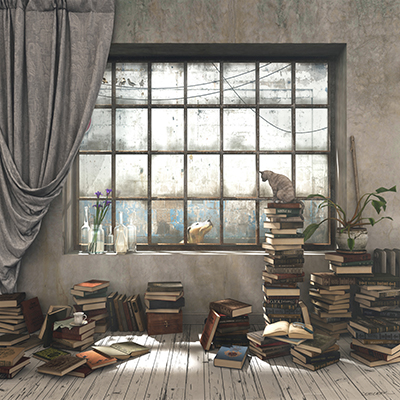 How long does it take to create one of her renderings from conception to completion? “Anywhere from ten to 200 hours,” she answers, “depending on the complexity of the scene and how much of it I need to construct.” Generally, quite a bit longer than it takes to make a typical grade school diorama, to be sure.
Looking back on her artistic journey, Cynthia says, “I moved to a place I didn’t know to chase a life I wasn’t sure I could lead.
Through will and effort—and more than a little bit being in the right place at the right time—now I’m thrilled and constantly grateful to wake up and do what I do.
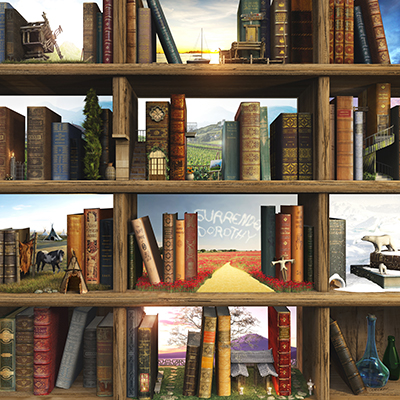 “We’re all more capable than we imagine,” says Cynthia, “and we’re all worth the risk.”
You can see Cynthia’s renderings in two Asheville galleries—Woolworth Walk (25 Haywood Street) and K2 Studio (59 College Street)—and on her website (curious3d.com). (Photo of the artist by Paul M. Howey)