
The Laurel of Asheville's Community Events Calendar
If you would like to submit an event to appear in our online Community Events Calendar, please visit our submission page. (To Note: We are currently having issues with our submission page, but it should be fixed soon. If your event is taking place before October 12, 2026, please email your event information and image to the address below.)
The Laurel of Asheville is a lifestyle magazine focused on the arts, culture, and communities of Western North Carolina, and submitted events should fall within this context.
All submissions are subject to editorial approval and edits for clarity and style before being published online. If you are going to include a photograph, please be certain that you have the rights to utilize that image. If there is a question about image rights, we may remove the image. Also, images should be no larger than 2000 pixels wide. Large images will prevent the event from being submitted.
Please allow up to 5 days for your event to be posted. If you encounter difficulties submitting an event, please email amy@thelaurelofasheville.com.

- This event has passed.
APLR Presents: Marisa Anderson
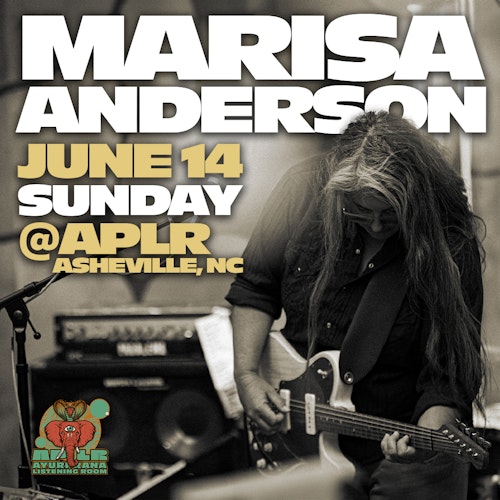
APLR Presents: Marisa Anderson
Sunday, June 14th, 2026
AyurPrana Listening Room – 312 Haywood Rd, Asheville, NC 28806
Doors 6PM || Event 7PM
Marisa Anderson
Marisa Anderson’s music transcends borders. The topography of her work interrogates the intersections of artistry and expression with form and tradition. A singular guitarist and voracious musical collaborator, Anderson crafts pieces bursting with equal parts reverence and curiosity, contouring familiar shapes into work that is wholly her own. Anderson has spent decades mining the veins of the complicated, interconnected American folk traditions she was steeped in from a young age, stretching beyond those traditions and incorporating the vocabulary and techniques of vernacular and folk musics from across time and beyond boundary into her work. Eschewing replication or revival, Anderson’s music lives in conversation with tradition. “My approach to tradition is with the hands that I have and the history that I have,” notes Anderson. “In that way it’s a collaboration—you don’t go into collaboration trying to play like the other person, you go in trying to find out how to play together.”
The Anthology of UnAmerican Folk Music is a collection of nearly one thousand songs culled from the private record collection of the late Harry Smith. Assembled by Anderson after a chance encounter led to an opportunity to study and explore this treasure trove of music, the Anthology focuses on music from places that the United States has been in conflict with since 1970: Southeast Asia, the USSR, and the Arabic and Islamic regions of the world. In Volume 1, Anderson presents her own deeply personal iterations of nine songs from the Anthology. Composed, transcribed, and arranged through a process of trial and error, deep listening, and research, Anderson charts a musical course from Afghanistan to Vietnam via Yemen, Cambodia, and Turkmenistan. Interpretations of compositions ranging from Pakistani qawwali to Syrian taqsim are played with Anderson’s deft and practiced hands. Each piece on the album stands as a dialogue between Anderson and the original source recording, refracted through the prism of her own unique musical lens. Anderson’s contribution to this dialogue ultimately invites the listener to join her in asking: “Who are the people we’ve been told in our lifetimes are ‘unamerican’? What have we lost or been denied access to in the fallout from that label?”
The ongoing project of the Anthology centers curiosity and a commitment to deep listening as it seeks to build bridges with communities and cultural practices from across the globe. Anderson openly acknowledges the limitations she was working with, which include an historic lack of access to traditions outside of US markets and frames of reference, improper documentation within the source material, and the need to operate within a finite amount of time for explorations of vast cultural traditions. For Anderson, these are key pieces to the dialogue. “I am a musician, not an ethnomusicologist or an anthropologist,” Anderson notes. “I’m curious about how music is made, organized, and shared. I am interested in how people and music move across the world, how war, migration, nomadism, colonization, and contemporary and historical economic dynamics affect music and musicians. What is the musical relationship of people to place? How is that relationship altered when shifting borders or global conflicts curtail movement or force migration into or away from a place? What do we carry with us when we leave home, and what do we bring home from faraway places?”
The instrumentation Anderson employs here is largely familiar to her: electric and acoustic guitars, electric keyboards, requinto jarocho, accordion, and tres cubano. The record also features key performances by violinist/violist Gisela Rodríguez Fernández. Aiming to stay true to the essence of the source material, Anderson pushes her tools past the edges of their traditional territories, despite knowing that her interpretations will never entirely replicate sounds and phrases built around non-Western musical systems and instruments. Accordion drones bely the flickering tendrils of acoustic guitar on pieces like “Quodlibet,” while approximating the original’s use of quarter-tones. “Taqsim for Guitar” forgoes a taqsim’s usual use of improvisation in favor of interpreting the source piece’s melodic phrasing more accurately. Considered arrangements of layered keyboards emulate droning flutes on “Pair of Duduk,” and intertwining guitars take on the winding vocal melodies of “Hamd.”
For Anderson, there are no easy answers. The Anthology of UnAmerican Folk Music is as much a celebration of music from beyond borders as it is an examination of those borders, real and imagined, that restrict movement and curtail the natural flow of music across the globe. Filtered through decades of experience as a singular artist and interpreter of feeling and sound, the Anthology’s first volume demonstrates Anderson’s reverence for those practices unfamiliar to and largely excluded from the American lexicon while capturing the core humanity behind a diversity of musical expressions.
All ages
Leave a Comment