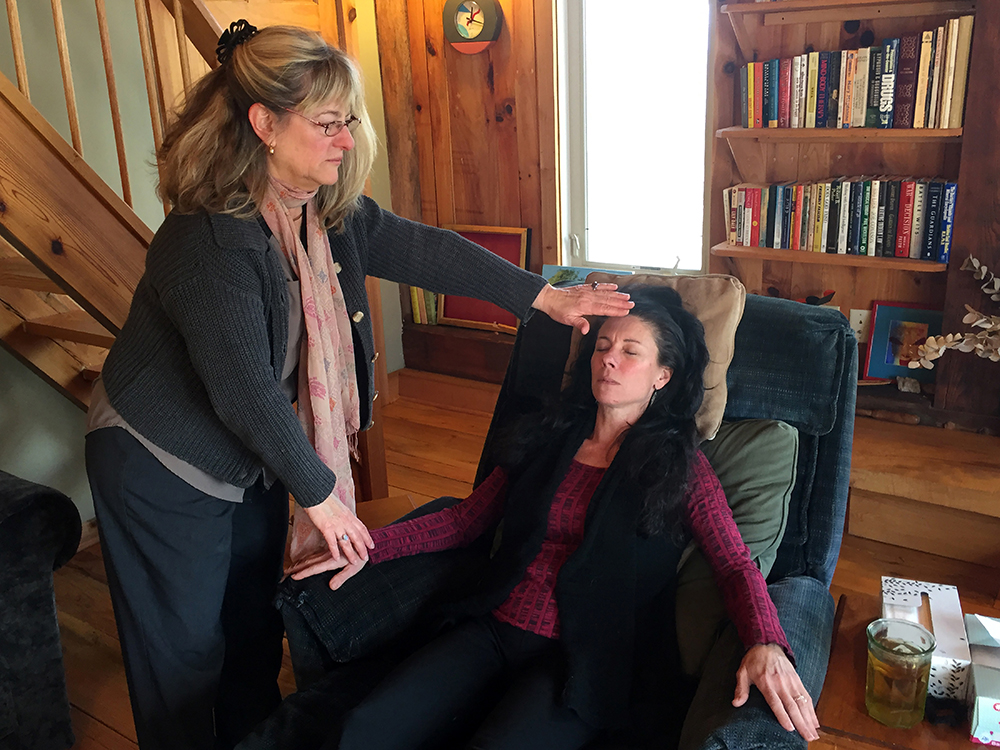
Sarah Gewanter providing hypnotherapy from her home office in Leicester. Photo by Michele George
By Belle Crawford
The subconscious mind controls many of our behaviors, attitudes, emotions and beliefs. But this doesn’t mean that the information stored there holds steadfast truths about who we are. Neuroscientists now tell us that retraining the subconscious mind through positive suggestion can bring about significant changes to outlook, performance, emotional expression and health. Through hypnosis, the subconscious mind can be reprogrammed, like a computer.
“Hypnosis is most well-known for use with habitual patterns like anxiety, fear and phobias,” says Sarah Gewanter of Asheville’s Hypnowisdom. “But it’s also effective for stress reduction, weight loss, increased creative expression, and greater spiritual connection.”
Gewanter has been a hypnotherapist for 30 years and practices from her retreat-like home in Leicester on top of a hill with views of the Blue Ridge Mountains. “Hypnosis is not magic,” she says. “Though it can feel magical, it’s really a tool for growth and well-being.”
Hypnosis works by inducing a trance-like state where the analytical mind is suppressed, making the subconscious more susceptible to new ideas. With repeated exposure to positive imagery and guided meditations, ingrained notions and reactions become profoundly alterable.
“Since we understand so much more now about the connection between the mind and the body and the impact of our thoughts on our health and wellbeing,” says Gewanter, “I expect we’ll see more and more use of hypnotic techniques for faster recovery of illness, mental health and pain management.”
Gewanter begins her sessions by having her clients sit in a comfortable chair and close their eyes. She then counts backwards from ten, encouraging clients to release any physical tension. While evoking images of a stairwell or gently sloping hill, she leads her clients downward into a deep state of relaxation. There, she is able to begin introducing them to new ways of seeing themselves and the challenges they face.
“For me, the feeling of calm I enter under hypnosis is like being awake and asleep at the same time,” says Rachel Durshlag, a Hypnowisdom client and student in Gewanter’s hypnotherapist training program. “I experience a profound surrender and a sense of coming back to myself in each session.”
Relaxation and repetition are important aspects of the therapeutic experience of hypnosis. Modern life is chaotic, and most people don’t slow down long enough to look inward on a regular basis and consider what a more optimistic version of themselves would feel like.
Retraining the mind takes intention, commitment and patience. With a trained clinician guiding the experience, it becomes easier to enter an internal space where previously unexplored potential can be discovered.
“What is most exciting to me about hypnosis is being able to see people change and move forward in their lives,” says Gewanter. “It’s being able to support people in reaching their goals where before they may have felt stuck or lacked confidence.”
Sarah Gewanter offers hypnotherapy and hypnotherapy training at Hypnowisdom located at 690 Boyd Road in Leicester. For more information, visit hypnowisdom.com or call 828.683.6900. Gewanter can also be reached by email at info@hypnowisdom.com. Readers interested in the spiritual applications of hypnosis for quantum healing can find information about the work of Dolores Cannon at dolorescannon.com.