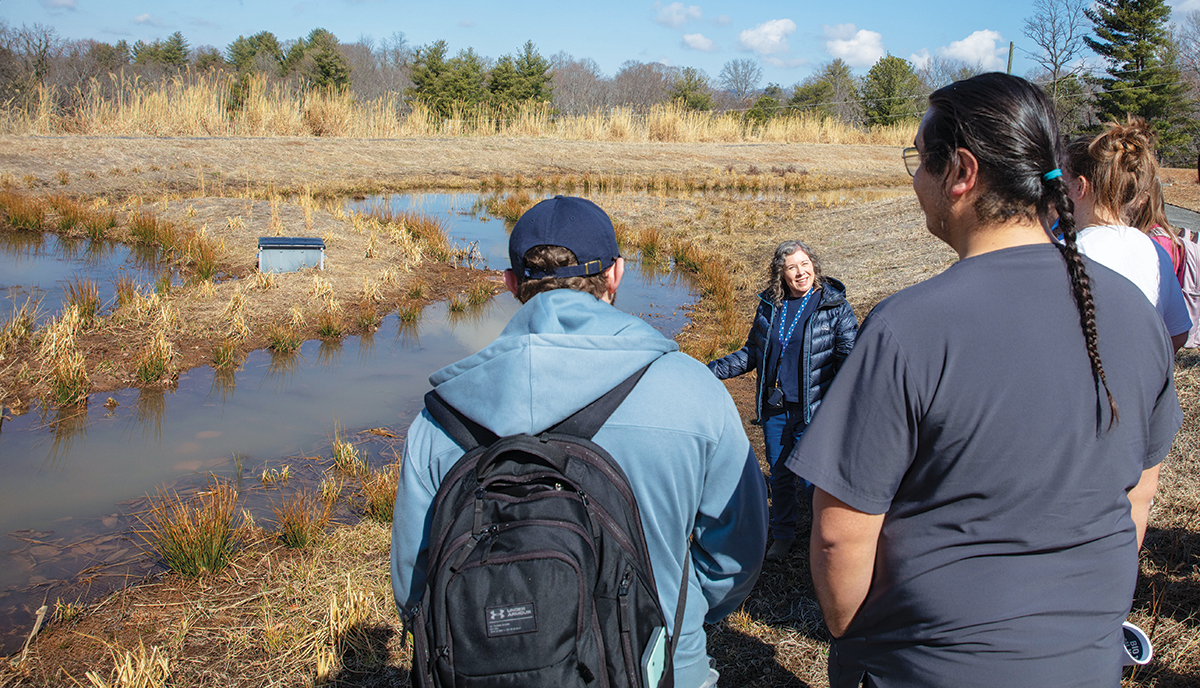
A-B Tech biology instructor Helen Burrell with students at the wetland area. Photo courtesy of A-B Tech Community College
By Kathleen O. Brown
Asheville-Buncombe Technical Community College and the nonprofit RiverLink have partnered to create an on-campus wetland area that is reducing stormwater runoff, improving water quality in Haith Branch and the French Broad River and serving as an outdoor classroom.
An asphalt parking lot at A-B Tech has been transformed into a wetland that collects and cleans stormwater runoff from 16 acres of hard surfaces across the campus. Instead of flowing into storm drains, rainwater now spreads out and soaks into the ground, allowing native plants and soils to naturally filter out pollutants.
“Haith Branch was previously inundated with large sediment loads caused by erosion from the volume of stormwater entering from campus parking lots,” says Helen Burrell, a biology instructor at A-B Tech involved with the wetland project. “For years, I have taken students to sample macroinvertebrates and chemical parameters in Haith Branch,” she says. “We sampled areas above and below where the sediment entered the stream.
We have seen differences in the numbers and kinds of animals present in the two areas. I am excited to sample again in these same areas now that the wetland is in place and see how the numbers and kinds of animals may change over time.”
The project was identified during a study completed by Blue Earth Engineering in 2021 that explored water quality issues impacting the French Broad River and smaller tributary streams that flow through the Central Asheville Watershed, says Renee Fortner, director of programs at RiverLink. Fortner says it took four years from project conception to securing grant funding to completing construction. A groundbreaking ceremony had been planned just days before Hurricane Helene struck the region. The storm delayed the start of construction, but the project was completed in September 2025.
“When the project was first conceived,” Fortner says, “Dirk Wilmoth was the college’s CFO and he was committed to addressing the negative impacts of stormwater runoff from A-B Tech’s campus on the surrounding areas. Dirk also connected our staff and the design team to the college’s Sustainability Committee which allowed us to form collaborative relationships with other A-B Tech staff, faculty and students.” Such collaborations included A-B Tech Survey/Geomatics instructor Christopher Milan’s students conducting a topographic survey of the gravel parking lot where the pond now exists.
Burrell says the second phase of the project includes purchasing equipment for students to conduct chemical and macroinvertebrate sampling of the wetland and for visualization of organisms living in the wetland. Ultimately, she says, many students from a variety of courses will use the wetland.
“Biology students will be sampling for aquatic macroinvertebrates and performing chemical testing and microbiology students will be testing for bacteria,” Burrell says. “Chemistry and physics classes are also looking to use the wetland for some labs. Construction management students are currently building a storage pod for the outdoor classroom area. The art department is planning to reuse leftover clay to make tiles that can decorate the concrete area where water enters the wetland. Sustainability students will also have an on-campus example of bioremediation.”
Since Hurricane Helene, Burrell says she thinks stormwater is on people’s radar more. “We hope that this project at A-B Tech can provide an example of what can be done to reduce the flow of stormwater entering streams, especially during large rain events,” she says.
Learn more about the collaborative project at RiverLink.org/projects/A-B-Tech-green-infrastructure-project.