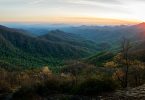
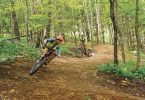
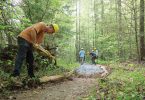
The Bartram Trail, showing the yellow blaze. (Photo by Russell Gillenwater)
Compleat Naturalist: A Walk in William Bartram’s Footsteps
“At the request of Dr. Fothergill, of London, to search the Floridas, and the western parts of Carolina and Georgia, for the discovery of rare and useful productions of nature, chiefly in the vegetable kingdom….” ~William Bartram, April 1773

Laura & Hal Mahan
Many of our area’s early explorers and natural historians came to inventory the New World’s wealth of undiscovered natural resources, which today we look upon as commonplace. The kings and queens of Europe hired botanists to discover and ship home rare and exotic flowering plants to add to their garden collections or investigate for medicinal properties. For example, sassafras was the largest export for nearly a hundred years beginning in the early 1600s. This common small tree was prized for its flavoring properties, which made medicines more palatable.
William Bartram (1739–1823) was the son of John Bartram, of Philadelphia, who started the first true botanical garden in North America near Philadelphia. John was named the official “King’s Botanist for North America,” and became a primary purveyor of seeds and plant specimens to the royal gardens in England.
Young William acted as his father’s assistant on some journeys, and then struck out on his own. Today’s botanical explorers can walk nearly the same path he followed on his historic exploration from the foothills of the Appalachian Mountains to Florida, through the southeastern interior all the way to the Mississippi River from 1773 to 1777. On this journey, he was supported by a wealthy patron in exchange for specimens, drawings, and a journal of observations. This journal, filled with fascinating descriptions of the countryside, people, and natural history of the time, was published in 1791 and is still in print today as Bartram’s Travels.
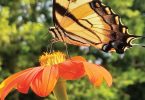
He described 358 species of plants in his collective journals, 130 of these being new to science at the time, including our flame azalea, which blooms here in May. William was so affected by its flaming orange color that he described a mystical apprehension that the hills were set on fire!
Today, the memorial trail follows William’s original route as closely as possible on public lands, going through the states of North and South Carolina, Georgia, Florida, Alabama, Mississippi, Louisiana, and Tennessee. The 80-mile North Carolina section is maintained by the nonprofit group, the North Carolina Bartram Trail Society (NCBTS). Since 1977, the NCBTS has blazed (with yellow markers), built, and maintained the trail, the North Carolina section of which begins just south of Highlands and ends at Cheoah Bald.
Recently the NCBTS updated their wonderfully detailed map of the Bartram Trail, making it even easier to walk in the footsteps of one of America’s earliest and most famous naturalists.
Laura and Hal Mahan are owners of The Compleat Naturalist, located at 2 Brook Street in the Historic Biltmore Village. To learn more, visit compleatnaturalist.com or call 828.274.5430.