By Laura & Hal Mahan
Thank you, Blue Jays! No, not the sports team—the bright blue, raucous bird that frequents our neighborhoods throughout the eastern US. It is quite likely that the majestic white oak tree that dominates the view from the back of our house came from an acorn that was “planted” by a Blue Jay many decades ago. As it turns out, jays and oaks have a long partnership stretching back thousands of years. The birds specialize in acorn gathering. A study in Blacksburg, VA found that Blue Jays transported and stored 54 percent of the acorn crop from a particular stand of oaks, and they ate a further 20 percent at the site. This is apparently one explanation of how oak trees of many species have become so widely distributed since the last ice age. The average distance from the seed tree to the jays’ cache sites was a little more than a kilometer.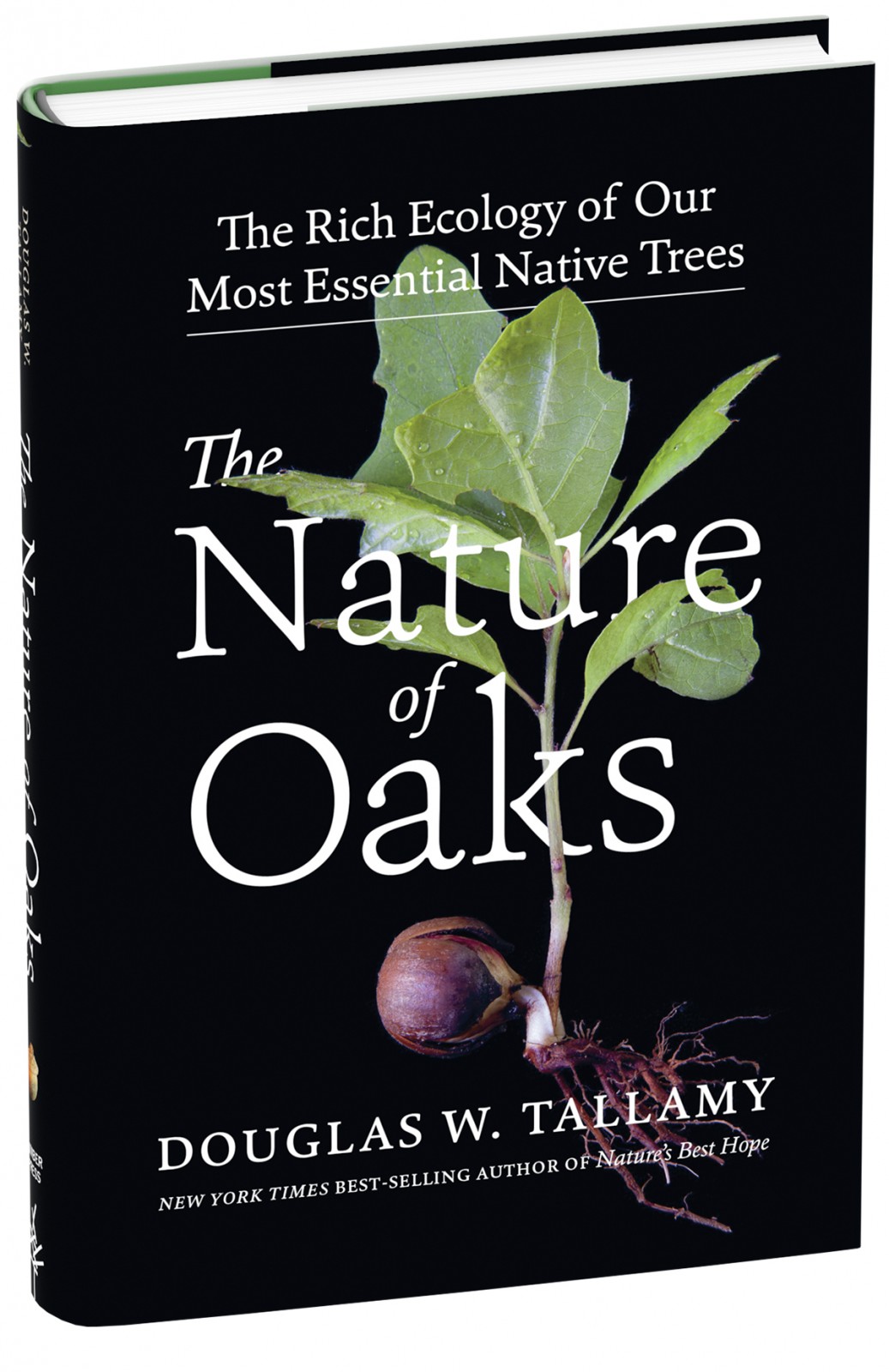
The new book The Nature of Oaks: The Rich Ecology of Our Most Essential Native Trees, is a page-turner. Just as a disclaimer, I am completely biased about oaks. They are my favorite tree, period. More specifically, white oaks. I think my fascination began in college when I learned that wild oak species hybridize and that if you know how to recognize them you might find, for example, a tree that is a cross between a white oak (Quercus alba) and a post oak (Quercus stellata). It blew my pre-formed biology student mind to think that plants were actually out there interbreeding amongst themselves without the help of modern horticultural methods. Ain’t science messy? And fascinating?
Author Doug Tallamy is well-known among nature lovers for his widely read 2007 book, Bringing Nature Home. Tallamy is an entomologist, which means he is an expert on insects. Putting Bringing Nature Home into a nutshell (ha!), his premise is that our native insects evolved over thousands of years with our native plants, and most insect larvae (caterpillars) are quite specific about which plant species they will feed on. Most folks know the story of the monarch butterfly caterpillar’s dependence on milkweed plants as a famous example. And here’s the clincher: nearly all songbirds rear their young on caterpillars. So you get the idea—no native plants, no caterpillars. No caterpillars, fewer songbirds.
In The Nature of Oaks, Tallamy hones in on the group of trees in our environment that he refers to as “keystone species.” A keystone species is one on which many other species depend and that if removed would drastically change the environment. In Bringing Nature Home, Tallamy provides the data. He and his students quantified how many species of caterpillars they found feeding on woody plant species, with oaks coming out the winner with a whopping 534. And in his new book, Tallamy leads you into the fascinating detail of the life of an oak tree, describing month by month many of the interactions it supports. The book is well-written, conversational and will make you take a second look at the tree that, lucky for us, is the keystone of our landscape.
Laura and Hal Mahan are owners of The Compleat Naturalist, located at 2 Brook Street in the Historic Biltmore Village. To learn more, visit CompleatNaturalist.com or call 828.274.5430. Doug Tallamy will be one of the keynote speakers at the Cullowhee Virtual Native Plant Conference on Friday and Saturday, July 16–17. Registrants can stream any of the sessions for six months. To find out more, visit wcu.edu/engage/professional-enrichment/conferences-and-community-classes/the-cullowhee-native-plant-conference.