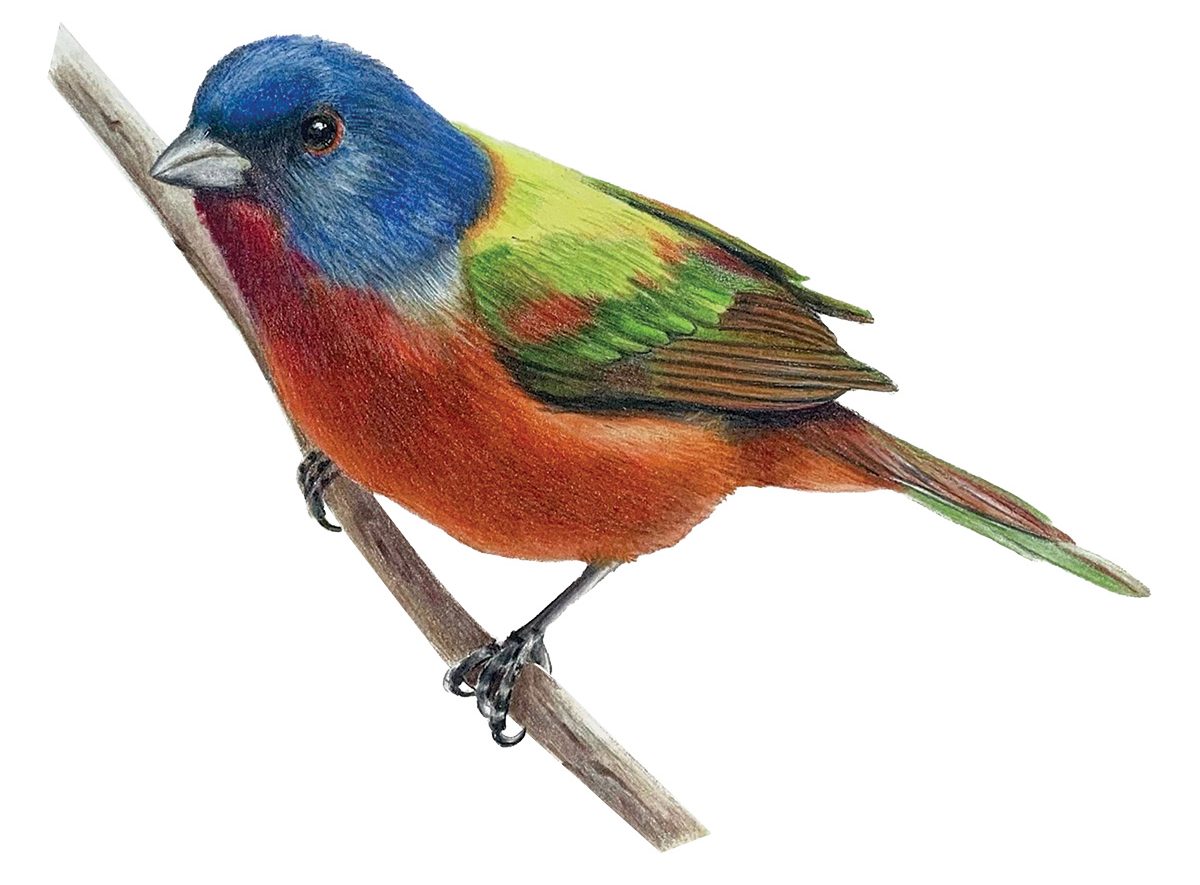
David Ballard, artist
By Casey First
The Painted Bunting (Passerina ciris) is an unmistakably beautiful bird that gives even the most avid birders pause. The male is adorned with vivid shades of blues, reds, yellows and greens that seem to fuse together, creating subtle and soft pinks, purples and hints of orange. The female counterpart is less vibrant, but equally exquisite in her own way, with a lemony yellow and bright green body that is uniform throughout.
The Painted Bunting’s body is stocky and similar in size to a sparrow. They have thick, stout bills perfect for cracking open seeds and foraging for food. Their song is a series of short, musical phrases of thin, sweet, high-pitched notes lasting about two seconds.
In the US, Painted Buntings have two distinct breeding grounds during the summer months: on the east coast from the North Carolina coastline down to Florida, and in the west in Texas, Oklahoma, Arkansas, Louisiana, Mississippi and northern Mexico. In the winter, the eastern population will travel to Mexico and Central America. Unlike other species of birds, the western population of Buntings begin their migration prior to molting and molt during
their voyage south.
Painted Buntings favor dense, scrubby, lowland habitats throughout their breeding and nonbreeding ranges, though eastern and western populations use slightly different environments shaped by geography. The western population most often breeds in thick, brushy areas, including vegetation along roadsides and near farmlands. In contrast, the eastern population typically nests in scrub, thicket and hammock habitats, as well as in overgrown patches within yards and fallow fields.
During the nonbreeding season, both groups rely on dense thickets and tall grasses for cover and foraging. Despite their eye-catching colors, Painted Buntings can be secretive, wallowing in the dark and thick brushes and thickets. However, once observed, these birds love to show off their ornamental colors. You may see the male showcase his bright hues in a complex courtship dance, similar to bird-of-paradise species like the Papuan.
It is very rare to see these birds in our area, but if you are up for a day trip to one of our nearby coastal towns in the Carolinas, you can find them there. At a bird feeder, they can be seen in small flocks enjoying millet, sunflower chips and even thistle. In the wild, these ground-foraging birds feed mainly on seeds from pine, rose, wheat and various grasses. During the breeding season, they supplement their diet with protein-rich insects such as beetles, grasshoppers and caterpillars to support both themselves and their young.
When breeding, both the males and females contribute to finding a suitable nesting site, typically in low-vegetation areas. The female weaves together a nest consisting of twigs, grasses, stems and leaves held tight by spiderwebs and typically placed in a crook of branches a few feet off the ground. Mama will lay three to four speckled eggs and have up to three broods per season.
Successful nesting and preservation of their nesting habitat is crucial for the long-term success of these birds. Recent studies have shown population drops over the past several decades, threatening the vitality of this species. Advocating for habitat preservation and careful zoning as land development continues in their breeding grounds is critical to their survival and our enjoyment of their dazzling colors for years to come.
Casey First is owner of North Asheville Wild Birds Unlimited, located at 946 Merrimon Avenue, Suite 120. Monthly bird events are free and open to the public, with no registration required. To learn more, visit NorthAsheville.wbu.com. Artist David Ballard lives in Candler. Find his work on Instagram at d.ballard.art.