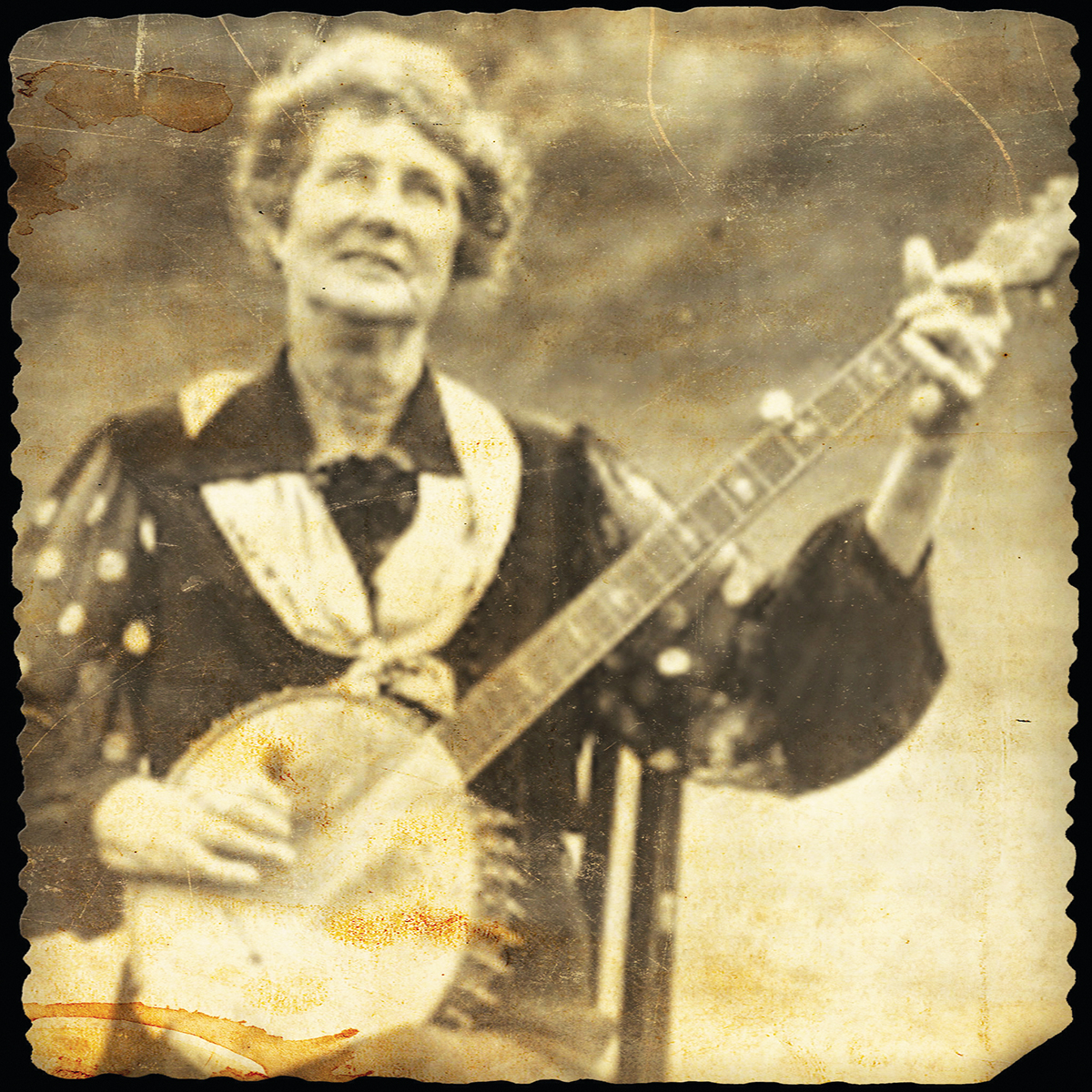
Samantha Bumgarner. Original photo courtesy of Southern Folklife Collection, Wilson Library, University of North Carolina Chapel Hill
By Lauren Stepp
It is the early 1900s in a Haywood County cove. The Pigeon River is roaring and a tall, ruddy-faced woman wielding a 10-cent banjo is about to forever change the course of hillbilly music.
“We was in Canton, and they was havin’ a fiddlers’ convention,” Samantha Bumgarner, a Dillsboro resident, would tell the Sylva Herald years later. “Somebody entered me in the contest. It was the first banjo contest I was ever in, and I was nervous. And here I looked up and saw all these fine banjos coming in from Asheville. I wanted to leave, but they wouldn’t let me. I tell you I was so nervous I didn’t know I was hitting the strings. But I won that contest. And I’ve been winning them ever since.”
Bumgarner would do more than win a handful of local contests. In April 1924, she and her friend Eva Davis of Sylva traveled to New York City to record songs for Columbia Phonograph Company. This was the first recording of women in the history of hillbilly music, a genre heavily commercialized in the late 1920s.
An unsung matriarch of mountain music and culture, Bumgarner will be inducted into the Blue Ridge Music Hall of Fame on Friday, June 18. Based out of the Wilkes Heritage Museum in Wilkesboro, the Hall of Fame exists to preserve the musical heritage of the greater Blue Ridge Mountains area. The honor will be bestowed posthumously, some 60 years after Bumgarner’s death. “It’s been a long time coming,” says local musician Laura Boosinger. “I just don’t think many people understand who she was.”
Born on Halloween in 1878, Bumgarner spent most of her life on the banks of the Tuckasegee River in Jackson County. Her father, Has Biddix, was a skilled musician who could make his sourwood fiddle “croon like a lovin’ woman,” reads an Asheville Citizen-Times article published in 1977.
Since playing the fiddle was thought to be sinful, especially for women, Bumgarner learned in secrecy, doing the same with her father’s banjo, though Biddix eventually made her one using a gourd, a cat’s hide and cotton thread. She received her first “real” banjo when she was 15.
In 1929, and for the 30 years that followed, Bumgarner performed at Bascom Lamar Lunsford’s Mountain Dance and Folk Festival.
Not much is known about who “Aunt Samantha,” as many called her, was off-stage. She married Carse Bumgarner, never had children and lived out her later years in a “typical mountain home…in the heart of the Cowee mountains.” (Sylva Herald, 1945)
“Her music, whether you call it hillbilly, mountain, bluegrass or old-time, is so much a part of the culture of our country,” says Art Menius, a North Carolina radio host. “This music reflects how different traditions have intertwined and created something that is wholly American.”
The 13th Annual Blue Ridge Hall of Fame Induction Ceremony will be hosted on Friday, June 18. To learn more about the ceremony and Samantha Bumgarner, visit WilkesHeritageMuseum.com.