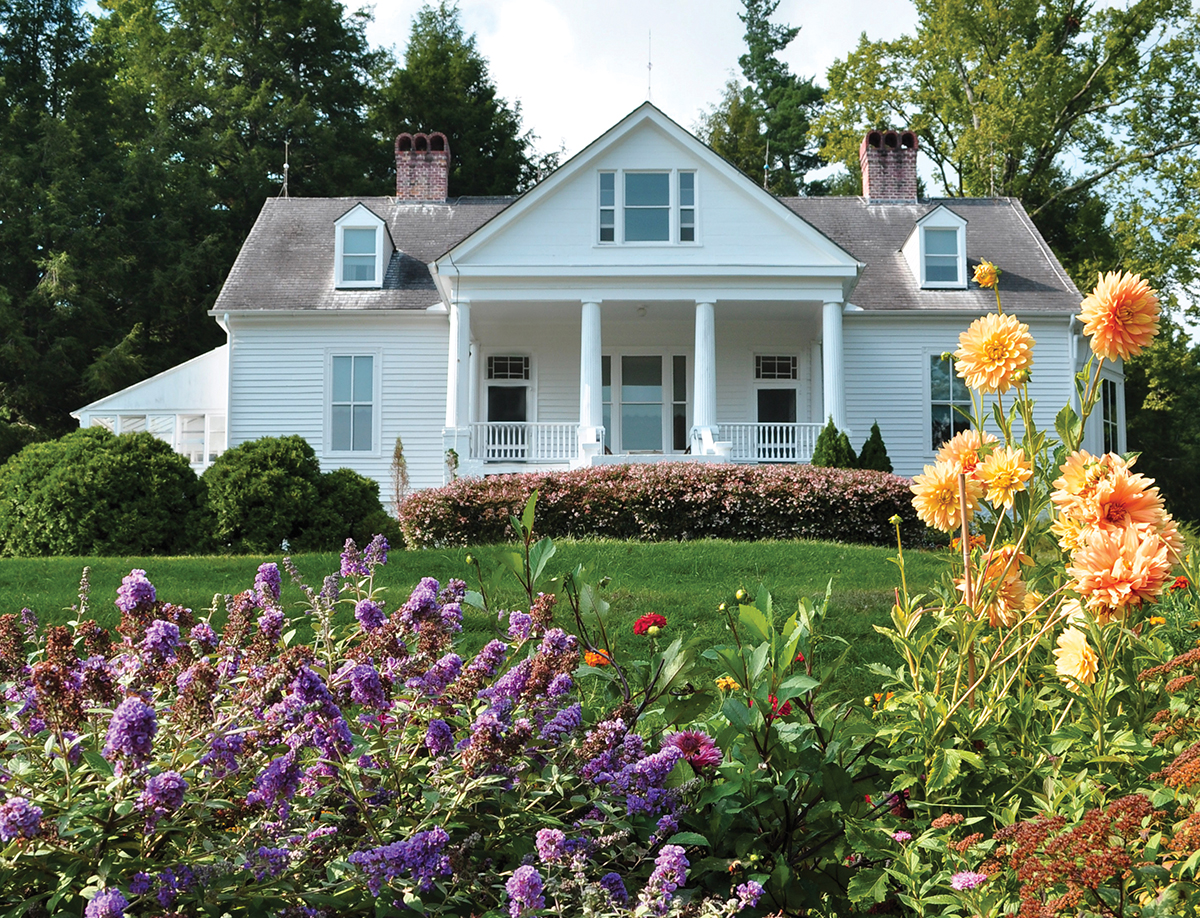
The Carl Sandburg Home today. Photo courtesy of the National Park Service
By Lauren Stepp
Today, most know Connemara as the celebrated home of Pulitzer Prize-winning poet and biographer Carl Sandburg. But before Sandburg moved to the Henderson County estate in 1945, it was a much different, darker place.
According to Jamie M. Mahan, cultural and natural resources program manager at the Carl Sandburg Home National Historic Site, Connemara’s history is inextricably linked to the racial inequalities of the American South.
As Mahan explains, the property was first owned by Christopher Gustav Memminger, a lawyer in Charleston, SC, who served as the secretary of the Confederate States Treasury during the Civil War. Memminger called the site Rock Hill and built the main home in the 1830s using slave labor.
“C.G. Memminger brought up to 12 enslaved people to the site from Charleston to do all manner of work for his family,” says Mahan. “There were gardeners, farmers, craftsmen, housekeepers, nannies and butlers.”
Sadly, very little is known about these individuals.
“… [T]heir lives weren’t documented, aside from a first name in some cases and possibly a deed from when they were sold,” says Mahan. “Since they were viewed as property, their stories have been mostly lost.”
In 1900, Rock Hill was purchased by Ellison Adger Smyth, a wealthy industrialist and Confederate veteran from Charleston. As the property’s new owner, Smyth renamed the estate Connemara in honor of his Irish heritage, expanded the barn area to house livestock and constructed vast vegetable gardens. But much like Memminger, he relied on Black workers—often underpaid and discriminated against—to maintain the estate.
Having written a multi-volume biography of Abraham Lincoln and reported extensively on the Chicago Race Riots, Sandburg was “acutely aware of the history of enslavement and white supremacy at Connemara,” says Mahan. “In Sandburg’s archives, there are articles, deeds and even Confederate money with Memminger’s portrait. We also know from the archives that Sandburg corresponded with Memminger’s descendants during the time he lived here.”
But it wasn’t until 2016, when the National Park Service funded a study to investigate the lives and contributions of Black workers at Connemara, that the fuller, more complex history of the estate began to emerge. The resulting research by David E. Whisnant and Anne Mitchell Whisnant, Black Lives and Whitened Stories: From the Lowcountry to the Mountains, has informed many initiatives at the historic site.
“The study has given us the information to increase our interpretation of the lives of the enslaved, and later hired, Black workers at Connemara,” says Mahan. “We have developed lesson plans for local schools, created an outdoor exhibit panel in front of the structures that were built and used by Black workers, updated our website with accurate information about the property’s owners prior to Sandburg and updated walking tours of the historic core of the park.”
It is Mahan’s hope that sharing these stories will “tell a fuller history of all the people who once lived here.”
The Carl Sandburg Home National Historic Site (1800 Little River Road, Flat Rock) is temporarily closed in the wake of Hurricane Helene. However, online exhibits can be explored at nps.gov/carl.