By Casey First
The Fox Sparrow (Passerella iliaca) is a member of the New World Sparrows, endemic to North America. This sparrow is a particularly large and chunkier sparrow that varies in appearance significantly across its range.
The “Red” Fox Sparrow that is common to the eastern US during the winter months is the star of this article. It has a rich reddish- and rust-colored plumage that is spotty and streaked, quite similar in appearance to that of a Hermit Thrush. It has a faint grey stripe starting at its bill that extends across its eye and back over its head. A deep chocolate brown envelops the back tail feathers. Its chest has splotches of contrasting stark white and brown which streak downward, dissolving into a white, rounded and extremely soft underbody. The bill is a two-toned yellow-grey color and is short, sharp and conical, perfectly designed to crack open tough seed husks and spear insects as they forage for food in the litter of the forest’s canopy. Like most sparrows, it has a medium-sized tail that is close to half the size of its body.
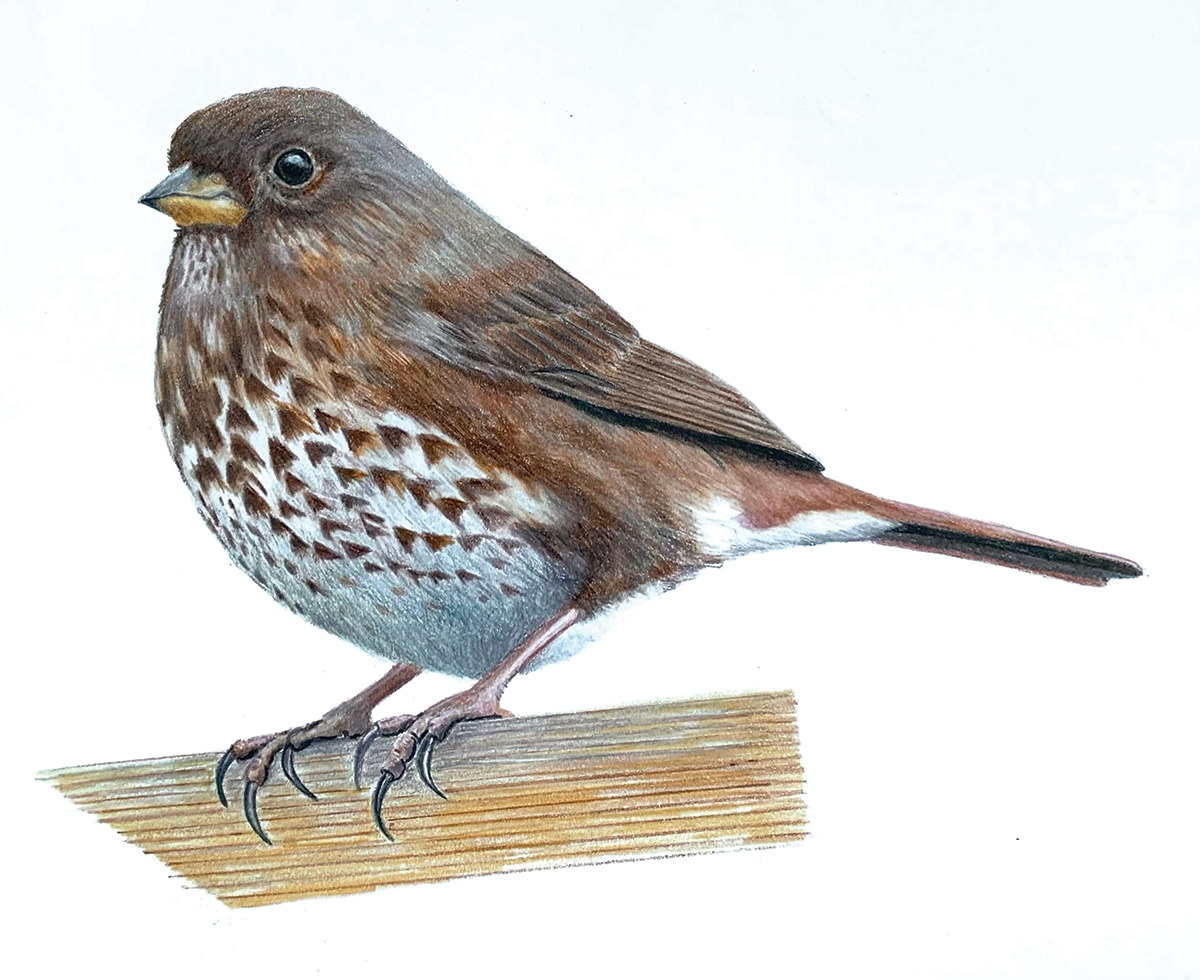
David Ballard, artist
Beginning in November, these sparrows can be seen in much of the eastern US (as far south as Florida) as they leave their breeding grounds in the boreal forests of Alaska and much of northern Canada. Their numbers peak in early winter, and they return north in early April. While they are here, they can be seen in backyard thickets and dense covering, scampering through leaves in search of their next meal. During breeding season, they eat a high-protein diet that consists almost entirely of insects like beetles, ants, bees and caterpillars. However, in winter they have a more balanced diet that includes a variety of food, ranging from fruit to seeds, grasses and weeds.
The Fox Sparrow exhibits a special “double scratching” foraging technique to catch prey under fallen leaves and debris. It involves a hop forward and an immediate hop back, during which they simultaneously scratch both feet backwards through leaf litter (a move common among sparrows and towhees) turning up leaves to see what is underneath. If you are looking to attract these sparrows to your backyard, try offering a ground feeder or open platform feeder that is filled with a mix of seeds like millet and premium oil sunflower seeds. You can also try scattering seeds on the ground, close to nearby bushes so they can hop in for a quick bite and then retreat to safety after eating. Planting berry bushes at the edge of your landscape and leaving leaf piles are also ways to encourage visitors.
During their breeding season, you can find them living in brushy woods and mixed woodland forest edges, the same places where they raise their young. During mating, their cup-shaped nests are found on the ground, on low tree branches, upturned stumps or in the crannies of thick bushes. Mama sparrow will lay about three eggs twice a season, and the young fledglings spread their wings to the world after around 10 short days.
During nesting season, these birds give off a bright, clear and lively song characterized by several short trills, or churs, very much uncharacteristic of their more reserved and reclusive behavior. However, even though they are shy and quick to cover, if you are lucky enough to witness them firsthand, you are sure to marvel at their splendor, colors and distinct personality.
Casey First is owner of North Asheville Wild Birds Unlimited, located at 946 Merrimon Avenue, Suite 120. Monthly bird events are free and open to the public, with no registration required. To learn more, visit NorthAsheville.wbu.com. Artist David Ballard lives in Candler. Find his work on Instagram at d.ballard.art