By Elaine Smyth
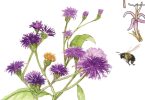
The name virgin’s bower (Clematis virginiana) suggests a quiet place of calm and ease, and indeed this plant is perfect for creating a beautiful, shaded nook in your garden. When it blooms, though, its small, white, faintly scented flowers can attract a crowd! More than a dozen different moths and butterflies, as well as halictid bees and flies are known to feed on it, and the plant is an obligate—a “must have”—for the clematis clearwing moth, Alcathoe caudata, the larvae of which feed on its roots.
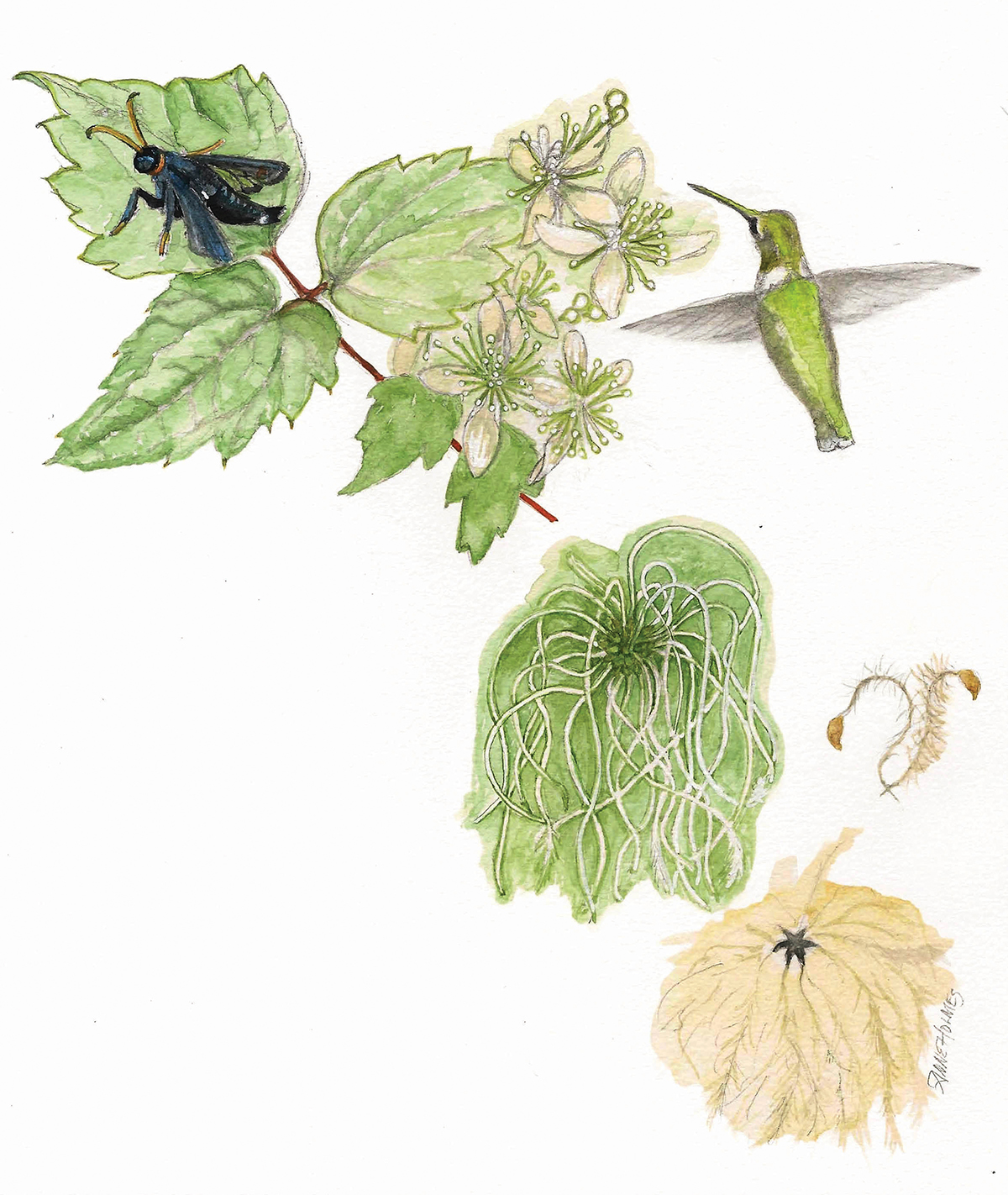
Anne Holmes, artist
A perennial vine, virgin’s bower climbs easily and rapidly, wrapping twisted stems around fences, trellises and most anything else it encounters. Reaching lengths of 10 to 20 feet, it can be pruned throughout the growing season to encourage a full, bushy form. Finely textured and deciduous, virgin’s bower tolerates a wide variety of conditions, but prefers partial sun, moist to mesic conditions and loamy soil. It is one of the few vines that will flower in shade. It’s best started from seed or from cuttings; its roots are deep but sparse, which makes transplanting difficult. Be aware that the plant is moderately toxic to mammals.
Virgin’s bower is sometimes confused with and often displaced in our landscape by sweet autumn clematis, Clematis terniflora, a plant originally from Asia, which is, unfortunately, highly invasive here. They are easily distinguished: the leaves of our native clematis have coarse, unequal teeth on the margins. In contrast, the leaves of sweet autumn clematis are smooth and without teeth.
Clematis virginiana can produce flowers that are only female (pistillate), only male (staminate) or “perfect” in botanical terms, having both male and female parts. The male plants are more showy when they bloom, but since they don’t produce seeds, they lack the silvery plumes that decorate the female plants, adding interest to the garden in fall and winter.
Upcoming Events at Asheville Botanical Garden
Learn more and register for classes online via the ABG website at AshevilleBotanicalGarden.org.
Tuesday,
August 4: C.P.A. series: Pollinator Friendly Pest Management, with Brannen Basham
Saturday, August 8: From Lawn to Meadow (Part I): Designing & Planting Native Meadows, with Emily Sampson
Saturday, August 15: Wood ID from the Inside Out: Understanding Structure, Strength & Use, with Ron Lance
Saturday, August 22: Grooming Wild Gardens – Ecological Garden Management from Theory to Practice, with Jenny Luczak
Saturday, August 29: From Lawn to Meadow (Part II): Establishment, Maintenance & Long-Term Success, with Emily Sampson
The ABG Visitor Center and Gift Shop are open 10 a.m. to 4 p.m. daily, featuring local products, garden-themed art, toys, tools, cards and books.
Asheville Botanical Garden, 151 W.T. Weaver Boulevard, is an independent, non-profit public garden showcasing 750+ species of native plants on 14 acres. Our mission is to promote and showcase the value and diversity of plants native to the Southern Appalachian region by serving as an educational resource and urban destination for nature study and enjoyment. Supported by members, donors and volunteers since 1960, the Garden is free to all. The Garden is open daily, sunrise to sunset, year-round. Learn more at AshevilleBotanicalGarden.org