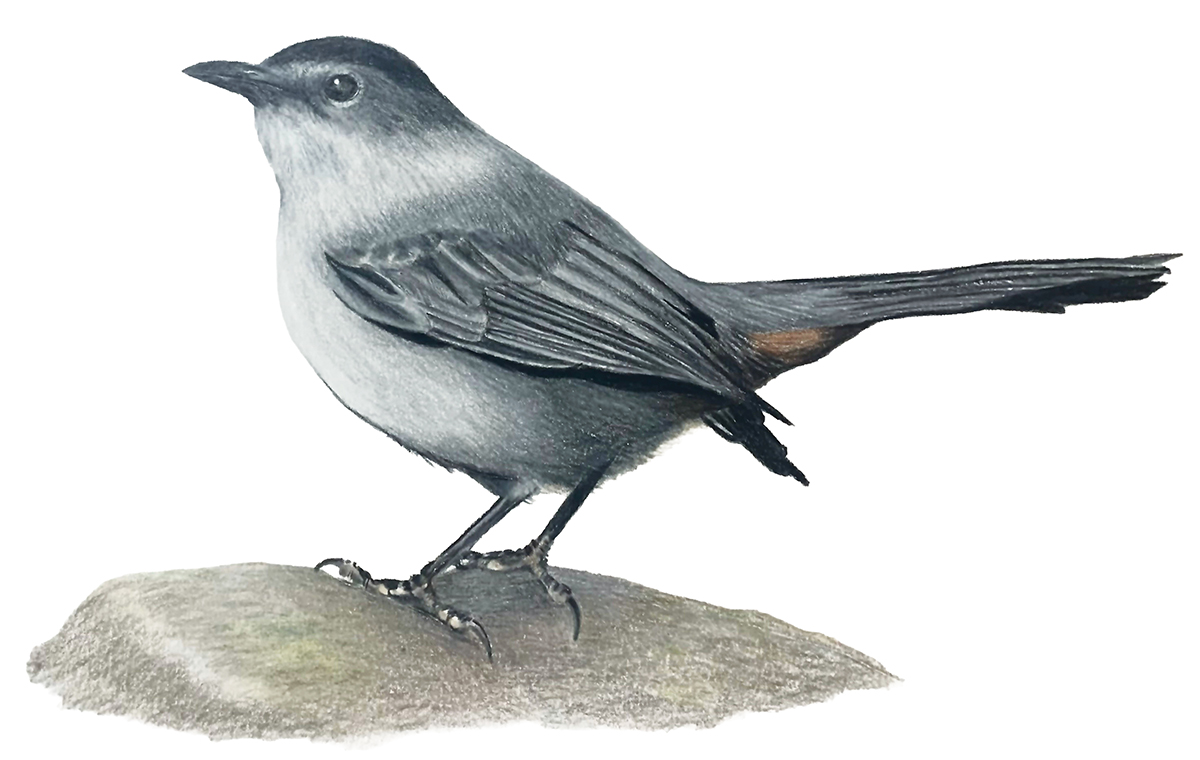
David Ballard, artist
By Casey First
The Gray Catbird (Dumetella carolinensis) is a member of the mockingbird and thrasher family. It is a medium-sized songbird, measuring about 8 to 9 inches long. It is slimmer and slightly smaller than an American Robin, with a smooth, dark smokey-gray body, black cap and tail, and a distinctive rusty-red patch beneath the tail. Both the male and female look alike.
Gray Catbirds breed throughout much of the US and southern Canada, from British Columbia and the Canadian provinces east to Nova Scotia and south through the eastern US. They also breed in parts of the central states and some of the western states, but not as far as California. In winter, most move south to the southeastern US, Mexico, Central America and the Caribbean.
In Western North Carolina, they are primarily summer residents, arriving in spring and generally departing in fall. Look for catbirds wherever dense, low vegetation provides cover. They favor tangled shrubs, blackberry and grape thickets, overgrown fields, woodland edges, stream corridors and brushy areas around parks and neighborhoods. They often avoid deep, unbroken forest, preferring the shrubby transition zones that are common around the mountains.
In our region, they can be seen in a wide variety of locations, from the valleys to higher elevations, from April through September, with migration bringing additional birds through in spring and fall. Beaver Lake Bird Sanctuary, along with gardens, greenways and other brushy habitats around Asheville, can be hotspots to see them.
The Gray Catbird is an omnivore, eating insects, spiders and other small invertebrates, along with a wide variety of berries and fruits. In summer, insects such as beetles, millipedes, fire ants, caterpillars, grasshoppers and crickets are important foods, while fruit becomes especially important later in the year. At backyard feeders, catbirds typically don’t eat bird seed, but may be attracted to suet that has dried mealworms or fruit mixed inside. They may also come to a platform bird feeder if you offer dried fruit like raisins or cherries. If you happen to have berry-producing shrubs or trees like serviceberry or dogwood in your yard, you might catch a glimpse of the catbird stopping by for a snack.
The catbird’s song is one of the most entertaining in the mountains. It is a rambling mixture of whistles, squeaks, chatters and musical phrases, sometimes incorporating imitations of other birds and even mechanical sounds. Its familiar call is a nasal, descending mew, remarkably similar to the sound of a cat. Listen carefully in a dense thicket and the voice may reveal a bird that remains hidden from view.
Catbirds build bulky, open-cup nests in dense shrubs, vines or small trees, usually only a few feet above the ground. Like most birds, the Mama bird does most of the nest building, using twigs, grass, leaves and other plant material. She typically lays three to five greenish-blue eggs and incubates them for about two weeks. Both parents feed the nestlings, which leave the nest roughly 10 days after hatching. Mama will typically lay two broods per season. Despite some habitat pressures, the Gray Catbird remains widespread and common, with a steady population over the past 50 years. Its continued presence in WNC is a welcome sign that healthy, brushy habitats remain part of our precious mountain landscape.
Casey First is owner of North Asheville Wild Birds Unlimited, located at 946 Merrimon Avenue, Suite 120. Monthly bird events are free and open to the public, with no registration required. To learn more, visit NorthAsheville.wbu.com. Artist David Ballard lives in Candler. Find his work on Instagram at d.ballard.art.