By Elaine Smyth
Anne Holmes, artist
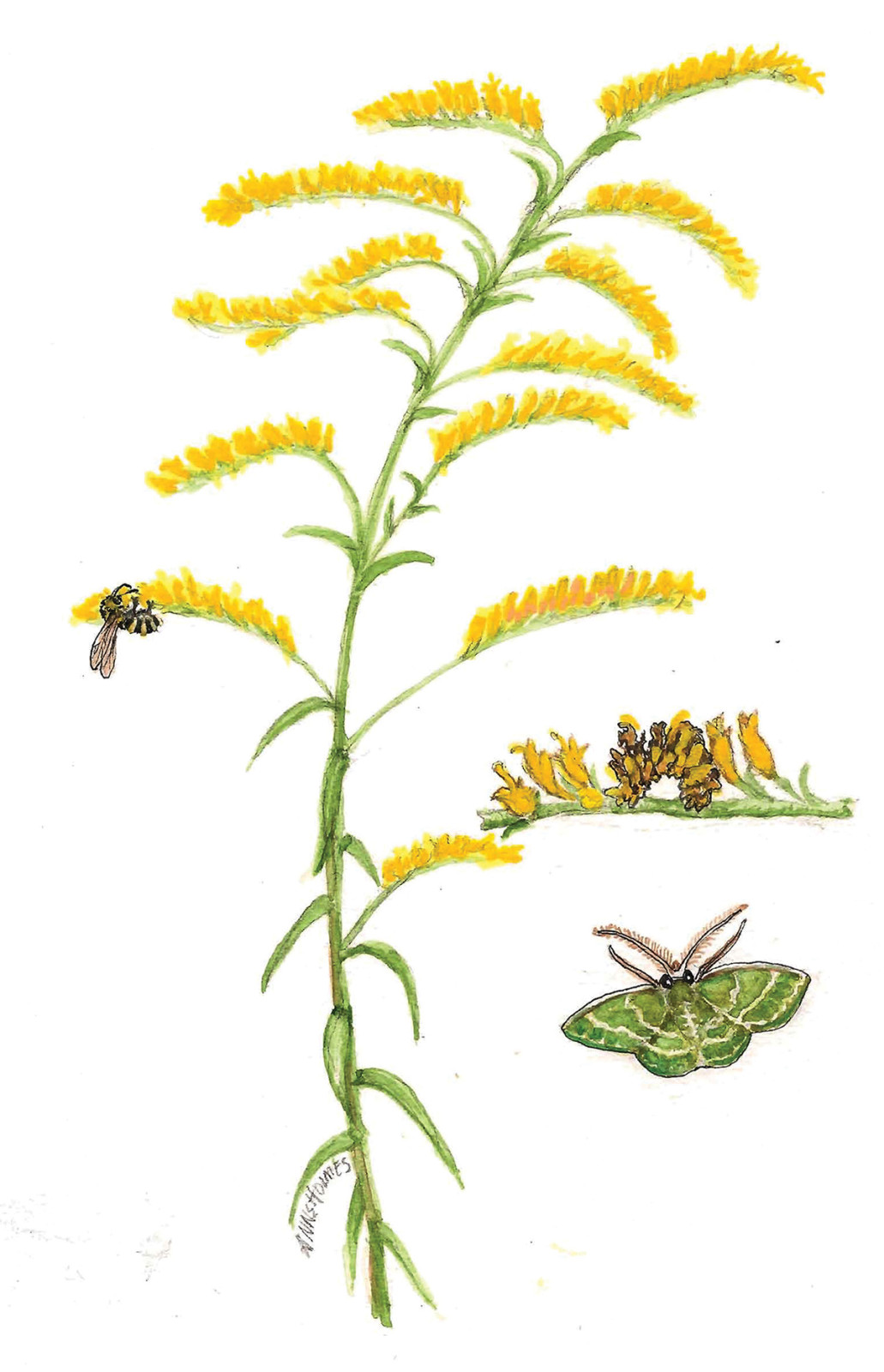
Solidago is the name given by botanists to a genus—a group of genetically related plants—that includes approximately 120 species in the Aster Family. These are the goldenrods, celebrated for their bright yellow blossoms that herald late summer in the Southern Appalachians. Most of the plants in this genus are native to North America, and all are herbaceous perennials, ranging in height from two centimeters to more than eight feet tall. The name Solidago derives from the Latin word solidare, meaning “to make whole” or “to heal.” It indicates how useful traditional healers have found many goldenrod species, both taken internally, as a diuretic, anti-inflammatory or pain reliever, and used as a poultice for healing wounds and rashes. Humans are not the only ones to appreciate its beneficial properties. The National Wildlife Federation lists Solidago as a top keystone genus for pollinators, second only to Helianthus (Sunflower) in supporting specialist bees, and one of the top 30 for supporting butterflies and moths, as host plants for their larvae.
Among the many goldenrod species, Solidago odora, or sweet goldenrod, stands out as a front-runner for home gardeners. Many goldenrod species spread aggressively and are hard to control in the garden, but sweet goldenrod tends to be well-behaved, growing in showy clumps two to three feet high. It likes full sun and average or dry, well-drained, acidic soils. It’s not picky, though, tolerating nutrient-poor soils as well as sand and clay. It will also do well in light shade, so it’s a great choice for butterfly and cottage gardens. It doesn’t need deadheading, either: the seedheads are beautiful in winter and are loved by seed-eating birds. Sweet goldenrod is also the chosen host for the beautiful wavy-lined emerald moth, Synchlora aerata, whose larvae feed on its leaves. Plant sweet goldenrod with Allegheny stonecrop (Hylotelephium telephioides) and New York ironweed (Vernonia noveboracensis) and make your garden a pollinator powerhouse next fall!
Upcoming Events at Asheville Botanical Garden
Learn more and register for classes online via the ABG website at AshevilleBotanicalGarden.org.
Tuesday, September 1
Certified Pollinator Series: All About Monarchs & Their Migration, with Kim Bailey
Sunday, September 6
Gardening on Steep Slopes, with Drew Lathin
Saturday, September 26
Common Mushroom Groups of the Southern Mountains, with Luke Cannon
Asheville Botanical Garden congratulates the North Carolina Native Plant Society on its 75th anniversary! Learn more at NCWildflower.org.
The ABG Visitor Center and Gift Shop are open 10 a.m. to 4 p.m. daily, featuring local products, garden-themed art, toys, tools, cards and books.
Asheville Botanical Garden, 151 W.T. Weaver Boulevard, is an independent nonprofit public garden showcasing 750+ species of native plants on 14 acres. Our mission is to promote and showcase the value and diversity of plants native to the Southern Appalachian region by serving as an educational resource and urban destination for nature study and enjoyment. Supported by members, donors and volunteers since 1960, the Garden is free to all and is open daily, sunrise to sunset, year-round.