
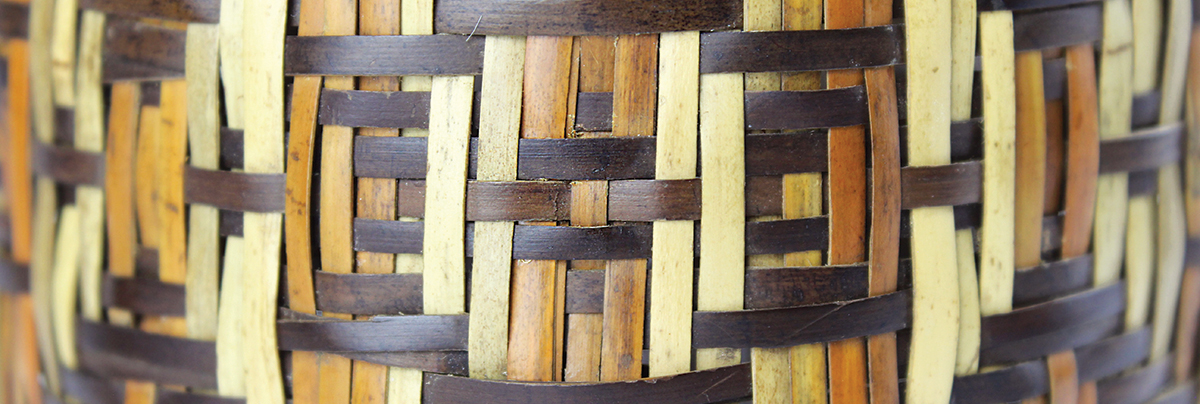
Rivercane basket detail. Dylan Morgan, artist
By Natasha Anderson
Bringing thousands of years of tradition into conversation with contemporary practice, the Center for Craft’s exhibition ᎢᏛᏍᎦ ᏫᏥᏤᎢ ᎠᎵᏰᎵᏒ Weaving Across Time showcases the works of nine Eastern Band Cherokee basket makers. Touching on the dynamic evolution of lineage, sustainability and cultural expression, the exhibition is on view through April 22.
“The inspiration for the exhibit began in 2019 during the planning for a forthcoming public art parklet inspired by Cherokee basket making,” says Center for Craft director of programs and curator Marilyn Zapf. “To compliment the parklet, we wanted to exhibit the works of contemporary Cherokee basket makers.”

Rivercane double weave with lid. Lucille Lossiah, artist
A focus on artists that harvest their own basket making materials was decided by an advisory committee of Cherokee educators. The exhibition was collaboratively curated with the participating artists and a small group of advisors. Artists show work made with two of the oldest materials in Cherokee basket making tradition, mountain rivercane and white oak, both of which have been used for thousands of years by Southeastern tribes. The labor-intensive process of basket making, which includes harvesting materials, gathering plants for dyes and deciding on intricate patterns, itself becomes a key component of the final object, which interweaves ecology, culture, land and identity.
These plants, particularly rivercane, are at the heart of Cherokee tradition and culture. The subject of serious conservation efforts, rivercane is also a vital plant for water quality and erosion mitigation, as well as a habitat for riparian species. Basket makers harvesting rivercane for splints approach the plant with deep reverence and knowledge of its centrality to the ecosystem, sometimes traveling hundreds of miles to harvest it sustainably. Other materials, including white oak, are selected with just as much care. Dyes used for the baskets, sourced from plants including bloodroot, butternut and walnut, add rich color to final pieces while also revealing information about harvest time and supply.
“The Cherokee are the first craftspeople and artists to live and work in this region, yet there is little public recognition of Cherokee in downtown,” says Zapf. “This exhibition showcases the skill and creative expression of the Eastern Band of Cherokee Indian basket makers and amplifies awareness of their artistic practice and relationship to this land.”
The baskets on display, all of which were created in the last two decades, connect lineages across time and space in a vibrant, living tradition. Patterns based on rhythmic numerical sequences are passed down from teacher to student. Basket makers also borrow from contemporaries and innovate to create pieces in their own recognizable styles.
“The Cherokee have always been able to change and adapt with time,” says basket maker ᎺᎵ ᏔᎻᏏᏂ Mary W. Thompson, who is also the consulting artist for The Basket public art parklet, “so our artwork and art forms have changed and evolved along with us.”
Center for Craft is located at 67 Broadway Street, Asheville. Hours are Monday–Friday, 10 a.m. to 6 p.m. Visitors can reserve 30-minute time slots for unguided visits to explore current exhibitions, learn more about the Center’s national impact and enjoy interactive activities. Learn more at CenterforCraft.org.



Hi. Can I have a link to this article so that I can post to my webpage?
Mary W Thompson,
Hi, Mary! You can just copy and paste the link at the top. Also shown below:
https://thelaurelofasheville.com/arts/cherokee-basket-makers-interweave-lineage-innovation-in-new-exhibition/