By Julie Ann Bell
A sketch can be many things, explains nature illustrator Roy King. “It could be a quick doodle on a napkin or a more detailed ink drawing on paper,” he says. “Sketching is a great way to practice a new subject, troubleshoot an idea or just let go of thinking altogether and let the pencil or pen move where it wants.”
Sketchbooks and sketch-based works by a dozen artists are displayed throughout Trackside Studios in June. Special events include hosting public classes for the 2026 Carolinas Sketch Crawl in early June and a Second Saturday reception June 13. Taryn Cozzy, Chalkley Matlack, Pat Abrams and King share their sketching journeys with us.
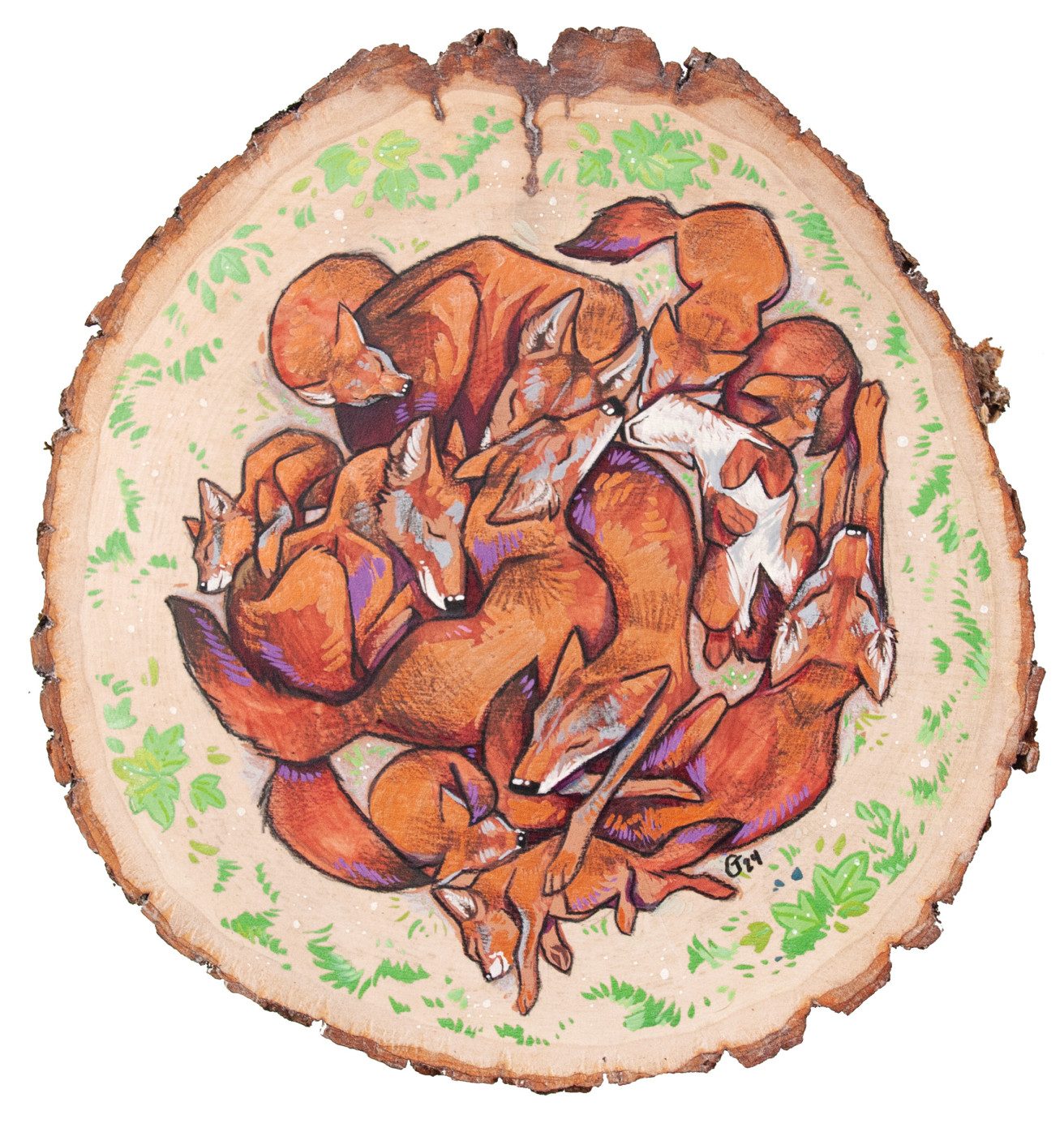
Red Wolves. Taryn Cozzy, artist
Both Cozzy and Matlack began sketching in childhood. Cozzy learned sketching and how to draw cute animals from her parents. This evolved into a career illustrating children’s books, animating storyboards and doing caricatures at Universal Studios. Her work often features people and animals as characters.
“When I was young,” says Matlack, “you couldn’t pry the sketchbook out of my hands. Because of this, I developed a good discipline of drawing practice. In art school, the discipline of drawing from life and learning how to transcribe the world in front of me into a 2D plane took hold.” Today, their imaginative work includes pen-and-ink illustrations and pyrographed designs on guitars.
Pat Abrams was interested in sketching as a creative outlet for most of her life, but says, “Since I don’t know how to draw realistically, I was dissatisfied with my results.” About four years ago she took a workshop with an artist whose sketchbook pages of simple, intuitive doodles using ink, watercolor and goauche inspired her and, she says, “I finally found my sketchbooking language.” Abrams uses her sketchbook as a place to experiment with composition, color, mark making and materials.
A decade ago, King was creating block prints and wanted to learn to draw his own designs. “I started sketching and immediately fell in love with the process,” he says, adding, “I haven’t looked back.” He uses his sketches to work out proportions and unique aspects of beetles, spiders, flowers and other natural subjects.
A wide variety of materials can be used for sketching. Abrams uses water-soluble ink, watercolors, graphite and acrylics. Cozzy loves pencils, the messiness of charcoal and the convenience of acrylic markers. She has also adapted to digital tools such as Procreate.
Matlack prefers heavy-weight paper with a tooth to the surface that can tolerate adding/subtracting and scribbling/erasing. They use graphite pencils, then add a splash of color with markers or paint. King’s favorite tool is a basic Bic .5mm HB mechanical pencil.
The artists take inspiration from nature, city scenes or the view from their porch. Some prefer to sketch while out and about and others in their home studio. Cozzy also likes to sketch at artist gatherings such as the weekly Art & Chill at Trackside Studios. Creating with other artists nearby “opens up the door for collaboration, thinking outside the box and building a sense of community” that she says helps her art flourish.
For those interested in learning to sketch or loosening up their sketching practice, Trackside Studios offers a variety of classes including Abram’s Sketchbooking, Clay Sayre’s Zen Doodling, Matlack’s Pyrography and Claire Simpson-Jones’ Travel Journaling.
Trackside Studios is located at 375 Depot Street in the River Arts District. Hours are 10:30 a.m. to 5:30 p.m. daily, and by appointment. Learn more at TracksideStudios.com.