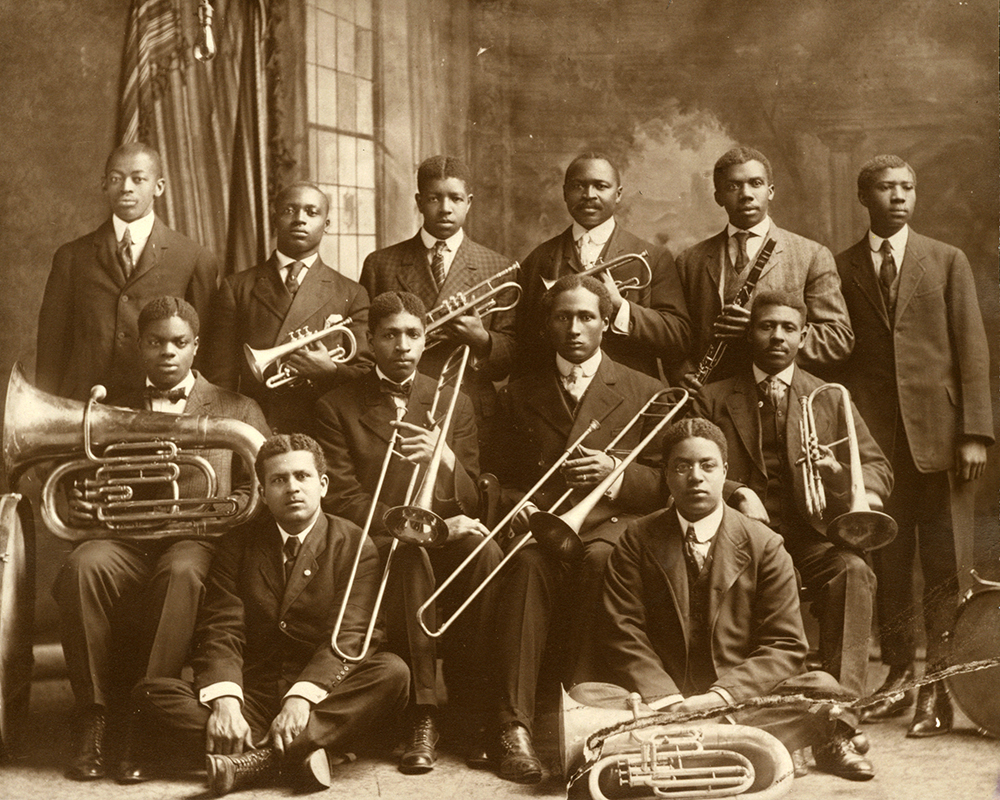
Photo courtesy of the North Carolina Collection, Pack Memorial Public Library, Asheville
The Young Men’s Institute Band of Asheville
By John Turk
This marvelous photograph of Asheville’s Young Men’s Institute Band was taken around 1908. At the turn of the 19th century, virtually every town, organization, business, and club supported a band. Unlike the major professional touring bands of Arthur Pryor, Patrick Gilmore, and John Philip Sousa, these bands were modest in size and instrumentation. And although they were usually termed “brass bands,” they regularly included a clarinet or piccolo and percussion instruments.
By the 1890s, there were an astounding 10,000 town bands in America! Some sported uniforms, while many simply performed in their Sunday best. Almost all sat for ensemble photographs such as this one.
A close examination of the photograph reveals an instrumentation of (left to right) standing; bass drum, cornet, trumpet, another cornet, clarinet, snare drum, seated; E-flat tuba, conductor (Dr. William J. Trent, future president of Livingstone College, Salisbury), slide trombone, another slide trombone, euphonium, valve trombone. The instrumental makeup of the Leading Note Band of Wilmington, Delaware, was almost identical, while the African American Kalamazoo Harmonic Brass Band added two alto horns.
What sort of music did these ensembles play? While it is difficult to find printed programs from 120 years ago, newspaper articles, letters, and diaries from the period reveal that the YMI Band would have performed marches, dances, popular songs, and novelty pieces. Arthur Pryor’s “The Whistler and His Dog” was a great novelty favorite. And yes, the band was required to whistle and bark.
Across the country these bands performed no Beethoven, Mozart, nor Wagner. Their mission was not to offer lofty arrangements, but to entertain. At their concert on February 16, 1897, Dana’s Band of Lima, Ohio, performed music by Theodore Boettger, George Voelker, Samuel Dewitt, and E. K. Heyser, names known today only by experts in music history.
Town bands, comprised of musicians both black and white, created a musical background to turn-of-the-century life in America. They thrived until they were overwhelmed by that new style of music of the 1920s: jazz. This image of the YMI Band is just a portion of the fabric of history presented in a stunning mural by Molly Must in Asheville’s Triangle Park located on South Market Street.
The Young Men’s Institute (YMI) was built by George Vanderbilt in 1893 to serve as the equivalent of the YMCA for African American men and boys who helped construct the Biltmore Estate during the 1890s. Many of these masons, carpenters, plasterers and laborers also built the YMI under the direction of Richard Sharp Smith. Located within the African American business district known as “The Block” at the corner of Eagle and Market streets, the YMI thrived beyond all expectations. It housed a drugstore, real estate firm, meeting room, and offices for doctors, lawyers and featured a magnificent auditorium. It is an institution unique to Asheville.
John Turk, Professor Emeritus, Youngstown State University, leads city walking and bus tours with History@Hand (history-at-hand.com). He can be reached at jrturk@ysu.edu.