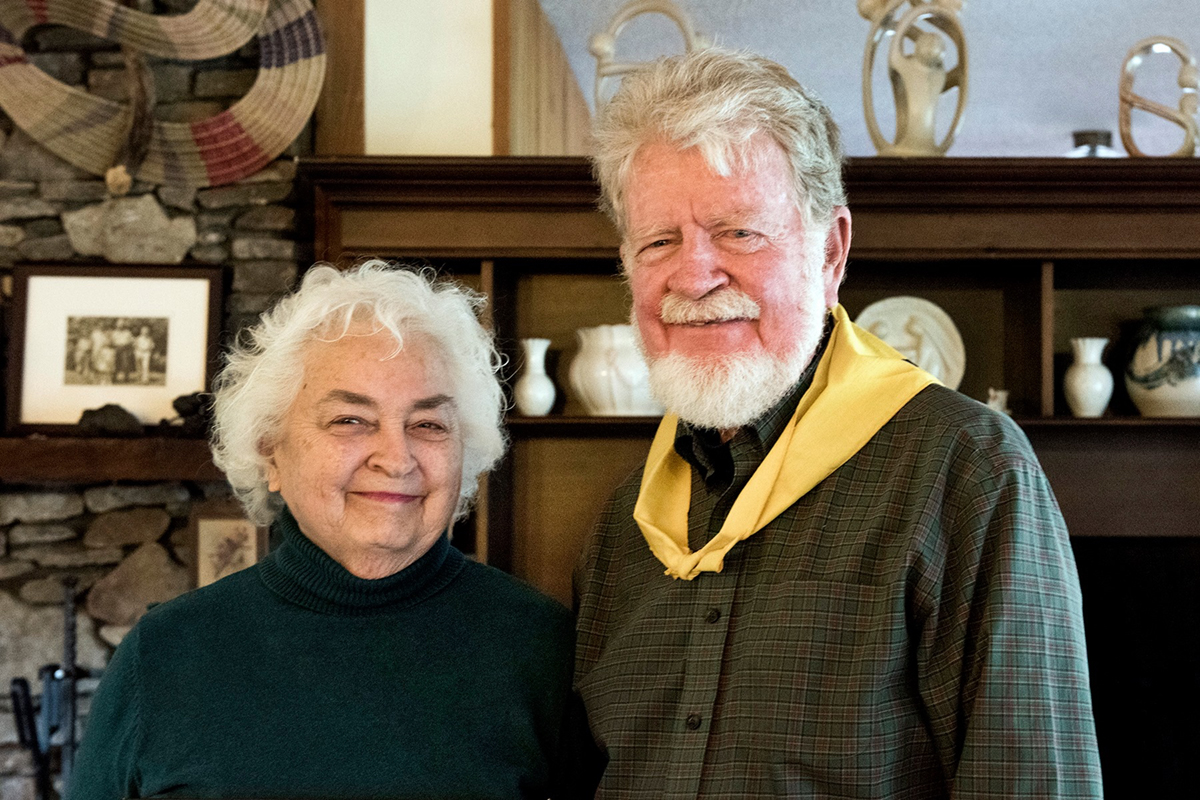
Joanne and Jere Brittain. Photo courtesy of David Weintraub
By Lauren Stepp
In 1966, the Tennessee Valley Authority (TVA) proposed an infrastructure project that would dam and channelize the Upper French Broad River Basin, thereby inundating 18,225 acres of Buncombe, Henderson, Transylvania and Madison counties and displacing 600 families. Citing flood control and improved waste management as key drivers, the TVA rubbed elbows with regional leaders, swaying politics internally and all but demoralizing opposition.
Jere Brittain was not among those subdued. A Western North Carolina native, Brittain dug his heels in and fought back, building a grassroots movement from the river up.
“Everyone told Jere: ‘What the TVA wants, the TVA gets,’” says David Weintraub. “They had never lost a battle before.” Executive director of the Center for Cultural Preservation, Weintraub is producing River Heroes of the South, a documentary that looks at the natural history of our region’s waterways. Set to release sometime next year, the film includes interviews from thought leaders and environmental stewards, Brittain being one.
Raised at the confluence of the Mills River’s North and South forks, Brittain describes the valley in the 1940s and early ‘50s as a “tightly connected community” of about 50 families.
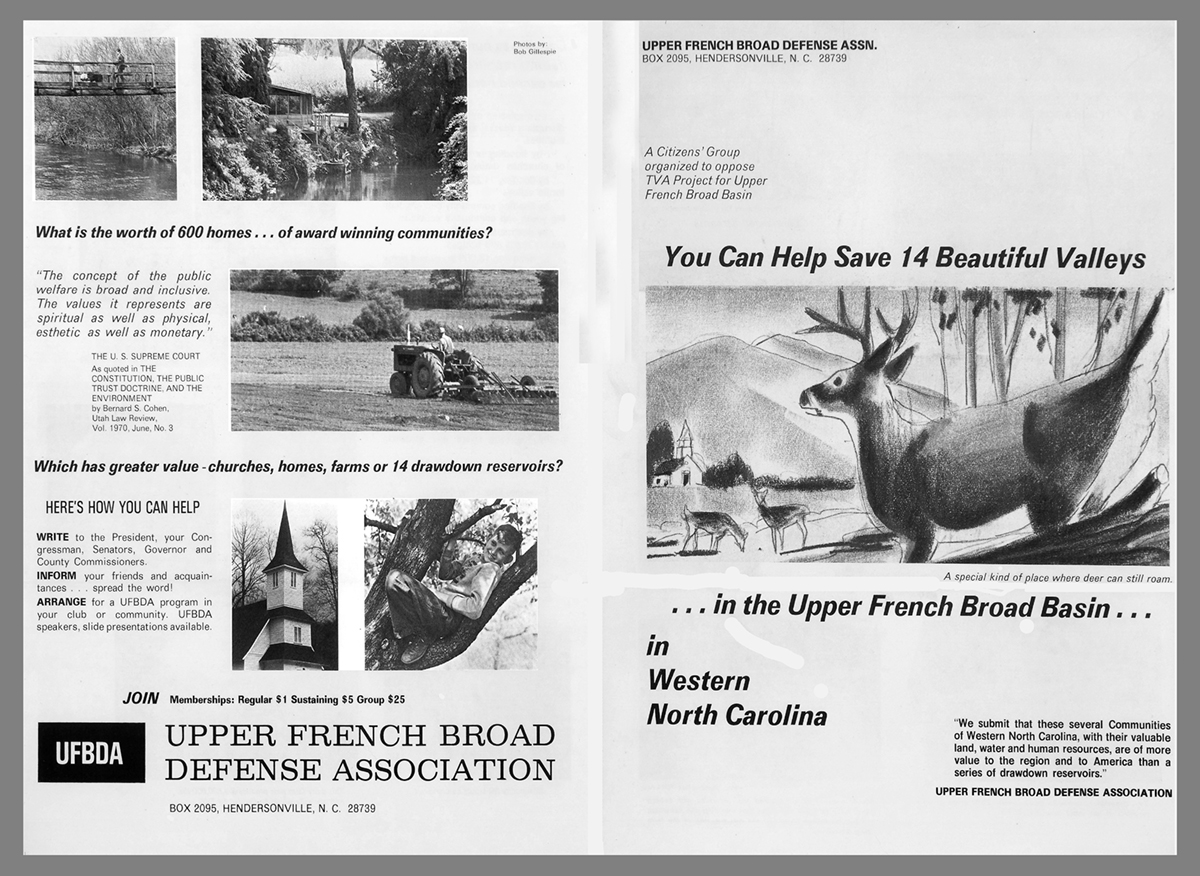
Mailings for the Upper French Broad Defense Association. Photo courtesy of David Weintraub
“Most families operated small farms, and from age eight or so, children were involved with mentoring with adults in farm work, often in the fertile bottomlands beside the North and South forks of Mills River. This resulted in a deeply felt connection with the land and the river,” he writes in his 2016 essay, How a grass roots citizen movement preserved the Upper French Broad River and its 14 major tributaries from a takeover by the Tennessee Valley Authority.
In 1967, just one year after TVA announced the infrastructure project, several small opposition groups coalesced to become the Upper French Broad Defense Association (UFBDA). At its peak, the organization boasted some 1,500 members although, as Brittain shares, the office had its beginnings in his kitchen.
“To say that the early and fragmented local opposition faced an uphill battle would be an understatement,” he continues. “Think: David and Goliath.”
The UFBDA had to be resourceful. Using the National Environmental Policy Act of 1969 as leverage, Brittain called for a public hearing. The TVA conceded to a three-day hearing in August of 1971, but fought dirty. Knowing that more reporters would be present during the first half-day, organizers manipulated the schedule so that only proponents would speak then. This, they thought, would favorably color media coverage.
Brittain’s team caught on.
“One member was a textile worker,” says Weintraub. “She sewed these bright yellow scarves with UFBDA stitched on the back.” When cameras panned the crowd, public opinion was evident.
The TVA backed down not long after the hearing, scrapping their plan in 1973. Though Weintraub describes the battle as one in which “heroes rose to challenges their community faced,” Brittain sees it differently.
“Often good luck works better than best laid plans,” the native, now in his 80s, says. “I think our involvement in the grassroots movement to oppose and eventually defeat this ill-conceived project is a story about our strongly shared sense of place.” And perhaps, more generally, the power of place in Western North Carolina.
For more information on the Center for Cultural Preservation, visit saveculture.org.