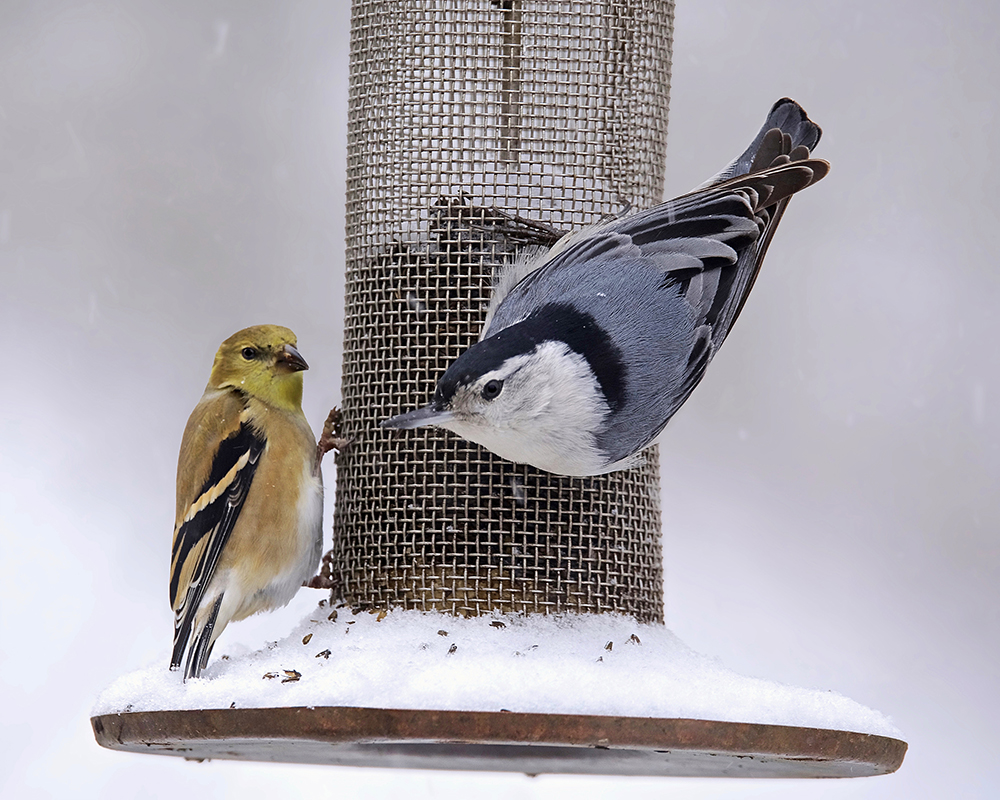
Photo by Warren Lynn
By Laura and Hal Mahan
We have not been feeding the birds. At least not lately. We very much miss it! But Asheville’s neighborhood bears are attracted to bird feeders and, since we reside in the city limits, we have had a self-imposed feeder ban since the end of March.
The other day we started thinking about why we miss it so much. Just, why? For some of us, the act of feeding the birds is so basic to everyday life that we don’t even think about why we do it. It is part of day-to-day home life, and it seems that it has been so since childhood. It is just something that one does without thinking!
According to Wikipedia, one in three American adults feed birds in their back yards. It is the second most popular hobby in our country, after gardening. But, why do we do feed birds? Who started it? How did it become such a common activity?
Henry David Thoreau is said to have been the first documented feeder of birds in the United States, back in 1845, while living at Walden Pond in Massachusetts. He threw out some corn to see what animals would come, and then wrote about it. We recognize Thoreau as a great naturalist and philosopher—a person who lived deliberately, alongside nature. This is increasingly difficult to do in modern times, which is perhaps one reason why we feed birds, to maintain a connection with nature.
Fifty years after Thoreau, it was becoming a common practice to cobble together bits of leftover wood to construct simple platforms and bins for holding seed for birds, which consisted mainly of waste and leftovers from the year’s harvest. In Britain during the harsh winter of 1890-91, national newspapers encouraged people to put out food for the birds, and by 1910 the activity had taken hold.
We might ask ourselves: Are we feeding birds for our own pleasure? Or are we doing it for the altruistic motive of “helping” our feathered friends? And then the disturbing thought arises that, in our attempts to help, we actually might be harming them under certain circumstances.
We do not feel the slightest bit guilty about the pleasure of seeing birds come to our feeders! The fact is that birds spend much of their time searching for food, and if a feeder makes it easier for us to observe them, so much the better. There is little documented evidence of the impact of bird feeding stations on bird populations. Much of their feeding time is spent on natural food sources.
Along with the pleasure, though, comes the responsibility of doing no harm. Provide some cover such as dense shrubs or piles of wood nearby so that birds can escape predators. Speaking of…keep those house cats indoors! According to the American Birding Association, outdoor cats kill approximately 2.4 billion birds every year in the United States alone.
And lastly, keep your feeders clean. Birds feeding in groups at feeders can pass diseases such as salmonellosis, so it’s a good idea to clean feeders with a mild bleach solution every couple of weeks.
Bird feeding represents a basic connection between humans and nature. We happily put our feeder back out today and will enjoy watching, while we keep a wary eye out for the bears!
Laura and Hal Mahan are owners of The Compleat Naturalist, located at 2 Brook Street in the Historic Biltmore Village. To learn more, visit compleatnaturalist.com or call 828.274.5430.