Photo by Jay Worley
By Paula Musto
If a raven tapped at the window, my brother said, he might well sell the house. The remark came after a large black bird appeared in his backyard. Was it a chilling messenger from Poe’s dark tale of lost love? If so, my brother was spooked.
Ravens have long been cast as bad omens, linked to the otherworld and viewed as harbingers of death and the unknown. Each October, they appear in Halloween displays beside witches, scarecrows and skeletons. Yet these mysterious birds are far more than symbols of night, death and the supernatural.
“Ravens are darn smart animals,” says John Koon, president of the Blue Ridge Chapter of the National Audubon Society. “They are compelling birds, closely intertwined with humans throughout history.”
Across cultures, ravens carry complex symbolism. European folklore ties them to cemeteries, battlefields and ghosts. In Norse mythology, Odin kept ravens as messengers from other realms. Among some Indigenous peoples of the American Southwest, ravens are more ambiguous—clever, powerful and sacred, but also dangerous and troublesome.
The legends survive even today. Ravens are among the most famous symbols of the Tower of London. If the ravens ever leave the tower, so the story goes, the British kingdom will fall. To forestall such a calamity, the resident birds are cared for by a special keeper called the Ravenmaster, a coveted position in royal circles.
A combination of high intelligence and human-like traits, Koon says, distinguishes ravens from other birds. Some avian researchers suggest their cognitive abilities rival those of higher mammals such as apes.
Ravens are capable problem-solvers, able to solve puzzles, use tools and cooperate with one another. With remarkable memories, they can recognize individual humans and other animals, distinguishing friends, rivals and potential threats. Perhaps, most notably, their vocalizations are highly varied and sophisticated. The raven’s deep, guttural croak—a low and hollow kronk, kronk—is only one part of its vocal repertoire. Ravens produce a wide range of sounds, including clicks, rattles, gurgles and screams.
“Ravens have an extremely wide variety of tonal vocalizations that can sound almost conversational,” Koon says. “Are they talking? It’s not proven scientifically. But, perhaps they are.”
Poe’s 1845 poem “The Raven” tells the story of a lonely man mourning a lost woman, Lenore. When a raven taps on his window and enters his room, the mysterious bird repeatedly delivers the unsettling word “Nevermore.” Generations of schoolchildren have studied the poem as an eerie ghost story, while adults may experience it as an exploration of grief and mental unraveling. Whatever the interpretation, the poem and, later, a number of films cemented the bird’s association with death, prophecy and the boundary between life and death.
Locally, birders report seeing ravens regularly off the Blue Ridge Parkway around Mount Pisgah and other high elevations in Western North Carolina. The birds prefer rugged habitats with rocky cliffs that are found throughout the Southern Appalachians, but are occasionally seen farther east in the Piedmont area.
The tricky part for casual observers is identifying a raven versus its close cousin, the crow, also a highly intelligent bird with a variety of vocalizations. Both have glossy black feathers, strong feet and sharp claws and similar body proportions when compared to other birds. Ravens and crows both possess excellent flying skills with the ability to soar, glide and maneuver through the air.
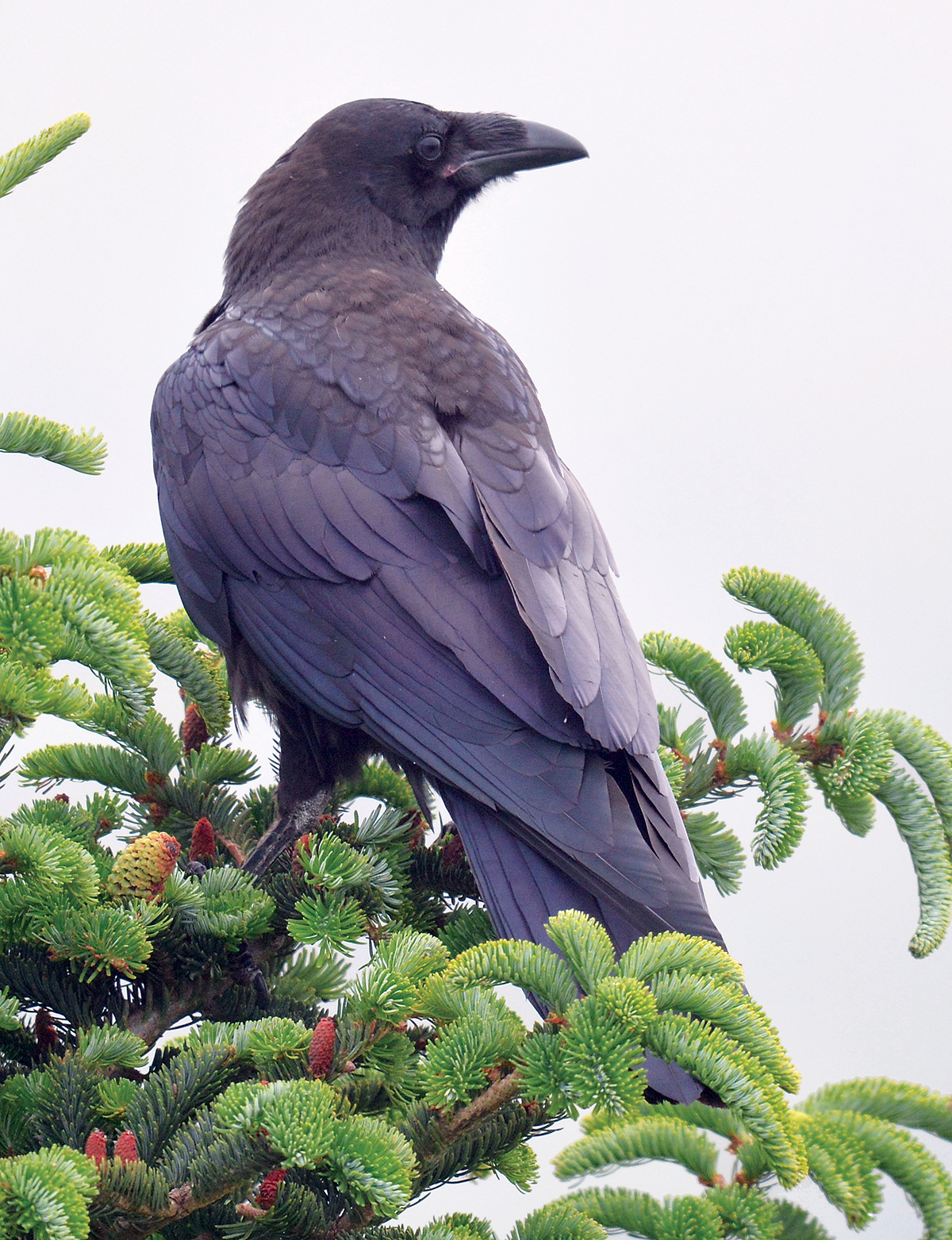
If you view the birds side by side, identifying the species is fairly easy. Ravens are much larger, almost hawk-sized, and have bigger, more curved bills with shaggy feathers and long, diamond-shaped tails. But, when observing birds in flight, even with binoculars, it’s more difficult to distinguish between the two. Clues include the crow’s straighter, thinner bill and shorter, more rounded tail.
Another way to differentiate between the two is to become familiar with their sounds. The American Crow, found in our region, makes a high-pitched and sharper caw-caw sound in fairly regular bursts; the local Common Raven makes deeper, more raspy vocalizations. Ravens are generally less vocal than their nosier relatives and while both species form monogamous pair bonds, ravens tend to be more solitary compared to the highly social crows, often seen in groups.
Finally, check out their flying styles. Ravens are more prone to use air currents for long, smooth glides, while crows tend to rely more on flapping. “Ravens are quite playful,” Koon says. “They are good aerialists who can hold nearly motionless as the current lifts them. They ride the wind rolling, tumbling and somersaulting in the air.”
It is not surprising that these extraordinary birds with their uncanny habits and reputation for cleverness are cast as the mischief-makers and pranksters of lore. Just beware if one comes tapping at your window.
Paula Musto is a writer and volunteer for Appalachian Wildlife Refuge.